


Dear GTM Strategist!
The results are finally in 🥁
Kyle Poyar (Growth Unhinged) and I were working hard for two months to present you with the 2026 State of B2B GTM Report, aimed at answering three main research questions:
What was working best in 2026 go-to-market
What did not work, and
What are the hottest trends and tools to consider for 2027?
300 B2B SaaS and AI companies answered this year, providing a comprehensive sample of AI natives, SaaS, and enterprise participants. Thanks a million to everyone who took the time to pitch - we could not have done it without you 🙏
You can go ahead, grab the report here and dive in yourself:
(41 pages of stunning insights that are pure gold for your slides and content strategy)
We put a lot of work and resources into these reports. Last year, the report was for paid subscribers only, but this year, thanks to our partners who helped bring it to life, it's free for everyone.
Presenting partner

Ploy is the marketing platform that turns your website into an always-on growth engine. Try it for free.
Gold partners

Sumble - High precision GTM data + intelligence.
Primer - Target your ICP across LinkedIn, Meta, Google, Reddit, and more - measure performance and know what to do next.
Silver partners
With gratitude to our silver partners Salesforge (AI outbound platform), Passionfroot (B2B creator marketing platform) & Bryn by Civic (signal-based GTM agent).
Thank you for supporting the GTM community and making this work possible.
In the report, you’ll see two main teams:
AI started to pay off. 43% of GTM teams now report a big impact from AI. A year ago it was 24%. I could not be happier about this. It seemed like 2025 was the year of “doing more and experimenting”, and 2026 became the year of focus, ROI, and scaling.
Relationships became more important. Founder-led sales is the most common primary GTM motion (26%), and network and intros are the #1 channel, with 62% of companies calling it core.
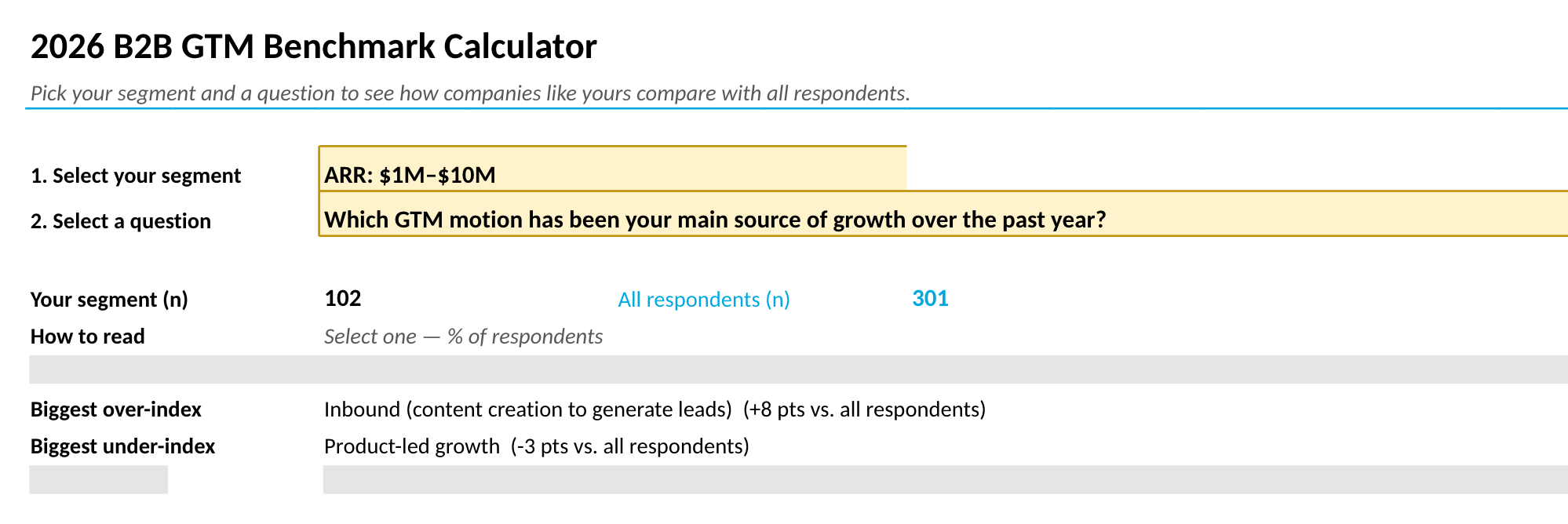
At the end of the post, you’ll find a special bonus for paid subscribers: a benchmark calculator that enables you to compare the benchmarks for your ACV or ARR ranges.
1. Which GTM motions work in 2026
Last year we worked with six GTM motions, and this year we added founder-led sales as the seventh, which went straight to the top with 26% of companies naming it as their primary motion, ahead of inbound (19%), outbound (18%), partners (11%), account-based (10%), product-led growth (9%), and paid digital (7%).
Which motion leads depends on how big you are and how big your deals are:
Under $1M ARR: founder-led (44%), then outbound (17%).
$1-10M ARR: inbound (28%) passes founder-led, but only by two points (26%).
$10-50M ARR: outbound (20%), then inbound and paid digital (16% each).
Above $50M ARR: inbound (24%), outbound (22%), and PLG (18%).
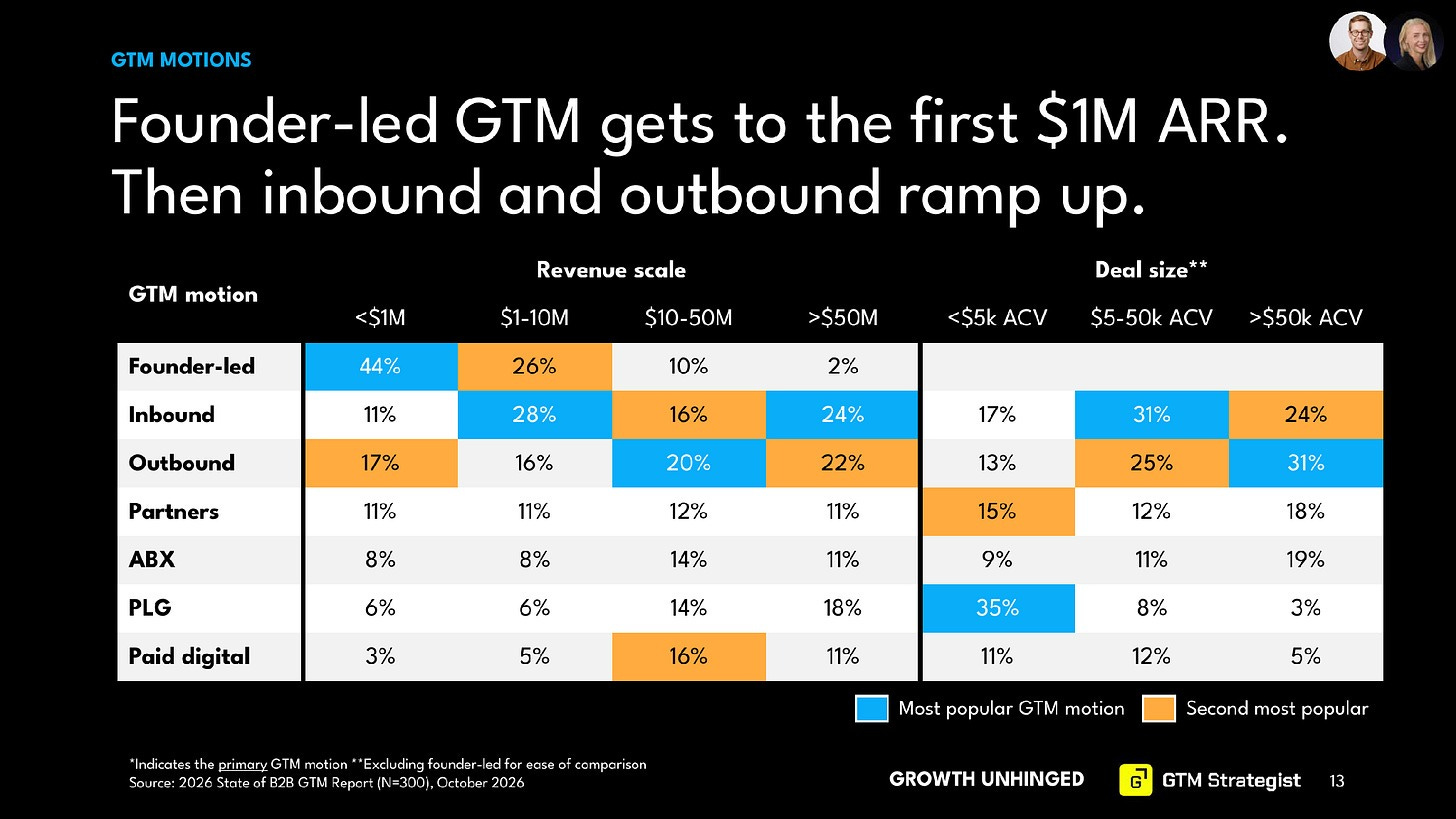
By deal size, PLG is still the #1 motion for products under $5k ACV (35%), inbound leads between $5k and $50k (31%), and outbound leads above $50k (31%).
If we take founder-led out to compare with last year, inbound (23% to 26%), outbound (19% to 24%), and partners (10% to 15%) went up, while account-based (18% to 13%) and PLG (18% to 12%) went down. The 44% of founder-led companies under $1M ARR did not surprise me, but 26% at $1-10M ARR did. How many of those founders planned to still be the main sales channel at $5M ARR?
2. The channels: what pays off and what does not
The average B2B company now runs 5.5 core channels, up from 5 last year. So which of them are worth the effort? Take a screenshot of this one 📸
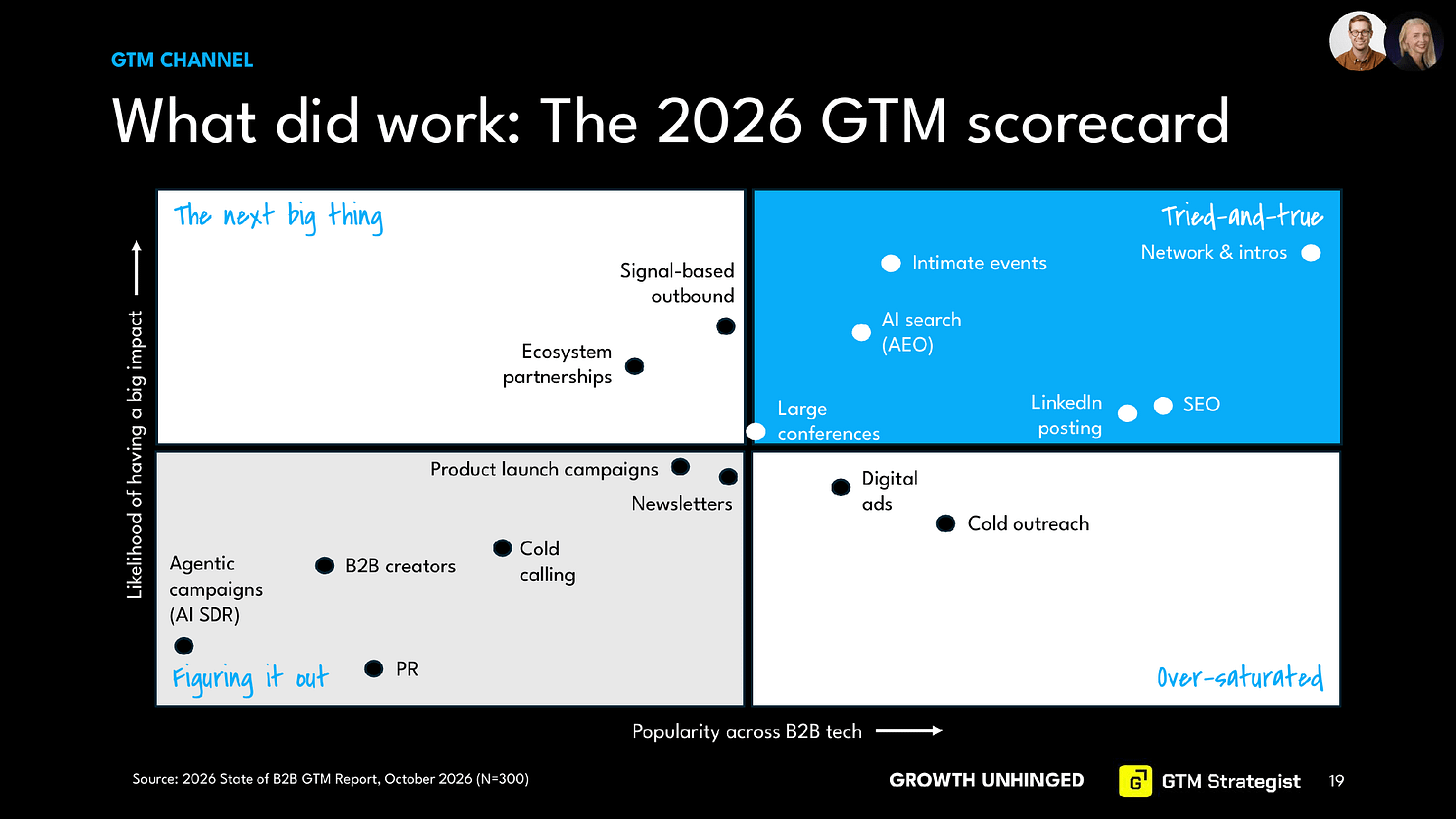
Tried-and-true (popular and likely to have a big impact): network and intros, intimate events, AI search, SEO, and LinkedIn posting. Large conferences sit on the edge of this box.
The next big thing: signal-based outbound and ecosystem partnerships.
Oversaturated: digital ads and cold outreach.
Figuring it out: product launch campaigns, newsletters, cold calling, B2B creators, PR, and at the very bottom left, agentic campaigns (AI SDR).
Two big outliers there: AI search (AEO) is up by 11 points, and 39% of companies now call it a core channel. Last year it was the channel where the most teams planned to invest more, and I named it as one of the two fronts for my own experiments, so I am happy that it moved from “figuring it out” to tried-and-true in twelve months.
Large conferences went the other way, down by 13 points, which is the biggest drop of any channel we measured in both years, with one important caveat: on the chart below, you see that large conferences are alive and well for larger deal sizes.
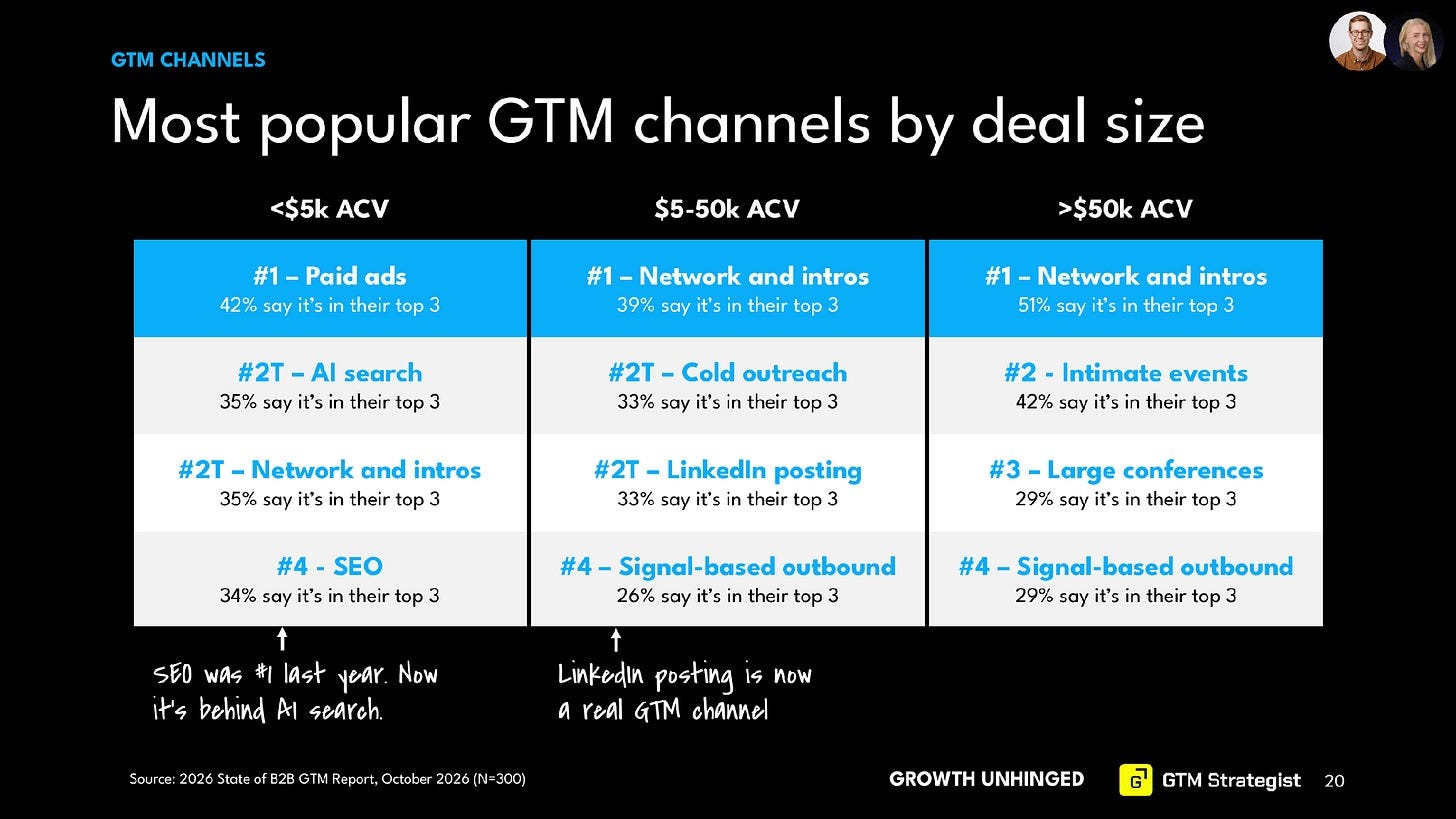
Under $5k ACV: paid ads are #1 (42% have them in their top 3), and AI search (35%) passed SEO (34%), which was #1 in this group last year.
$5-50k ACV: network and intros (39%), then cold outreach and LinkedIn posting (33% each). LinkedIn posting by founders and employees is now a real GTM channel.
Above $50k ACV: network and intros (51%), intimate events (42%), and large conferences (29%).
In the full report, you’ll also find a breakdown of the most popular GTM channels by company size.
“Network and intros” is in the top 3 from the first dollar up to $50M ARR, and in every deal-size group. I think that is the strongest result in the whole report. If intros are your best channel, what is your system for getting more of them?
Now follow the money. This is where teams plan to invest more in 2027:
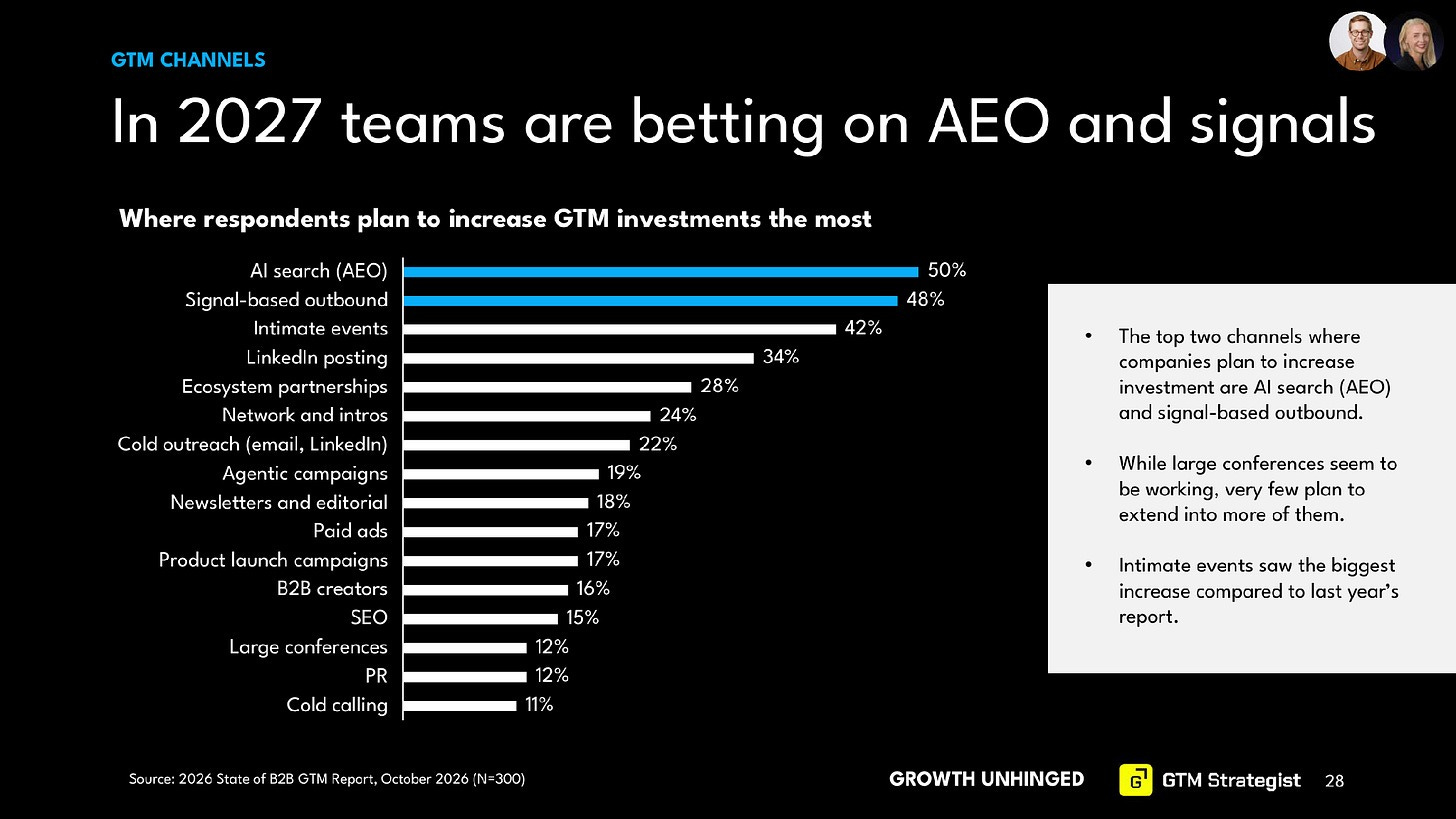
In the report, you can also check 2027 channel bets by company size.
From $1M ARR up, the top 3 is the same in every group: AI search, signals, and intimate events. Which of the three is already in your 2027 plan?
A short note on paid ads, because our partner Primer added live spend data from 379 B2B advertisers. The median monthly paid budget is $5,400 at $1-10M revenue, $14,000 at $10-50M, and $63,000 above $50M. Only 3% of teams that run paid campaigns use ChatGPT Ads today, but 39% plan to try them in 2027, and the first reviews in our survey are not great (”terrible costs, no lift over AEO”).
3. AI finally shows ROI
Last year I called this part “time to show some ROI, baby”, and this year the ROI showed up:
43% of teams now report a big impact from AI. Last year it was 24%.
Only 4% report no impact at all. Last year it was 22%.
Little to no impact combined went from 53% to 28%.
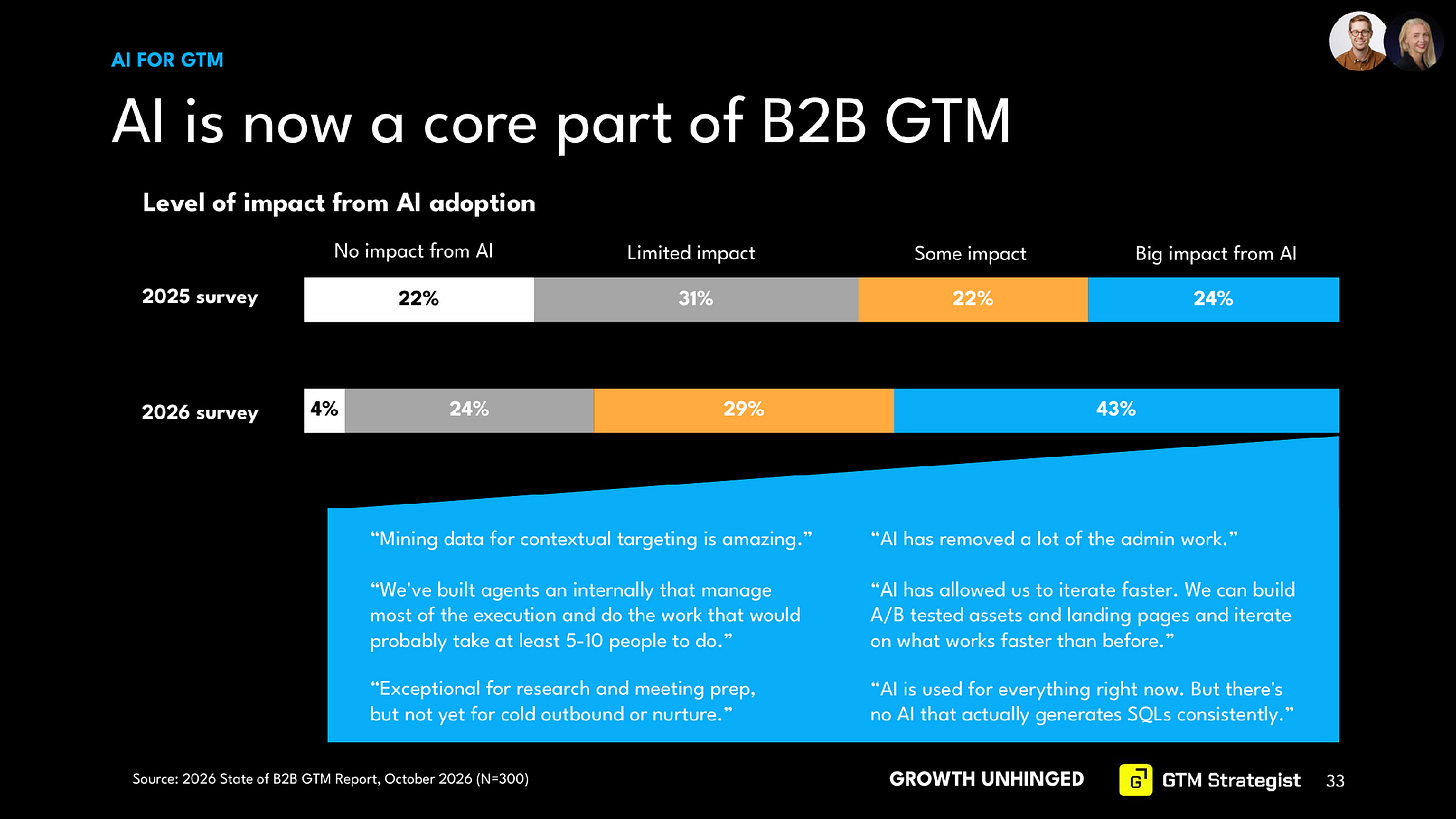
One respondent wrote: “We’ve built agents internally that manage most of the execution and do the work that would probably take at least 5-10 people to do.” Another one set the limit: “AI is used for everything right now. But there’s no AI that actually generates SQLs consistently.” I think both can be true in the same company, and probably are in most of them.
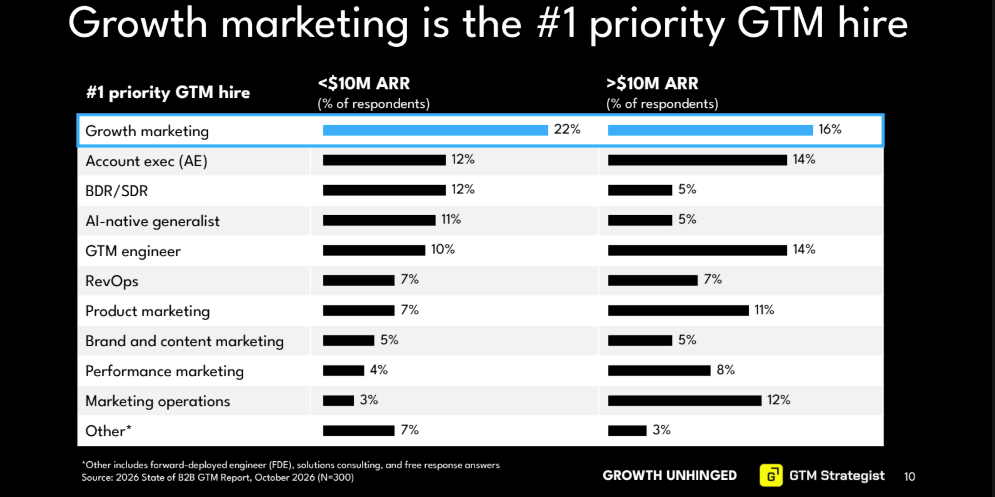
You can see the change in hiring plans too. Growth marketing is the #1 priority hire for companies of every size, but above $10M ARR the GTM engineer (14%) is now tied with the account executive for second place, and under $10M ARR 11% of companies want an “AI-native generalist” as their next GTM hire, nearly the same as a BDR/SDR (12%). Who is your next GTM hire?
4. The GTM tools of 2026: most impactful, must try, and what dropped out
Same as last year, we asked about tools in two ways: which tools have the most impact for you now, and which ones are a “must try”.
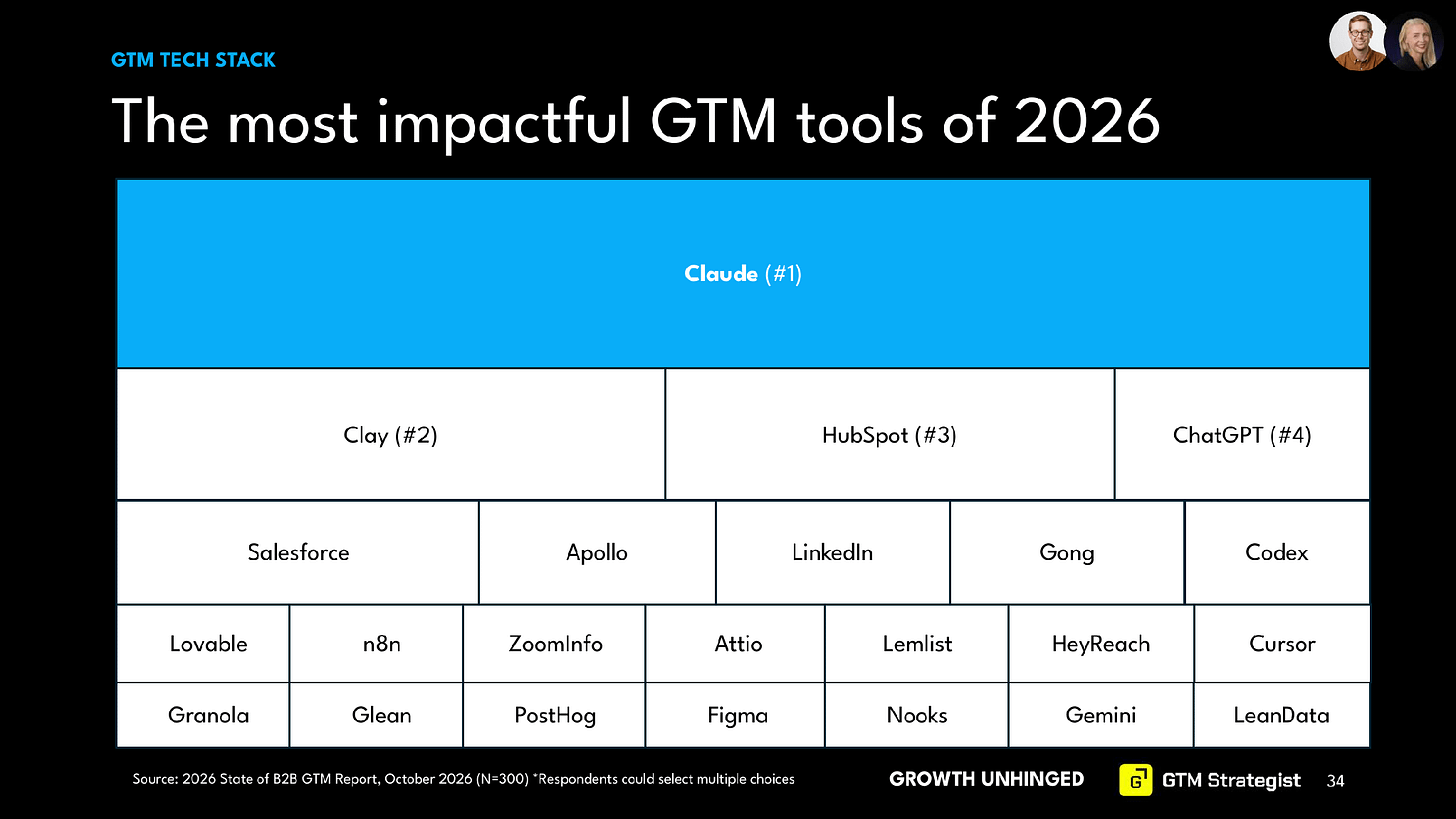
Claude is the most impactful GTM tool of 2026. It was #4 last year, and ChatGPT, which was #1, is now #4. Clay moved up to #2 and HubSpot is #3. Salesforce, Codex, and Lovable are new in the top 10, and Notion, 6sense, and n8n dropped out of it. Last year, this entire section was dominated by GPT. This year, Claude really outshined it in GTM use cases, but Team OpenAI is preparing a big comeback in Q3. Some claim that Codex is a superior coding tool to Claude Code. However, time will tell what’s actually valuable.
The biggest key takeaway this year is probably to keep your options open and to make sure that your context is transferable enough if you would have to change to the new tools. Everybody is doubling down on vendor-locked-in AI, aka modes, but since tools are evolving super fast, I prefer to have my options open.
In April I wrote that I run Claude Code as my GTM operating system, and I shared how to build your own GTM repository [LINK: The GTM Repository for Claude Code]. Seeing Claude above ChatGPT, HubSpot, and Clay six months later still surprised me.
The “must try” list is where it gets interesting, because 7 of the top 10 tools were not there a year ago.
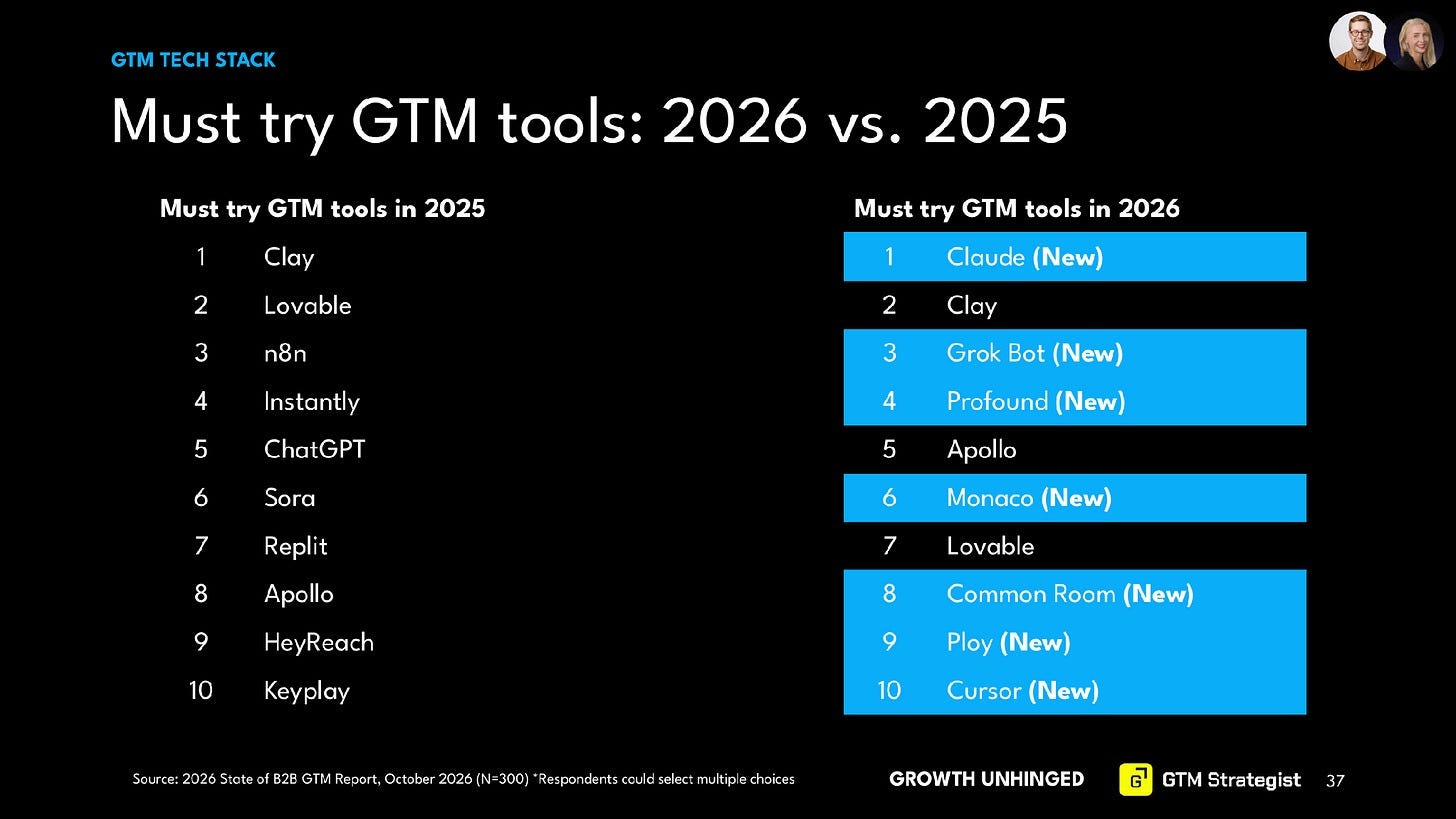
Must try in 2026: Claude (#1, new), Clay (#2), Grok Bot (#3, new), Profound (#4, new), Apollo, Monaco (new), Lovable, Common Room (new), Ploy (new), and Cursor (new).
Stayed in the top 10: only Clay, Apollo, and Lovable.
Dropped out of the top 10: n8n, Instantly, ChatGPT, Sora, Replit, HeyReach, and Keyplay.
Last year I wrote that the GTM tech that got us here won’t get us there. Our landscape is changing fast. Best-in-class companies are always experimenting with new tools and typically allocate 10-30% of their AI budgets to experiments.
Our predictions for 2027
2027 will be a wake-up call for GTM budgets, because AI adoption went fast and next year somebody in finance will ask what it costs - and how it impacts the pipeline. And positioning and messaging is the next battleground: every company sounds the same, customers are tuning out, and being great at AI will not help much if the pitch does not land.
“If you feel like your messaging isn’t resonating, you’re not speaking to enough customers. The voice of your customer is your messaging. Customer marketing should be leading your GTM strategy, from positioning down to content pieces that feed every stage of the funnel across every channel.”
Bryant Chou, Co-founder, Ploy
What I shared here are my key takeaways. Kyle went deep into his analysis on Growth Unhinged. The full report is 41 slides, with ROI heatmaps for all 16 channels by deal size and by company size, the signals that GTM teams act on, and the paid ads data - and you can get it FREE:
One of the most frequent issues when we are consuming these reports is applying them to your specific use case. This year, we wanted to make sure that we give you a special tool in which you can easily navigate to exact findings and recommendations that are applicable directly to your company.
So here’s a special bonus for my paid subscribers - a benchmark calculator where you can play around with the data and compare the benchmarks for your segment:
Huge thanks to Kyle Poyar for another year of this research, to our partners, and to all of you who participated in the survey.
What surprised you? What do you see differently in your business? Let me know in the comments.
This is 🪙🪙🪙🪙🪙 canceling plans for tomorrow to dive deeper into the report 😁
Loved the webinar! I stayed for 5 min and already got more on those 5 min than any other webinar this year! superb work Maja and Kyle