



This newsletter is supported by Attio, the AI CRM.
I helped build something every founder should have in their toolkit.
GTM Atlas is a free resource for early-stage teams building from scratch, and I wrote an entry on building a GTM brain that gets smarter over time, using context engineering to make AI permanently smarter about your ICP.
With Atlas, you’ll get a point of view on your growth strategy, frameworks you’ll return to, and the creative latitude to build the right motion for your business, not someone else’s.
Wherever you are, Atlas was made for you.
Mapped by operators. Curated by Attio.

Dear GTM Strategist,
Lately, we have been so deep in Claude that we might have slightly neglected the “strategy part” of the go-to-market strategy in our conversations.
Reality check:
If we spend all our time copying each other’s repos, workflows, and skills- who is really driving our GTM? AIs?
Time to take a mini break from terminals and .md files and shift our focus from how to do X (tactics) to what to do (strategy) instead.
As the world shifts into the third wave of AI and AI-native companies disrupt our imagination of what can be done in record time with a handful of people (and agents), it is harder than ever to stand out, stay relevant, and build any moat.
To sharpen our strategic muscle, I curated 3 thought-provoking ideas from GTM Atlas:
Your product is the pitch by Elena Verna
Your website is middle of the funnel now by Emily Kramer
An AI’s job is to remove wasted motion by Kyle Norton
Some snippets made me feel really uncomfortable (no spoilers), which is the whole point of learning something new.
My sole intention for this piece is to slightly provoke your mind, prompt you to think differently, and arm you with relevant insights that could help you build a more effective GTM system.
Let’s see if I can make it happen.
Here are the big ideas I hand-selected for you:
1. Your Product Is the Pitch

Author: Elena Verna, Head of Growth at Lovable
The companies winning right now are giving the most away upfront - product, access, experience - before asking for anything in return. Decision makers (CISOs, CTOs, VPs) are doing their own evaluation. If you’re not letting them touch the product, you’re already out.
But here’s the part I keep coming back to.
“Stop trying to minimize the freemium. Treat it as the line item that replaces your Google and Meta spend.”
Lovable gives away millions of dollars of software every year. Hackathons, schools, book clubs - no requirements, no forms. Elena says it’s their best acquisition channel by a significant margin compared to any paid spend they do.
This is a complete reframe of how most founders I talk to think about freemium. They treat free usage as a leak to plug. Elena treats it as a marketing budget. Same dollar amount, totally different mental model.
A few other ideas from her chapter that I dog-eared:
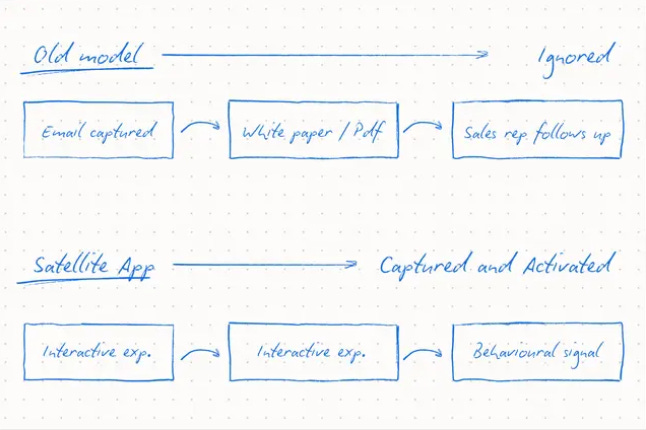
Satellite apps are replacing gated PDFs (and that is great for AEO 👌). Nobody wants to trade their email for a whitepaper anymore. Elena is seeing a rise in interactive, clickable mini-apps - real experiences with a back-end, where prospects enter their own information and get something useful back. It puts marketing in an engineering position, but the engagement is incomparable to flat content.
Build in public is now an acquisition channel. When software becomes commoditized, what differentiates you is the team building it. Lovable’s first few million in ARR came largely from their CEO being publicly transparent about what was working and what wasn’t. Founder social brand is no longer a vanity project.
AI agents are part of your ICP now. This one stopped me cold. Elena’s hypothesis is that B2B software is evolving to be consumed by machines, not humans. Humans will own the agent interface. Agents will perform the tasks. Your future buyer profile includes the machines doing the work.
If you’ve been treating PLG as something you’ll get to “after we lock in sales-led motion and start generating predictable revenue,” this chapter might make you feel uncomfortable. Which is the point. In the AI-first GTM world, speed is of utmost importance.
2. Your website is middle of the funnel now

Author: Emily Kramer, founder at MKT1
I’d never say that marketers are lazy. They are usually one of the hardest-working people I see in the organizations we work with. But all the busyness could be a trap! Many of them are so busy thinking about the next campaign, event, and webinar that they fail to see that the nature of their work has changed tremendously. The big question here is - are we busy doing things that still work?
Emily Kramer placed a fair warning: RAM - Random Acts of Marketing. It’s what happens when teams have access to more tools, more channels, and more AI-assisted ways to create content than ever before, and they respond by just doing more of everything. Copying what other teams do. Saying yes to every founder request. Never stopping to ask which box is actually worth checking. Emily’s argument is that the teams pulling ahead aren’t doing more. They’re doing less, better. How?
Her solution is the gen marketer: a generalist who can orchestrate across all the marketing sub-functions, run “fuel + engine” campaigns (where fuel is the content and engine is how you distribute it), think in big bets that differentiate, create leverage by tapping into ecosystems, and is genuinely fluent in generative AI workflows. The big question here is not how to do more, but how to extract more value from what we are already doing.
Of course, you want an example: The role of the website in the AI-first GTM world.
LLMs scour the internet and find your pricing, whether you put it on the page or not. Traffic is fundamentally lower because people are getting answers from chatbots before they ever click through. So when someone lands on your site as an arguably higher-intent lead, the stakes for converting them are higher than ever. Emily offers some practical tips: Stop gating. Put pricing in a structured format. Put meeting booking in the demo flow. The website is no longer where you figure out who your customer is - you should already know.
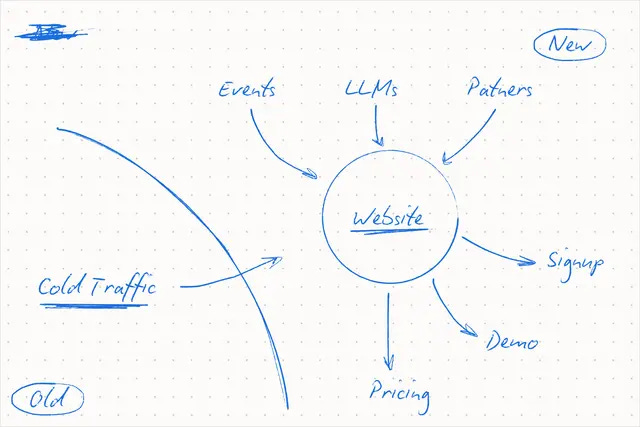
And this change has two massive implications for GTM down the line:
Accounts before contacts. Emily is direct about this: we’re so obsessed with leads that we don’t think nearly enough about the accounts we want. It’s a multi-person sale. Stop net fishing. Do account research, niche down, and systematically pursue the ones that fit. Stop thinking about lead capture and qualification - start thinking about which accounts are even aware of you and what stage they’re at.
Kill MQL and SQL. When you’re going after whole accounts with multiple stakeholders, MQL/SQL labels create territorialism between marketing and sales that’s completely unnecessary. The buying journey isn’t linear. These are milestones, not handoffs. The fight over “marketing didn’t deliver enough” vs. “sales isn’t converting enough” is a distraction from the actual job: getting qualified, hand-raising buyers and going full force on them together.
Maybe sales and marketing will finally become best buddies in this new world … or maybe agents will take over the customer journey - who knows.
3. AI’s job is to remove wasted motion

Author: Kyle Norton, CRO at Owner.com
And for those two who are 🥱 - too much growth and marketing - Kyle comes to the rescue with some thought-provoking numbers 🍽️ next:
“Our ACV is only $8 to $10k, so how do you make cold outbound work in that world? By obsessing over the quality of the data, and stripping every wasted motion out of your rep’s day.
Outbound won’t work if your BDRs are spending 70% of their day researching leads and calling contacts who aren’t the real decision makers. You can maybe book a meeting every two days. You press reps so hard on a dial number of a few hundred a day that they can’t find enough high-quality leads to hit it. If you tiered those leads, 25% might be A, 50% B, 25% C. Tier C is who you will never close. The dial number gets hit, but you’ve wasted your time.”
What did Owner do about it? They built what Kyle calls AI PCR - pre-call research - that captures everything between calls automatically. Their outbound BDRs now make 150 to 250 calls a day and stay hyper-prepared throughout. Kyle’s top BDR last month generated $174K in closed-won ARR. Cold. The historical average was $72K per rep per month. They’re now at around $120K per BDR. How? By centralizing AIs.
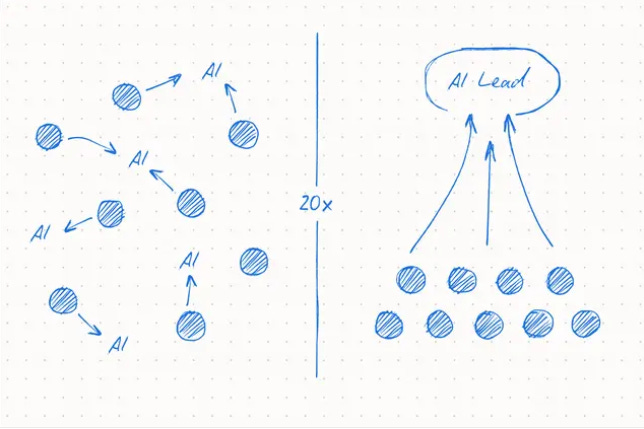
A lot of teams think the answer is giving every rep their own Claude skill and letting them generate their own lead lists. Kyle says no. One specialist owns the system, builds it to production quality, and deploys one version at scale. Expert vs. non-expert in applied AI isn’t 50% better or 100% better - it’s 20x better. You need the expertise concentrated, not scattered.
Your AEs don’t need to be AI-savvy. This was the most controversial line in his chapter. Kyle wants to encourage AI fluency everywhere, but he’s clear: making your AEs better at AI doesn’t move the needle the way people assume. Fixing the data and the system does.
A lot of that gain didn’t come from better scripts. It came from giving reps only the leads worth calling.
If you’ve been telling yourself that hiring more BDRs is the answer to your pipeline problem, this chapter is going to be uncomfortable reading. In the best way.
What All Three Have in Common
When I finished the Atlas, I noticed something: Elena, Emily, and Kyle are talking about completely different parts of the funnel - capture, qualification, outbound - but they’re saying the same thing.
Stop adding more. Start removing waste.
Elena: stop minimizing freemium, give away the product so the buyer can actually feel it
Emily: stop running random acts of marketing, pick fewer bets and make them count
Kyle: stop cranking dial volume, fix the data so reps only touch leads worth calling
The 2026 GTM AI playbook isn’t about doing more things faster with AI.
It’s about using AI to strip everything that doesn’t compound.
The teams that figure this out first are the ones we’ll be writing about next year.
The full GTM Atlas has six more chapters I haven’t covered here - Nicolas Sharp (Attio’s founder & CEO) on why there is no universal playbook, Roniesha Copeland (Vercel) on building the system before the message, James Pastan (Framer) on activation, Rati Zvirawa (Intercom) on letting AI own (not just assist), Josh Epstein (Coder) on retention as a culture problem, and yes, my chapter on building a GTM brain.
It’s free, non-gated, beautifully designed, and definitely worth your time.
I read it twice. Your turn.
Talk soon,
Maja

✅ Need ready-to-use GTM assets and AI prompts? Get the 100-Step GTM Checklist with proven website templates, sales decks, landing pages, outbound sequences, LinkedIn post frameworks, email sequences, and 20+ workshops you can immediately run with your team.
📘 New to GTM? Learn fundamentals. Get my best-selling GTM Strategist book that helped 9,500+ companies to go to market with confidence - frameworks and online course included.
📈 My latest course: AI-Powered LinkedIn Growth System teaches the exact system I use to generate 7M+ impressions a year and 70% of my B2B pipeline.
🏅 Are you in charge of GTM and responsible for leading others? Grab the GTM Masterclass (6 hours of training, end-to-end GTM explained on examples, guided workshops) to get your team up and running in no time.
🤝 Want to work together? ⏩ Check out the options and let me know how we can join forces.
Thanks for including me in this one!