



This newsletter is supported by Swan AI, the AI GTM engineer.
Swan helped build something every GTM team should have in their toolkit.
GTM Skills is a free, open-source library of go-to-market skills - built with Pavilion and GTM Engineer School, and signed by the operators who got real results running them.
With GTM Skills, you get the actual system an operator ran - not a framework slide, not a prompt someone typed once. Install it, run it, and it executes the same way every time.
Wherever your stack lives - Claude Code, Cursor, Codex, or Swan - GTM Skills was made for you.
Human-crafted. Community-run.
Dear GTM Strategist,
If you’re like me, you’ve probably spent the last couple of years obsessing over prompts. Better prompts, longer prompts, prompts stolen from someone else’s LinkedIn post.
But here’s the thing.
A prompt is just a suggestion. It’s advice you give your AI once, and hope it does the right thing. That’s not a system - that’s you, doing the AI’s job for it, one chat window at a time.
The GTM operators pulling ahead right now are no longer working on better prompts. They’re engineering skills - reusable playbooks that their AI agent executes the same way every time.
I spent this week going through GTM Skills, an open-source, community-built skills library built by Swan in collaboration with Pavilion and GTM Engineer School. Some of what I found made me rethink things I thought were settled (pricing, account scoring, cold outbound) - which, as always, is the whole point.
Here are 5 skills I hand-picked for you.
In this post, you’ll learn:
Why your ICP should refine itself against real win/loss data, not sit on a slide from last year’s offsite - from Ido Goldberg (Co-Founder & CPO, Swan AI)
The R.E.P.L.Y. framework behind cold email that earns replies instead of just opens - my own system, finally turned into something your AI can run
What actually separates a good sales call from a wasted one, from Kevin “KD” Dorsey (CRO, LeanScaper)
Why your data warehouse should be talking to your GTM tools, not just sitting there, from Austin Hay (Operating Partner, Khosla Ventures)
Bonus: How to prove what your AI agent delivered before the renewal conversation gets awkward, from Manny Medina (Co-Founder & CEO, Paid)
Let’s see my picks in action.
1. Define/Refine Who You Sell to
Author: Ido Goldberg, Co-Founder & CPO at Swan AI
Most ICPs I’ve seen are no more than a slide someone built to present once during a strategy offsite. After that’s done, they just sit there collecting dust and never get checked against what’s actually closing. Every quarter it stays wrong is a quarter of ad spend, outbound, and rep hours pointed at the wrong accounts.
Ido’s ICP skill fixes that by pulling your last 6 months of closed-won and closed-lost deals and holding the pattern up against what you say your ICP is - industry, company size, funding stage, geo.
The single most important output is the place where actual wins disagree with the stated ICP. Lead with that.
That’s the part that stood out to me. Not “here’s a fresh ICP” - a contradiction report, in the numbers that pay your reps’ quota. Where you’ve been telling the team to chase 1,000+ employee companies, but the wins concentrate under 200. Where losses cluster in an industry your ICP doesn’t even mention - which means your team’s been burning cycles on deals that were never going to close.
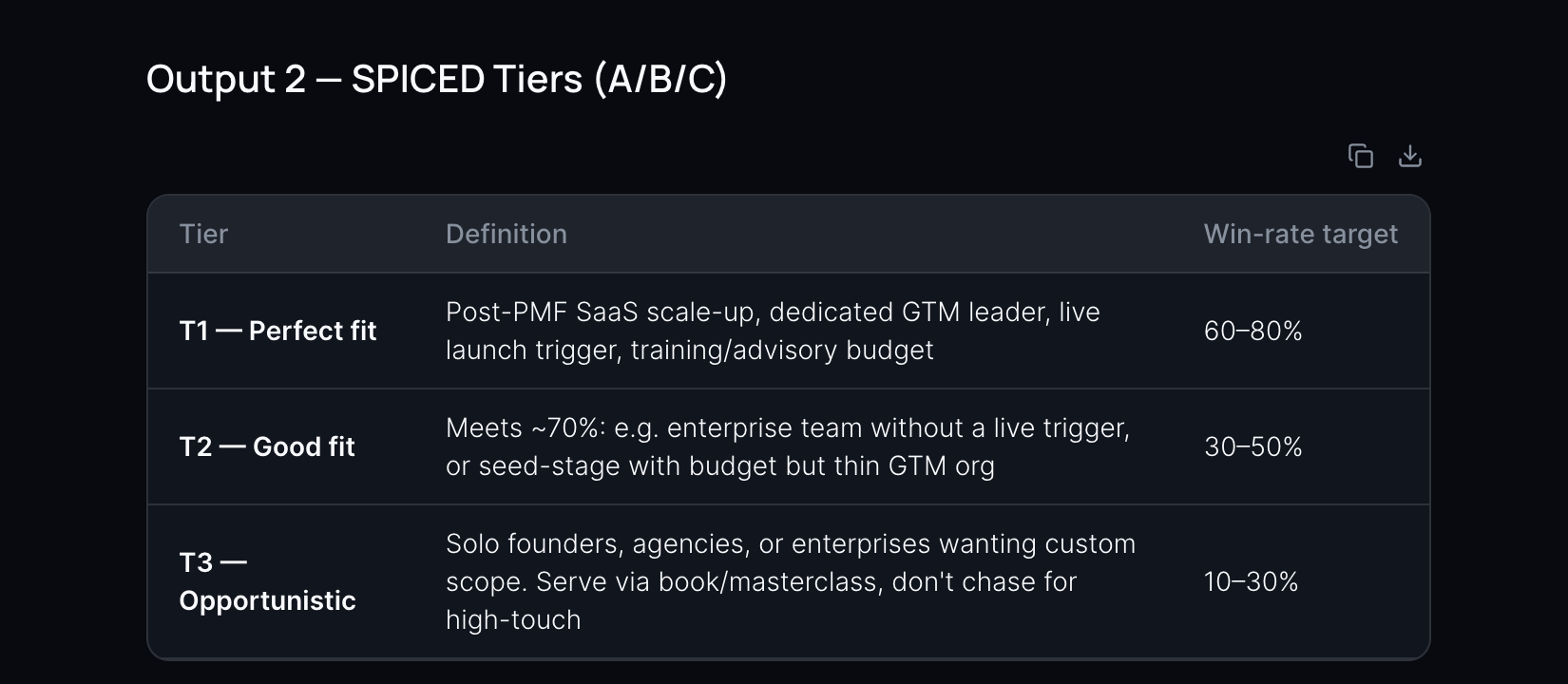
A few rules baked into how it works:
Never fewer than 10 closed deals. Below that, it won’t refine - the signal is noise.
Max 3-5 proposed changes per pass. More than that means you don’t need a refinement; you need to start over.
Approve each change. Every new segment or persona edit gets shown back before it’s written anywhere.
If the data says your ICP already holds, the correct output is “no meaningful drift.” Inventing changes to look productive is treated as a failure mode, not a feature.
2. Write Value-First Cold Email That Earns Replies
Author: Maja Voje, Founder at GTM Strategist (hi, it’s me 👋)
Full disclosure: this one’s mine, so take the enthusiasm with a grain of salt.
My Outreach Messaging skill is built on the same campaign structure that generated $1.5M in pipeline for one client. It’s based on one idea: give before you ask. Every cold email has to give the reader something real - an insight, a benchmark, an ungated resource - whether or not they ever write back.
The reply is what you earn after you’ve already been useful.
That’s the whole philosophy in one line. It’s built around a framework I call R.E.P.L.Y.:
Relevance - a real why-now, not “hope you’re well”
Empathy - their pain, in their words, not your product’s words
Payoff - the value, delivered in the email, not promised on a call
Low-friction ask - one question a phone can answer in one line, not a 30-minute booking
You-focused - count the “you”s vs. the “we”s. If “we” wins, rewrite it.
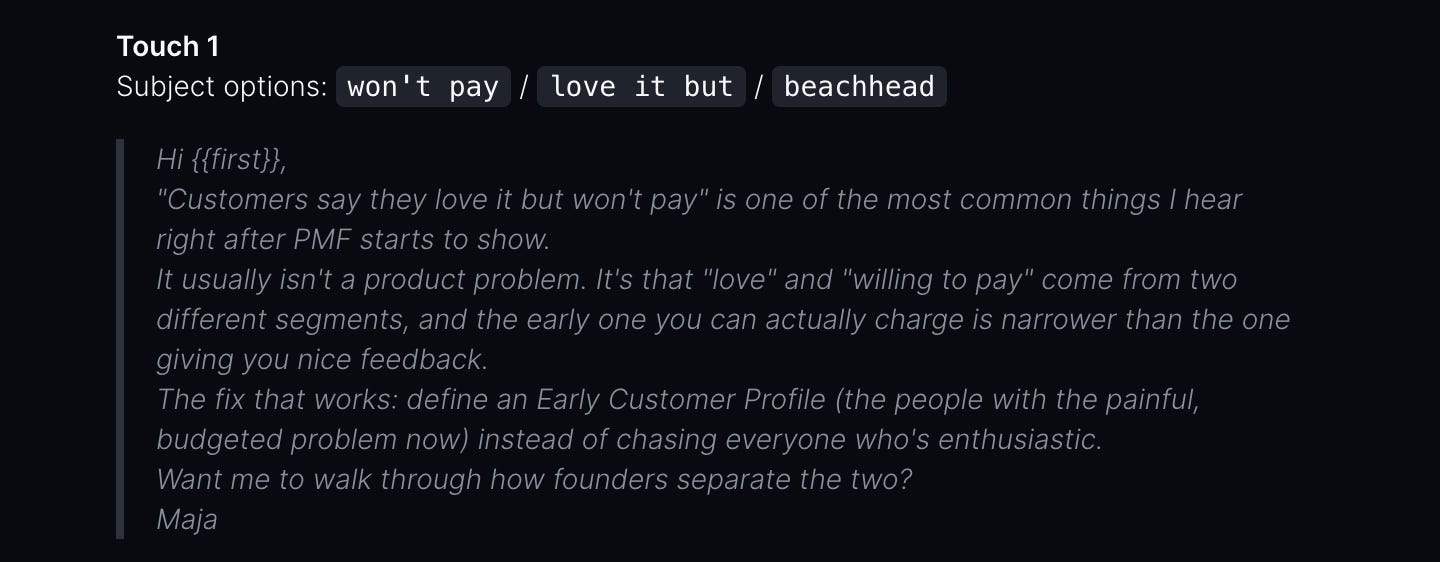
The test I run on every draft: if they read it and did nothing else, was it still worth 20 seconds of their time? If deleting your email costs them nothing, you sent a pitch, not value - and pitches are exactly what’s flooding every inbox right now, which is why they don’t convert.
3. Build Behavior-Based Scorecards for Each Conversation Type
Author: Kevin “KD” Dorsey, CRO at LeanScaper
Ask five managers what a good discovery call sounds like and you’ll get five different answers - and a rep who has no idea which one they’re being graded against this week.
KD’s Call Scorecards skill turns “what good looks like” into 10-15 observable, gradeable behaviors for any call type. This applies to prospecting, discovery, demo, pricing, close, and more. Every score needs a moment in the transcript that earned it.
Weak programs grade on vibes (”felt good energy”), roll out a 40-item card nobody uses, or score calls without ever practicing the misses.
That single rule is why this works where most scorecards don’t. “Good energy” doesn’t localize a rep’s problem. “Never found out what matters to the decision-maker - scored 1” does, and it tells the rep exactly what to go fix before their next call instead of after they’ve already lost the deal.
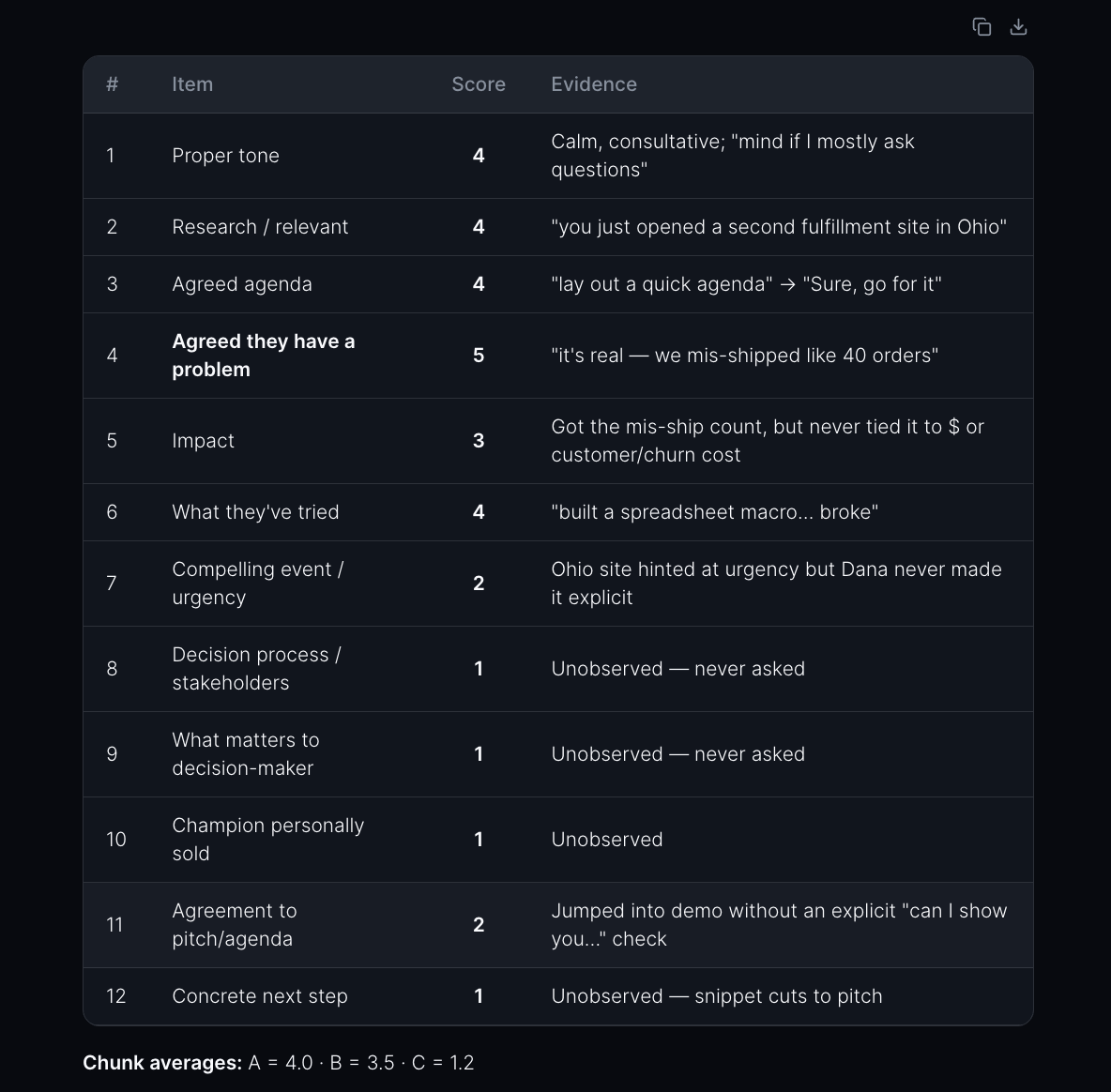
The mechanics of the skill are pretty simple:
Build small first. 10-15 behaviors, pulled from what your actual top reps do - not a 40-item card built once and never touched.
Score on volume. SDRs running 2-3 calls a day, AEs running 7-8 demos a month - score every one, not a sample once a quarter.
Chunk the practice. Don’t roleplay the whole call to fix one weak section. Drill the exact chunk a rep scores lowest on until they leave the session on a 5.
Track the trend. A 90-day line that shows the team improving chunk by chunk - not a scorecard nobody looks at after the kickoff deck.
4. Turn a Scored Audience Into GTM Motion
Author: Austin Hay, Operating Partner at Khosla Ventures
Let’s assume you have a segmented, scored, and refined audience sitting in Snowflake. The ICP is refined, and a high-intent list is ready to be put to work. Yet, until it leaves the warehouse and lands in front of a rep, an ad platform, or a sequencing tool, it’s no more than endless rows of data.
Austin’s Reverse ETL activation skill puts all that data to work. It pulls accounts, contacts, and computed traits from your warehouse into your CRM, ad platforms, or sequencing tools where magic actually happens.
The failure mode this skill exists to prevent: a naive “sync the table” job that writes half-matched rows, re-writes unchanged records, blows past API limits, and pushes suppressed or non-consented contacts into a sequence.
It’s exactly where most AI-powered GTM stacks break. And this risk gets bigger as the rest of your stack automates. The faster you score and segment, the more damage one sloppy sync does downstream.
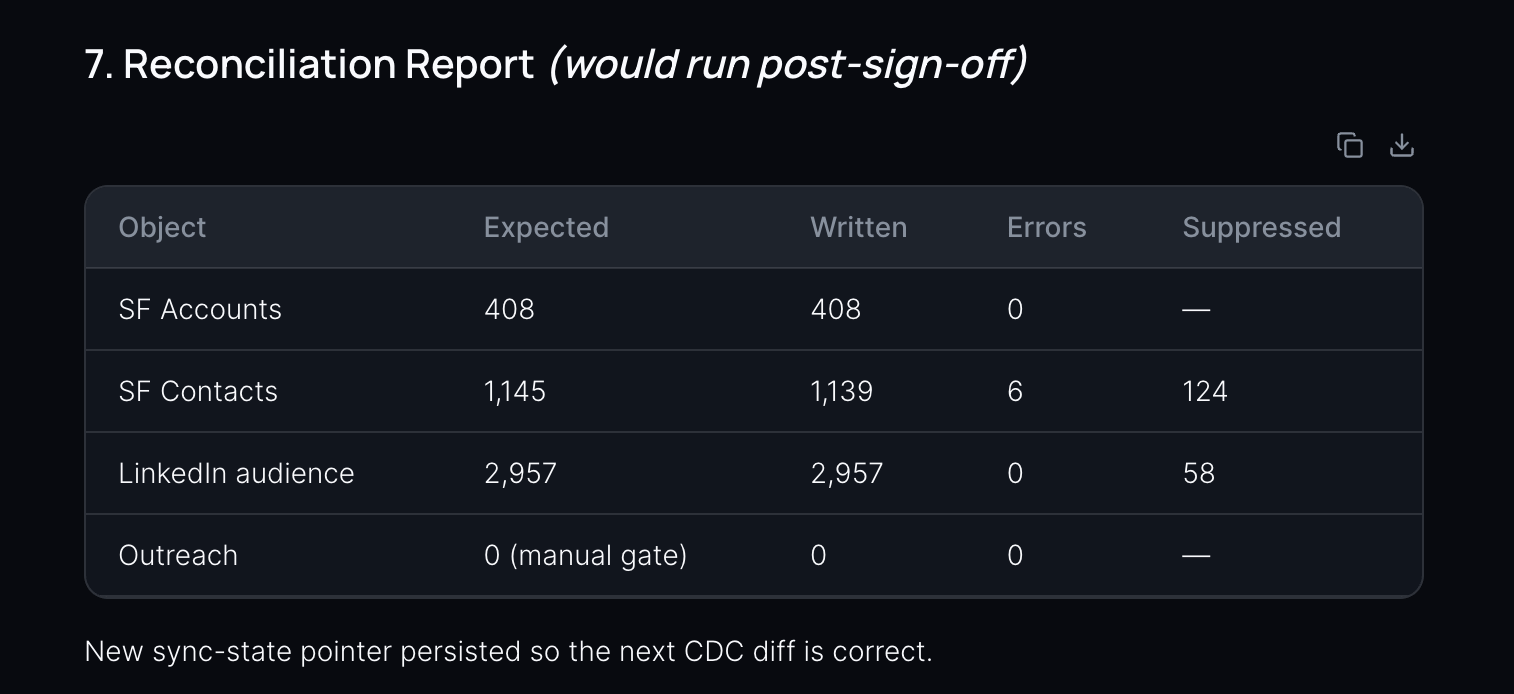
The guardrails that keep that from happening:
It checks before it writes. Rows below a 90% match-confidence floor get flagged for review. No confident match - no new record.
It only moves what changed. Untouched data doesn’t get synced for no reason (protecting your API budget).
It respects opt-outs. Anyone who unsubscribed stays out, every time, automatically.
It has a panic button. Try to delete too much at once, and it stops itself and flags you instead.
It shows you the plan first. You see exactly what’s about to change before it actually changes.
5. Turn Agent Activity Into a Value Receipt
Author: Manny Medina, Founder & CEO at Paid.ai
If you find the previous four skills in this post useful and decide to adopt them, there’s one thing to keep in mind. Someone’s eventually going to ask what all of it actually bought you. And “the AI did a lot of stuff” is not an answer that survives a budget review.
Manny faced this problem himself, from the other side of the table - because AI agents are, in his words, cognitively invisible to the people paying for them. No one walks past an agent’s desk and notices it’s been crushing it. If nobody’s making the value explicit, somebody’s quietly deciding it’s not worth the line item.
Agents are cognitively invisible to the people paying for them, so their value has to be made explicit - continuously, not just at renewal.
His ROI proof generator was written for AI vendors proving value to customers - but the logic runs both directions. The same receipt format works whether you’re the one selling the agent or the one who just approved the budget for it internally. Either way, someone’s going to ask the same question at renewal time.
The skill is strict about what actually counts as proof. Three kinds of metrics exist, and only one closes the argument:
Usage reporting (tasks run, tokens burned) - an engineering metric, not a business case.
Performance analytics (uptime, latency) - a reliability metric.
ROI reporting (time saved, cost avoided, revenue generated) - the only one anyone signs off on.
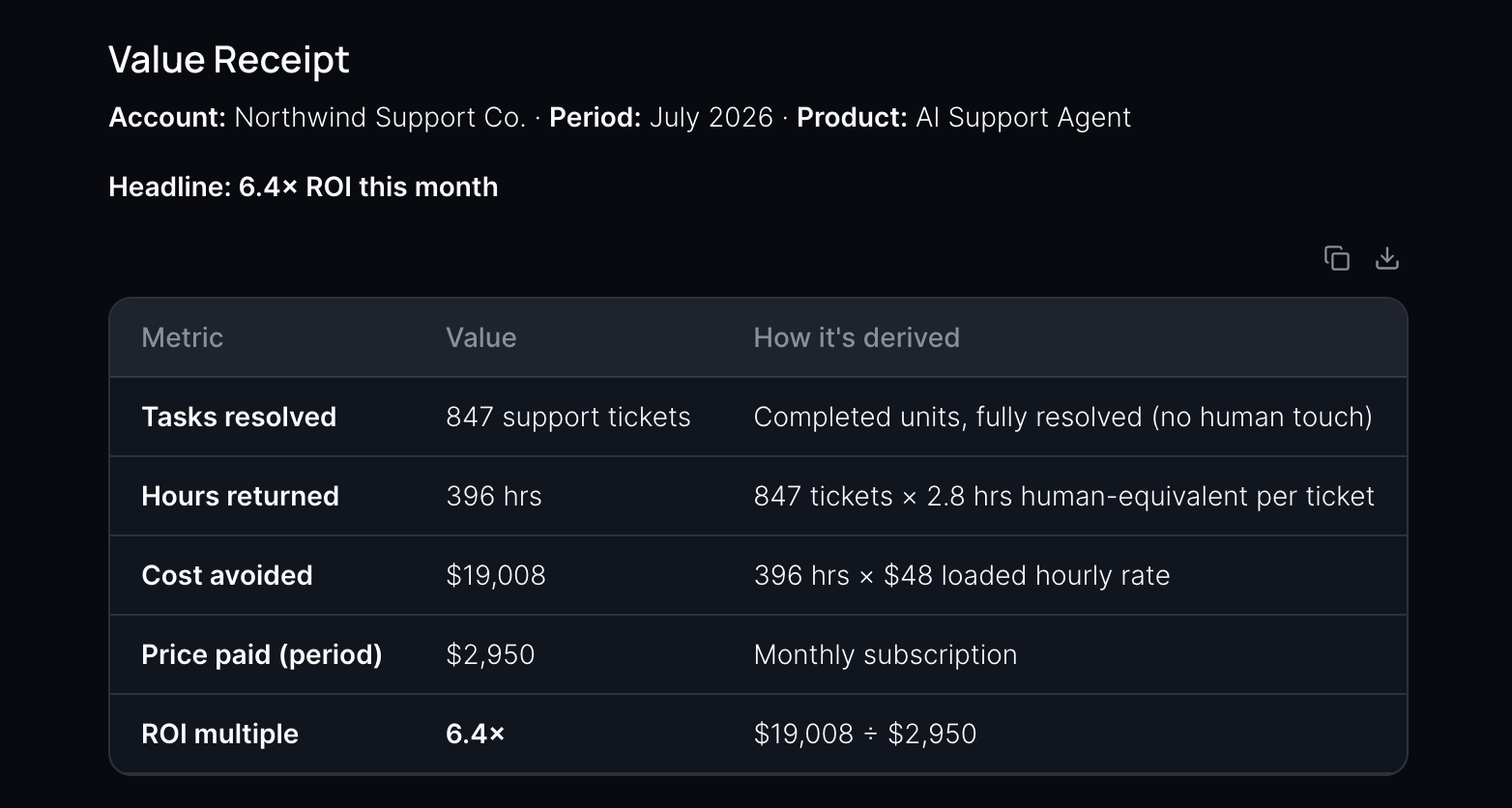
The receipt itself is four numbers, always shown with the arithmetic behind them:
Tasks resolved - in plain, specific language (”340 accounts re-scored, 12 ICP contradictions surfaced”)
Hours returned - task volume × real human-equivalent time
Cost avoided - hours returned × the real loaded rate
ROI multiple - value delivered ÷ what the tooling cost for the period
MUST separate customer-agreed benchmarks from assumptions, and label any assumption. NEVER fabricate a benchmark or a rate.
That single rule is what separates this from the AI-ROI slide everyone’s already tired of - the suspiciously round “10x productivity!” claim nobody can trace back to a real number. If you can’t re-derive the multiple yourself, it doesn’t belong in the deck.
GTM Skills is free, open-source, and ungated - built by the operators named next to their own work, not a vendor with a roadmap to sell you. Worth going through the full library, not just the four I picked.
Which one are you testing first?

✅ Need ready-to-use GTM assets and AI prompts? Get the 100-Step GTM Checklist with proven website templates, sales decks, landing pages, outbound sequences, LinkedIn post frameworks, email sequences, and 20+ workshops you can immediately run with your team.
📘 New to GTM? Learn fundamentals. Get my best-selling GTM Strategist book that helped 9,500+ companies to go to market with confidence - frameworks and online course included.
📈 My latest course: AI-Powered LinkedIn Growth System teaches the exact system I use to generate 7M+ impressions a year and 70% of my B2B pipeline.
🏅 Are you in charge of GTM and responsible for leading others? Grab the GTM Masterclass (6 hours of training, end-to-end GTM explained on examples, guided workshops) to get your team up and running in no time.
🤝 Want to work together? ⏩ Check out the options and let me know how we can join forces.