


Presenting partner: Viktor
Viktor is an AI employee that lives in Slack and Microsoft Teams. Connects to 3,200+ tools. Does the work, not just answers questions. Hire Viktor for your team.

GTM partners:
Ahrefs Brand Radar - Make AI recommend your brand.
Clay - Build systems to grow revenue.
FullEnrich - Call your prospects before anyone else.
HubSpot for Startups - The GTM engine that grows with you. See if you qualify for 90% off.
Miro - The collaborative workspace where GTM teams and agents converge to build together.
Ploy - The marketing platform that turns your website into a growth engine.
Primer - Target your ICP across LinkedIn, Meta, Google, Reddit, and more.
Dear GTM Strategist
By now, everybody has told you that call recordings are a treasure trove of insights. “Just bring them into Claude!” (or whatever you use as your central AI brain). Great advice. Zero context.
So most of us did the obvious thing: hit record, let the notetaker do its magic, and prompt AIs to pull out snippets of value from customer gold piled up in a library no human ever opens.
At best, we used them for our RevOps and GTM engineering endeavors - but how about marketing?
Enough is enough.
In this edition, I want to show you what real marketers are actually doing to harvest that intelligence and turn it into specific tactics: sales enablement that helps reps close better, and marketing materials that get done in no time.
These materials win hearts and minds immediately because they’re built from pain points customers said out loud. In their own words. We say it back to them.
Yulia Olennikova runs product evangelism and social selling at N.Rich, an ABM platform that helps B2B companies reach enterprise buyers. She will show us how she completely changed the way her team creates sales enablement materials.
I have a soft spot for marketing examples because I’ve spent a decade working on marketing materials that were never celebrated as “deal closers”.
This one is super actionable since building is the new reading. But I still invite you to read this one. You’ll walk away with very actionable ideas for all the gems buried in your recording library.
Let’s go dig.
SPONSORED
Want a free GTM diagnostic trained on 35,000+ startups?
Sharpen your GTM for Q4 with a 10-minute diagnostic tool from HubSpot for Startups. Drop in your URL, answer a few questions, and get:
Your GTM score across 5 areas: pipeline, messaging, content, competitive position, and social visibility
A prioritized 90-day roadmap: what to fix first, and what can wait

Over to Yulia:
This July, I finally did something I’d been putting off for months. I mapped our best-performing sales narratives - the ones that actually appear consistently in closed-won deals - against the content assets we have to support them. And it finally helped me justify the time I spend on content in front of the entire revenue team.
Because we all know how “valuable” it sounds when a marketer claims they’re going to work more on content - the value perceived is close to zero (“so another 2000-word blog post on “what is X” no one is going to read? Are you sure?” So if you’re a B2B marketer who sometimes wonders whether what you’re producing actually connects to pipeline - this exercise is for you. It takes anywhere from 3-4 hours to a couple of days depending on your setup, and it will change how you answer the question “what should we write about next?” permanently.
The shift to start with: from keywords to winning sales narratives
Most content strategies are built on a random set of inputs. What you end up with is a “salad” content plan with no real evidence behind it - and no understanding of whether it’s driving results.
“Salad” content strategy bingo - check everything that made you change your content plan at least once!
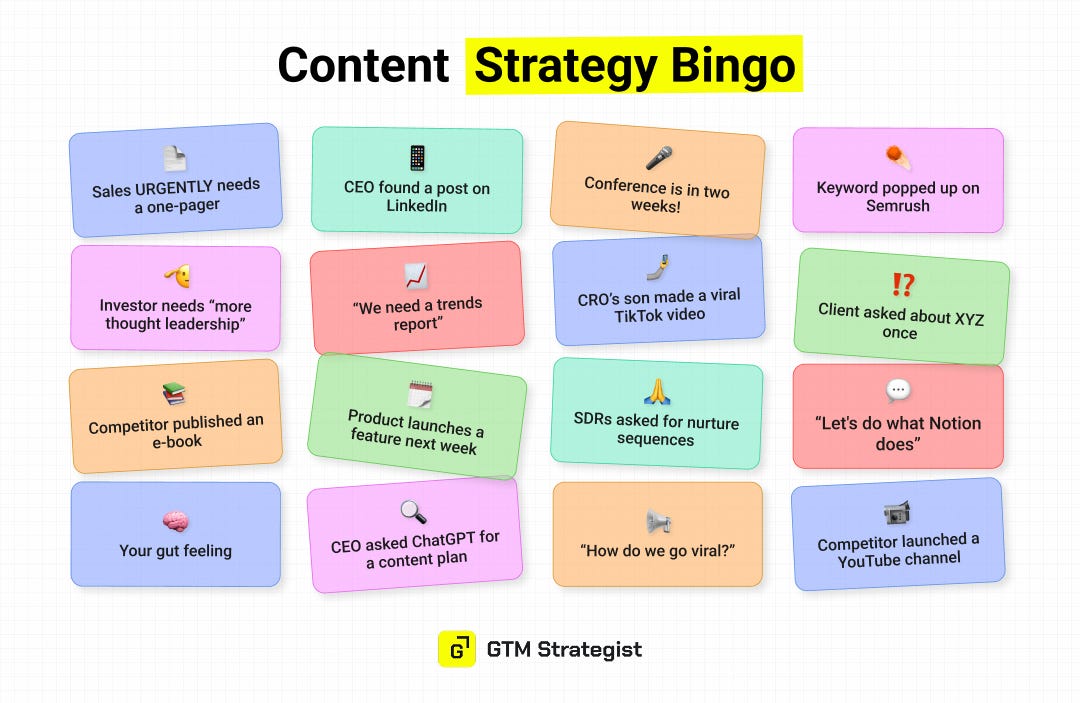
I’m not saying all of these inputs are totally useless - but unless you have a foundation to score all those ideas against, it’s really hard to define what’s really worth spending time and money on.
And that foundation is often missing - because no one asks a question that ties all the content investments to pipeline and revenue:
What narratives are actually closing our best deals, and do we have the assets to support them at every stage of the buyer journey?
When it’s missing, the result is: your best salespeople are winning deals with certain messaging they’ve refined across hundreds of calls, objections, and follow-ups. They know which framing makes an enterprise buyer lean forward. They know which angle neutralizes the most frequent objections. But if marketing isn’t extracting and supporting those narratives systematically, the sales team is essentially running on tribal knowledge while marketing produces content based on something else entirely.
There’s a second layer to this that’s gotten significantly more urgent in the last 18 months: LLMs. B2B buyers (just like everyone else) are now typing questions into ChatGPT, Perplexity, or Claude as part of their research process. Before they visit your website. Before they fill out a form. Before they even search on Google! And if your narratives aren’t indexed and present in AI-generated answers, you’re invisible in a channel that’s growing fast.
The audit I’m about to walk you through solves several problems at once:
It surfaces what’s actually winning deals
It identifies what’s missing
It gives you a framework for tracking your visibility with humans and AI systems simultaneously.
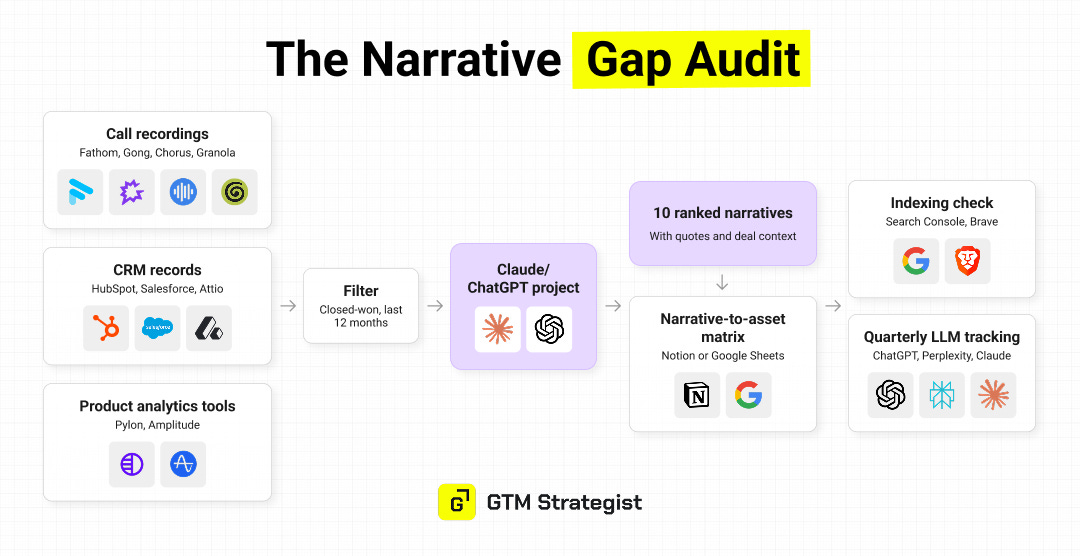
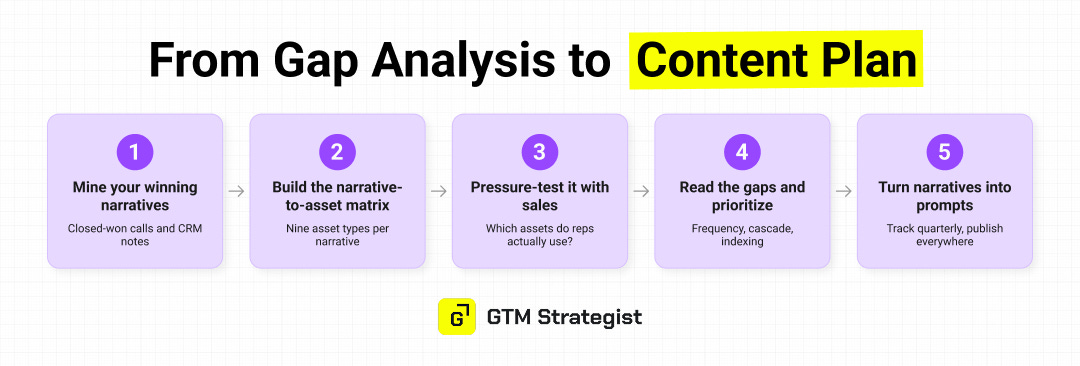
Step 1: Mine your winning narratives from call recordings and CRM data
This is the step that intimidates people into not starting. Good news: in the very beginning, you don’t even have to speak to your sales team 🙂
If you’re reading this article, I’m sure you have a call recording tool or a decent amount of sales notes in CRM (ideally both) - so you’re in a good place to start.
I used an internal bot built by our CTO Anton Charnou that he called Son of Anton (I’m sure you’ll appreciate the naming). The bot lives in Slack and connects our Fathom call recordings with HubSpot, so I can ask questions in plain language and get answers with links to actual deals, specific calls, and exact quotes.
Here’s the prompt I used to kick off this exercise:
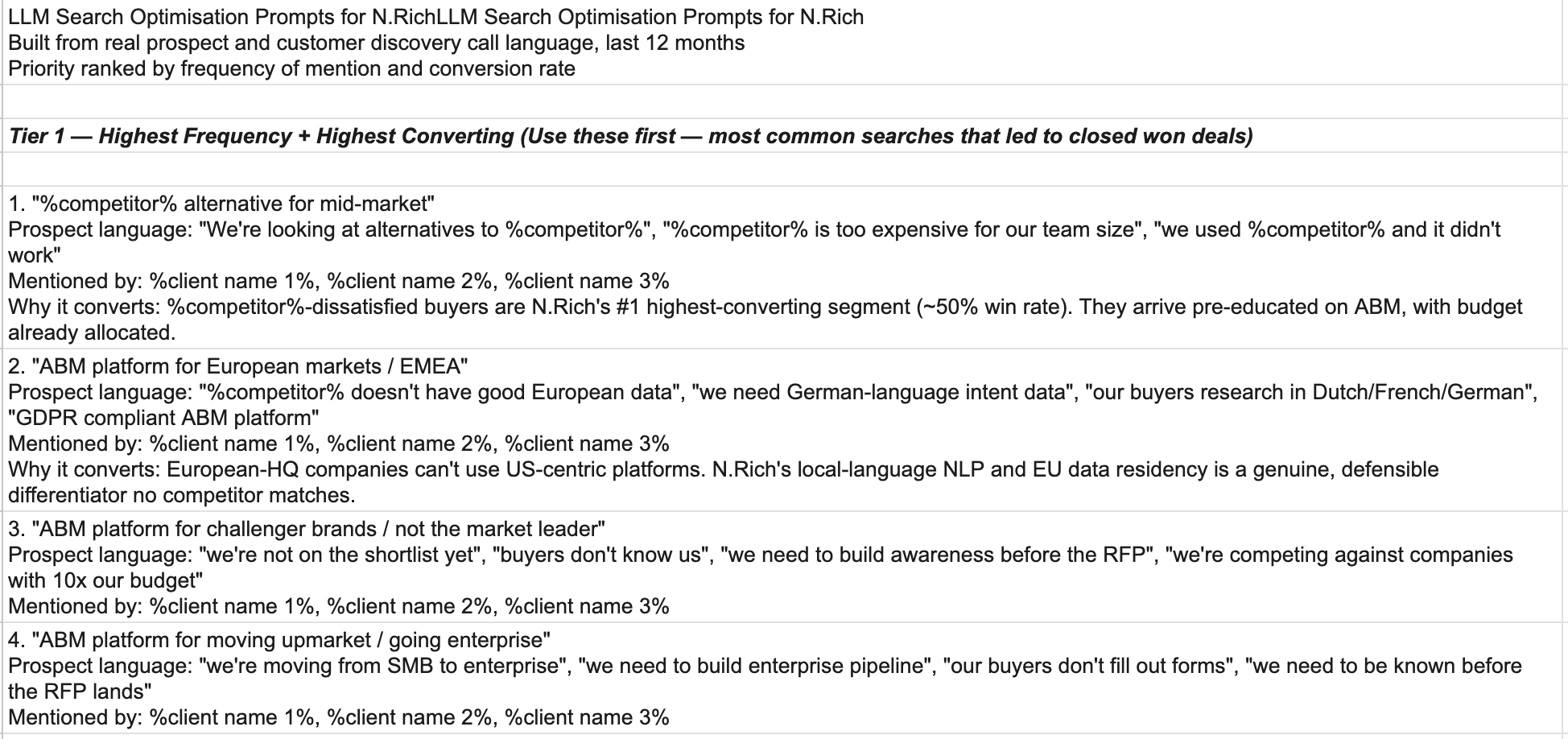
Analyze our call recordings for the last 12 months. Pull together 10 narratives and value propositions that appear consistently across all the calls associated with closed won deals. Rank them by frequency and impact. Mention the exact clients and the context for each conversation.
The output was a ranked list of 10 narratives with deal context, client names, and representative quotes.
Some context: N.Rich is an ABM platform used by mid-market tech companies that have (or are building) a high-ACV sales motion and are looking to actively grow market share. Typically our clients are sales-led organizations, with lean marketing teams that need to grow awareness AND generate immediate results (i.e., leads and pipeline) at the same time - and clearly demonstrate the results of their efforts to the sales and the C-suite.
So here’s a highlight of what I got (some details removed for privacy reasons):
If you don’t have an integration (manual path with Claude):
Export your call transcripts from whatever recording tool you use - Fathom, Gong, Chorus, and most others have bulk export. Filter to closed-won deals only, and limit to the last 12 months if you have a lot of volume.
Create a Claude Project and upload the transcripts. Then use this prompt:
I’m uploading call transcripts from our closed-won deals from the last 12 months. Please analyze them and identify the 8-10 most frequently recurring narratives, value propositions, or pain points that appear across these calls. For each narrative: give it a short descriptive name, describe the buyer’s underlying problem, explain how it was addressed in the call, note which deal stages it appeared most often, and include 2-3 direct quotes from the transcripts that illustrate it. Rank by frequency of appearance.
A more sophisticated option is building a solution that uses MCP to connect multiple tools - HubSpot/Salesforce, Gong, Pylon, and whatever other tools you use for deals and customer analytics.
How long does this take?
With a working integration (or if you’re building your own solution): 2-4 hours including setup and review. With the manual Claude path: half a day to a full day, depending on how many transcripts you’re working with and how much time you spend on interpretation.
Either way: the most important call you’ll make is which deals to include. Closed-won only. No “good conversations that didn’t go anywhere”.
Be the first to know when The State of B2B GTM 2026 Report drops.
This year, 300+ GTM pros took our survey. Instead of just publishing the results, Kyle Poyar (Growth Unhinged) and I are launching them at a virtual summit on October 14, so we can learn together and hear what’s working right now at SpaceXAI, Clay, Granola, Vercel, and more.
Walk away with the hottest GTM tactics, tools, and AI workflows from best-in-class companies, and use them to sharpen your 2027 plan.

Step 2: Build your narrative-to-asset matrix
Once you have your narratives, the second step is mapping what content assets exist - or don’t - for each one.
Here are the asset categories I use, and why each one is on the list:
Website page (indexed) - Does a dedicated page exist that targets this narrative? Is it indexed and crawlable (strongly recommend double-checking this)? This is your most durable asset for both SEO and LLM visibility.
Mention on the main page - Does this narrative appear in your header, hero text, or homepage body copy? Absence here means first-time visitors often won’t understand that you solve this problem at all.
Webinar (indexed, with transcript) - A recorded webinar with a full indexed transcript is one of the highest-leverage assets you can produce. It does triple duty: it builds trust with human buyers who want to evaluate your thinking, it feeds LLMs with structured, indexed content tied to your narrative, and it can be repurposed into every other asset category on this list. Oh, and don’t hesitate to ungate it and make it public on YouTube. The impact will be disproportionate vs. hiding the content behind a form!
Social posts - Ongoing LinkedIn presence around this narrative signals to buyers and algorithms that this is a genuine area of expertise, not a one-time page. LinkedIn is the second most cited source in LLMs (or is it already the most cited after the Reddit crash?).
LinkedIn newsletter - Longer-form thought leadership that follows a narrative consistently. Useful for nurturing buyers who aren’t ready to engage yet.
Blog post (indexed) - Permanent SEO asset and LLM training data. One good blog post that ranks can generate more LLM citations than a month of social content.
Downloadable asset (website) - A gated or ungated resource that your SDR team can share with prospects.
Sales collateral: slide - Does your sales team have a deck slide they can pull for this narrative in a live call? If not, they’re improvising on your most important messaging in front of buyers.
Sales collateral: one-pager - Standalone asset for async sharing, follow-up emails, and proposals. Especially valuable for narratives that involve multiple stakeholders who weren’t on the call.
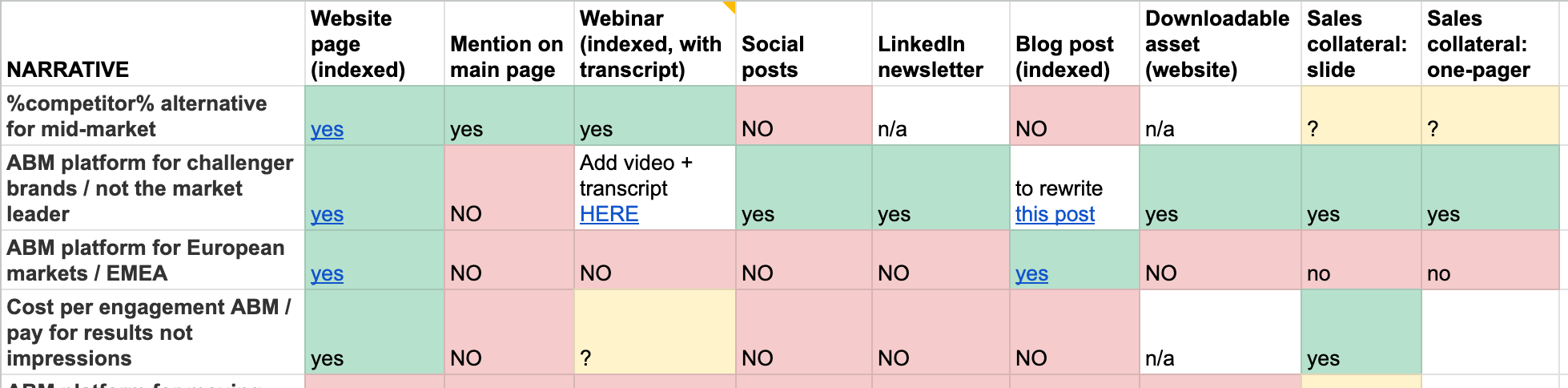
The matrix looks like a spreadsheet: narratives in rows, asset categories in columns, and a simple status in each cell - exists and strong, exists but needs work, or missing entirely. The template I’ve linked at the end of this article has the structure built in, with a priority scoring column and a dedicated column for LLM tracking prompts.
Here’s my working doc in progress:
Step 3: Run the asset list through your sales team
This is the step most marketing teams skip entirely. Yes, you need to talk to your sales team at this point 😀
But it’s also the step that will save you the most wasted production effort.
Before you decide what’s missing and start filling gaps, spend 30 minutes with your salespeople and ask them: of the assets that already exist, which ones do you actually use? Which ones do you need urgently tomorrow?
The answer is rarely “I didn’t know they existed”. It’s usually something more specific and more useful.
The advanced version: give your reps the asset list for each narrative and ask them to rate each one across five concrete selling situations:
First touchpoint / cold outreach - What would you attach or link to a cold email or LinkedIn message to someone who has never heard of us?
Discovery follow-up - After the first call, what do you send to reinforce the narrative you just discussed and keep momentum going before the next meeting?
Answering a frequent objection - The buyer says “we’re already using [competitor]” or “we don’t think we need this right now.” What asset do you reach for?
Multi-stakeholder buy-in - Your champion needs to sell internally to someone who wasn’t on the call - a CFO, a CRO, a board observer. What do you give them to share?
Reviving a stalled deal - The deal has gone quiet after a promising discovery. What’s the re-engagement asset that doesn’t feel desperate?
You can also add: competitive displacement (buyer is actively evaluating an alternative), post-demo reinforcement, or final-stage objection handling - whatever your cycle typically includes.
What we learned when we ran this at N.Rich:
Our reps consistently preferred short video clips over full webinar recordings. A 3-4 minute clip that addresses one specific idea is more likely to get sent and watched. This changed how we think about the “webinar” row in our matrix (and yes, it added more tasks on our plate, but also gave us more short-form pieces for social).
One-pagers are still very much alive. I can’t believe it, but in 2026, with enterprise buyers, attaching a PDF to a follow-up email is still one of the most effective things a rep can do. I don’t entirely understand why the format has held on this long, but if I search for “one-pager” on Slack, I still find a lot of messages asking for it.
Step 4: Read the gaps and prioritize (ruthlessly!)
Once the matrix is filled in, you’ll see that some narratives are well-supported, some are partially built, and some are almost entirely missing. Your job now is to prioritize, and not all gaps are equal.
The prioritization logic that works for me:
Frequency × completeness. Take your highest-frequency win narratives - the ones that appear in the most closed-won calls. Cross-reference with how many asset categories are missing. The intersection of high frequency and low asset coverage is your highest-priority content work.
The cascade principle. Some assets unlock multiple others in a single production effort. A webinar with a full indexed transcript can become: a blog post (edit the transcript), a LinkedIn post series (pull the best exchanges), a one-pager (summarize the key argument), and LLM-visible content (index the page). If you’re resource-constrained, start with assets that cascade. A well-produced webinar with full transcript typically unlocks four or five other cells in your matrix.
The indexing gap. Separately from whether an asset exists, check whether your key narrative pages are actually being indexed. I do this in two places: Google Search Console and Brave Search. GSC is obvious. Brave matters because it’s used as a data source by several major LLMs, which means a page that’s indexed in Brave has a significantly higher chance of appearing in AI-generated answers. If a key narrative page isn’t showing up in Brave, submit it manually. This is low-effort and currently underutilized by most B2B marketing teams.
After running this exercise, I could look at our matrix and see immediately: our “ABM platform for challenger brands” narrative - companies that aren’t the market leader but compete for enterprise attention - had strong social presence and a good website page, but no indexed webinar, no downloadable asset, and no sales one-pager. So this went to our Q3 content plan.
It took me about 15 minutes to turn the matrix into a prioritized backlog.
Step 5: Turn your narratives into LLM prompts - then use them everywhere
This is the part of the exercise that most people treat as a bonus and then never do. I want to reframe it, because once I understood what these prompts actually are, this became my favorite part of the whole framework.
If you want to go deeper, add a prompt after the first output:
For each of the narratives above, describe what a buyer would type into Google or an AI assistant if they were searching for a solution to this problem. Give me 3-5 search queries or prompts per narrative, written the way a buyer would actually phrase them - refer to the exact quotes from our calls. Give me the exact timestamps for each.
If you can write the prompt - “what’s the best ABM platform for a B2B company that isn’t the market leader but competes for enterprise accounts?” - you have found the exact phrasing that encodes both the problem and the solution your buyer is looking for.
AI search is changing how B2B buyers research. A significant and growing portion are now using ChatGPT, Perplexity, or Claude as their first research pass - before visiting your website, before filling out a form, before searching Google. If your brand appears in those answers with meaningful context, you’re on the shortlist before the buyer has even identified themselves. If you don’t appear, you’re invisible in a part of the buying journey that has no equivalent in your analytics.
Building the prompts
For each narrative in your matrix, create three types of tracking prompts - questions written the way your buyers would actually phrase them:
Type 1 - Category search (does your brand appear when buyers search your category?)
What are the best ABM platforms for mid-market B2B companies?
Which ABM platform has the best GDPR-compliant intent data coverage for European companies?
Type 2 - Competitive displacement (does your brand appear when buyers evaluate alternatives to competitors?)
What are the best alternatives to XYZ for a lean marketing team?
Why do companies switch from XYZ, and what do they move to?
Type 3 - Problem-first (does your brand appear when buyers describe their situation rather than searching by category?)
We’re a B2B SaaS company that isn’t the market leader in our space, but we sell to enterprise. What ABM tools are built for companies like us?
How can a challenger brand get on the enterprise shortlist before their better-known competitors do?
If you ran the extended prompt from Step 1, you already have buyer-phrased queries for each narrative. Paste those directly here.
Now: use these prompts as a content distribution brief
Once you have the prompts, don’t limit them to a quarterly tracking spreadsheet. These phrasings should appear across every content touchpoint that is indexable or crawlable - because the more places those exact ideas appear in natural language, the more likely AI systems are to associate your brand with them.
Specifically:
Blog post titles and meta descriptions - If one of your prompts is “what ABM platform works for companies that aren’t the market leader?” your blog post title should answer that question directly and your meta description should repeat the framing.
LinkedIn post hooks - Open posts with the buyer’s question. “If you’ve ever wondered how challenger brands compete for enterprise attention before the RFP stage...” is far more magnetic than a generic opener, and it trains the algorithm to show your content to people asking that question.
Video and webinar descriptions - YouTube descriptions, Wistia video descriptions, webinar landing pages - these are indexed and read by LLMs. Write them to answer the prompt directly, not to describe what the recording is about.
G2, Capterra, and review site profiles - Your product description fields on review platforms are some of the most LLM-cited content that exists about your brand. Update them to use the exact language from your prompts. Most companies set these once and forget them.
Speaker bios and event descriptions - When you or your team presents at a conference or podcast, the event page is indexed. Your bio and session description should carry the narrative language, not just your job title and company name.
Run a review campaign with your best customers
This one can have an outsized effect on LLM presence.
LLMs are heavily influenced by third-party sources - G2 reviews, Trustpilot entries, LinkedIn recommendations, industry round-up articles. If the language in those external sources doesn’t reflect your narratives, you’ll struggle to appear for the right prompts no matter how well your own content is optimized.
The fix: run a proactive review campaign where you give your happiest customers the context and language to write about you in ways that actually help. Not scripted reviews - but a short brief that says: “here are the three things we’d love people to understand about working with us” followed by the exact ideas from your narratives, written in plain language.
Pair this with specific asks: a G2 review, a LinkedIn recommendation, a mention in an industry roundtable post, a quote in a category comparison article. Each one is another external source using your narrative language - and each one makes your LLM citation profile stronger.
Running the quarterly tracking
Every three months, paste your prompts into ChatGPT, Perplexity, Claude, and Google AI Overviews. Log:
Is your brand mentioned? (Yes / No / With caveats)
What context? (Positive, neutral, compared favorably or unfavorably)
Which competitors appear instead of or alongside you?
What sources are being cited?
The trend over time is more useful than any single snapshot. If you publish a new piece of content targeting a narrative and your LLM presence for that narrative improves the following quarter, you have signal that the content is working - signal that doesn’t show up in traditional analytics.
Also check (AGAIN) that your key narrative pages are indexed in both Google Search Console and Brave Search.
Bonus: Turn narrative signals into SDR triggers
If your team tracks website visitors at the account and contact level (with N.Rich or any other tool), everything you just built also becomes a signal layer for your SDR team.
Every asset in your matrix - every blog post, webinar, downloadable, webpage - is now a trackable touchpoint that tells you something specific: which narrative this account is interested in.
Next time, instead of “noticed you’re in the B2B space and thought our platform might be interesting,” your rep can open with: “your team has been engaging with our content on [narrative] - that’s exactly the use case we’ve built [specific capability] for”.
To set this up:
Tag each narrative-supporting asset in your analytics or ABM platform with the narrative it belongs to
Create a trigger: when an account hits multiple assets within the same narrative, alert the SDR with the narrative context and the specific assets they engaged with
Give your SDRs a one-line “conversation opener” for each narrative, so they know how to use the signal without having to interpret it themselves
And every time a new asset is released - a new blog post, a new webinar, a new one-pager - send a Slack update to the sales team. The matrix only creates value if the people who need it know what’s in it.
What this workflow changed for me
I want to be specific here rather than generic, because the outcomes surprised me in ways I didn’t fully anticipate.
The content planning problem went away. I genuinely no longer have the “what should we write about this month?” conversation. Any cell in the matrix that’s red and belongs to a high-frequency narrative is my content brief.
I found LLM visibility gaps that didn’t show up elsewhere. Two of our narratives had decent Google Search presence - pages ranking, traffic coming in - but were almost entirely absent from AI-generated answers. The content existed but wasn’t getting cited. That told me something about format and indexing that I wouldn’t have caught from analytics alone.
Sales started using it and told us what was actually missing. Once the sales team knew the matrix existed, they started asking for it - specifically: “does this narrative have a one-pager yet?” But the more valuable output was the sales team audit in Step 3. Learning that reps weren’t sharing webinars (too long) and that one-pagers were actually the most-used asset in their follow-up toolkit changed what we prioritized producing. Having a shared artifact that both marketing and sales reference changes the dynamic between the teams in a subtle but meaningful way.
How to run this yourself
Here’s everything you need to get started:
→ Download the Narrative-to-Asset Matrix Template + Prompts File
The package includes:
Narrative-to-Asset Matrix (Google Sheets template) - all 9 asset categories, a priority scoring column, an LLM tracking prompts column, and color-coding built in
Prompts - every prompt from this article, organized and ready to copy-paste: the CRM/call recording analysis prompts, the manual Claude Project path, and the full LLM tracking prompt library by type
Run this audit once, update the matrix quarterly, and you’ll always know what to create next - and why it matters for revenue.
One last thing: update your sales team whenever a new asset goes live. They’ll thank you for that :)
Loved it : )