



This newsletter is supported by Swan AI.
For over a year, I’ve followed Swan’s mission to build the first autonomous business - $10M ARR per employee with AI agents. In year one, 3 founders landed 200+ customers across 5 continents and $1.5M in monthly pipeline, with zero employees or SDRs. This year they raised $6M to build the first shared context and workflow systems purpose-built for AI agents.
The architecture matters more than the agents.

They just revealed how they structure it: the truths that repeat across your GTM - ICP, scoring, voice, routing - live in one place, and every workflow points to them. So when your ICP shifts, you fix it once instead of editing it across fifty plays and tools.
(free, non-gated)
Dear GTM Strategist!
I often get asked, “We need a GTM slide for our pitch deck - can you please review this”?
Then I get something that more resembles a wishlist of GTM motions and a clusterf* of various marketing and sales channels that should or could work down the line.
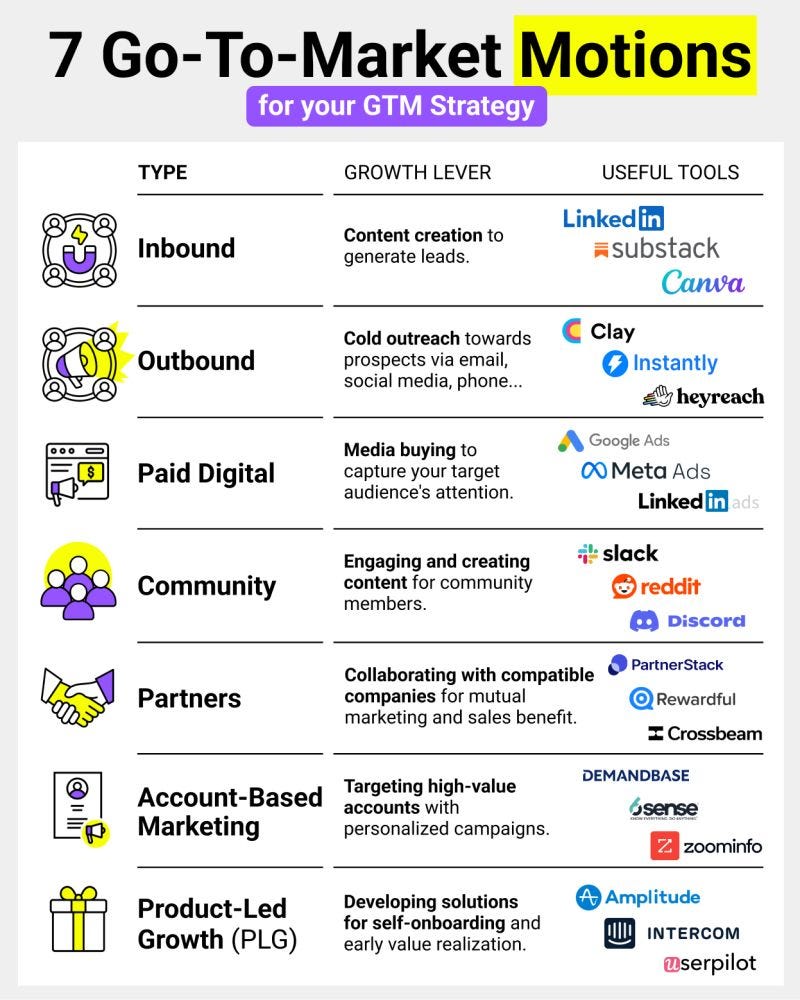
And investors are pretty great at smelling insecurity. “All” you need to do is to make them believe that the team knows what they are doing and how they will get there.
How does the opposite of it show?
In a GTM slide that is full of vague goals, but shows little of what will actually drive the growth.
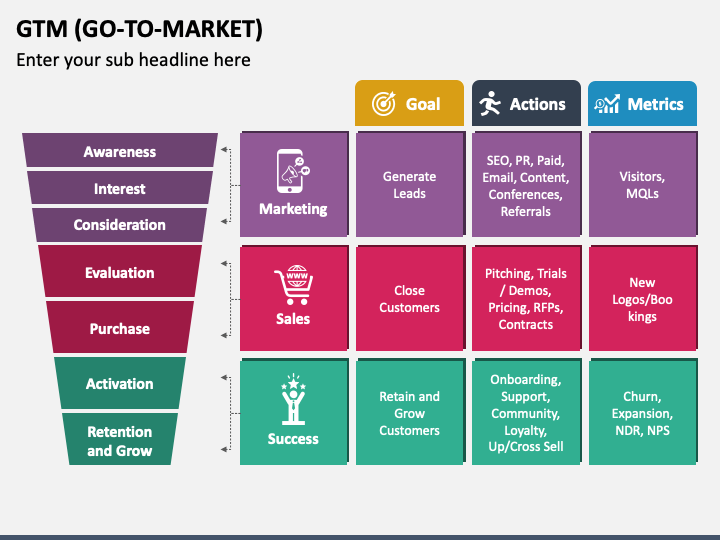
More than 2 years ago, I posted a guide to a killer GTM slide with an investor, Jonathan Crowder, and it became one of my best-indexed posts - but much has changed since.
More competition, AI native trailblazer startups setting bigger appetites with investors and in-built expectations that nearly every team should somehow use AI in their product and/or GTM - to name some. VC is now more selective, more AI-centric, and more concentrated in a smaller number of winners and mega rounds.
I’d immediately argue that this one is not useful just for startups fundraising but to all of us who are working on GTM presentations for clients, bosses and team members - investors can be internal or external :)
The sole mission of this article is to empower you with structural and tactical insights into how to make a compelling pitch to people that you need on your GTM journey.
The logic of the GTM Power Slide is simple - the purpose of the GTM slide is to create confidence and evidence that your GTM plan will work by providing traction data and projections that do the story for you - and it will be faster and better with their contribution, for which they will be handsomely rewarded. Not much different than sales, ain’t it?
This is why this article did not need a makeover - it needed a do-over.
We asked well-respected investors in the GTM space to share their best practices with us: Liz Christo from Stage 2 Capital, Paul Irving from GTMfund, Kyle Poyar from Growth Unhinged, and Ivan Landabasso from JME Ventures.
We got some really good insights and packed them into a “pitch perfect” GTM slide for 2026 that you can use as a template for your presentations.
So, let’s get into it.
What changed since the pre-AI native era?
The market split in two - and your GTM slide now decides which side you land on.
AI took 80% of global VC in Q1 2026. Average AI deal sizes hit $51M versus $4.7M for non-AI - a 10.9x gap, up from 8.4x in 2024. Outside AI, capital is tight.
Series A is a revenue test now. Investors want real revenue, not a demo, and they expect fast growth. Carta puts the median Series A post-money at $78.7M, and the top 10% of startups raised half of all 2025 capital.
VCs are writing fewer, larger checks. Over 40% of seed and Series A dollars in 2026 went to rounds of $100M+. Everyone else faces a tighter, more scrutinized environment where financial discipline and a clear story matter more than ever. Your GTM slide is that story.
In a nutshell: investors are writing big checks to a select few while the rest have to live with scraps and “valuable feedback”. It is an especially painful problem on the periphery - outside San Francisco, London, and other VC power hubs.
How to convince them with the GTM slide?
Step 1: Show traction
We won’t focus on product-market fit, “problem-solution” slide and other parts of the presentation today. These come before and create the narrative that will make the GTM claims more believable.
And then there’s one slide where you can expect most discussion: your go-to-market plan. You need to nail it.
So more than anything, you need to show where you are starting from: your existing traction.
You need to give the confidence that you know what you’re doing. Your GTM slide should show a realistic picture of how you plan to acquire customers in your market, supported by clear assumptions. Show your existing traction and present a story on why this is an investment opportunity the investors should be part of.
Step 2: Outline a clear strategy to continue ahead
Here’s where the story part should continue. Anyone can draw a graph with projected growth. You need to explain what will drive it. Which GTM motions are bringing in revenue right now, and what are your bets that the investment will boost?
The most common mistake is to present too many options. Then it resembles a wish list, but no one will know what the focus should be. Instead, explain what your key drivers of growth are, why you make that assumption, and how you will measure it (what the goals and KPIs are).
Kyle Poyar (Growth Unhinged, previously partner at OpenView) explains: “VCs want to see that your GTM is repeatable, predictable, and efficient. You know your best customer, you have channels that are working, your sales reps are hitting quota, and you know exactly what you could do to accelerate growth even further.”
For the earliest stages (Pre-Seed & Seed), the GTM slide usually isn’t that deep - and it doesn’t need to be, says Paul Irving, general partner at GTMfund. Three things stand out to him:
1. An unfair advantage in distribution.
For example, a built-in audience, a media asset you own, strong advisors, or founders who came from the space. “It’s not a prerequisite, but it’s the first thing I look for, because it lets you iterate with customers faster than a competitor can.”
2. A motion that fits the business.
Where your customers are, how they buy, what kind of company you’re building. Too often it’s cookie-cutter and doesn’t match the business. For example, outbound email to restaurant owners who never open email. The strategy has to match the specific customer.
3. One to three channels you can own.
“I’d rather see one or two channels they’re going to win outright to get off the ground than a seven-channel distributed plan an early team can’t run,” says Paul.
Step 3: Let the numbers do the talking
Numbers are the foundation. It’s how the valuations are made and justified.
So, which metrics to focus on?
It depends on the round you are looking for:
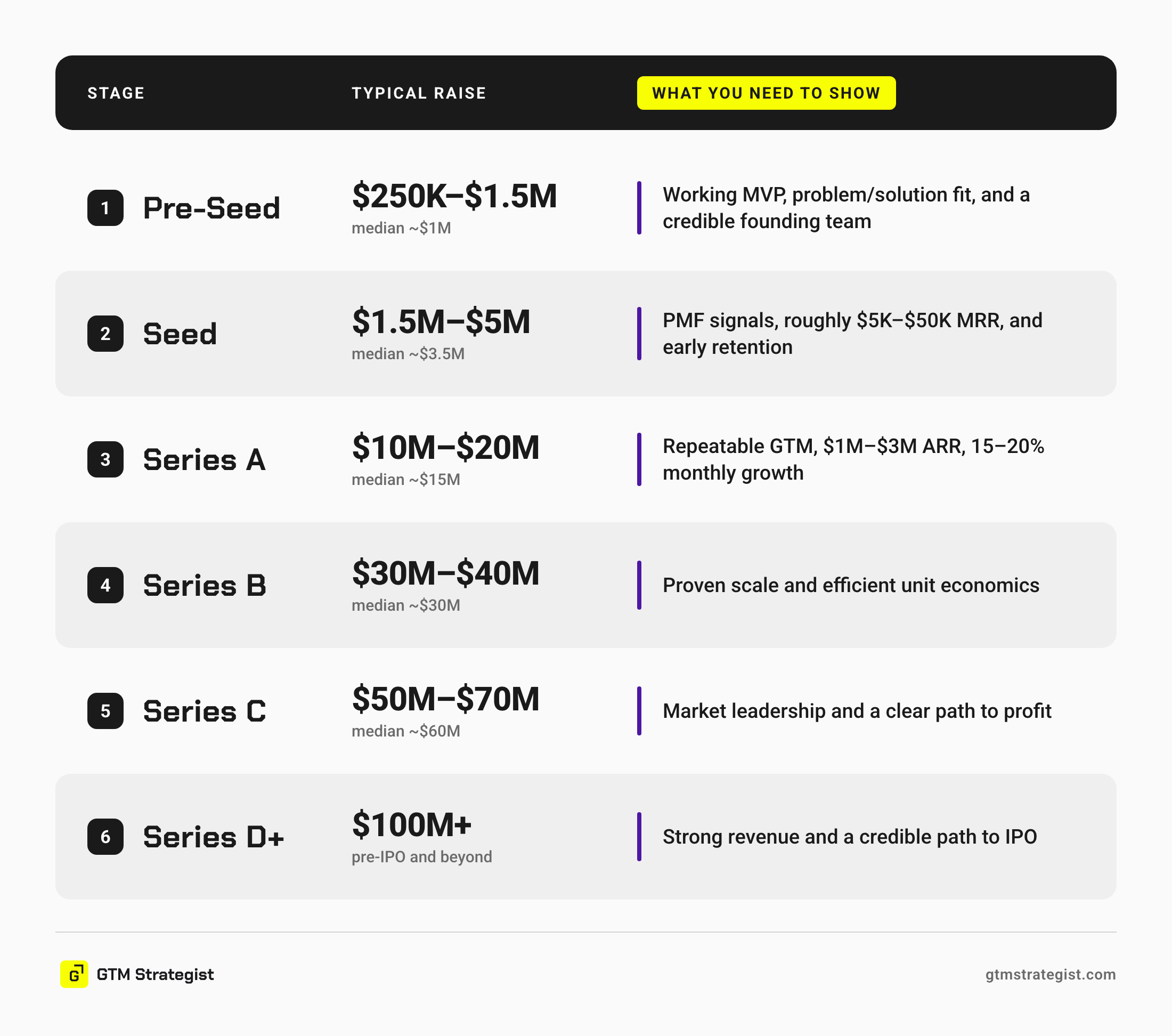
First step (even if you’re not preparing your GTM slide yet): start measuring the numbers so you can then pull them together when needed. CRM is the best source of truth to do that.
Liz Christo (partner, Stage 2 Capital) says: “I see a lot of decks that are incredibly qualitative and subjective. They communicate how they are feeling during their sales process rather than reverting to the data. Often I think that’s because they don’t actually have the data. My big encouragement is whether you are a founder selling or have a large team, get the right CRM hygiene in place so you can track basic metrics: leads, opportunities, customers, ACV (annual contract value), go-live dates, etc...As the old adage goes, you can’t improve something you can’t measure.”
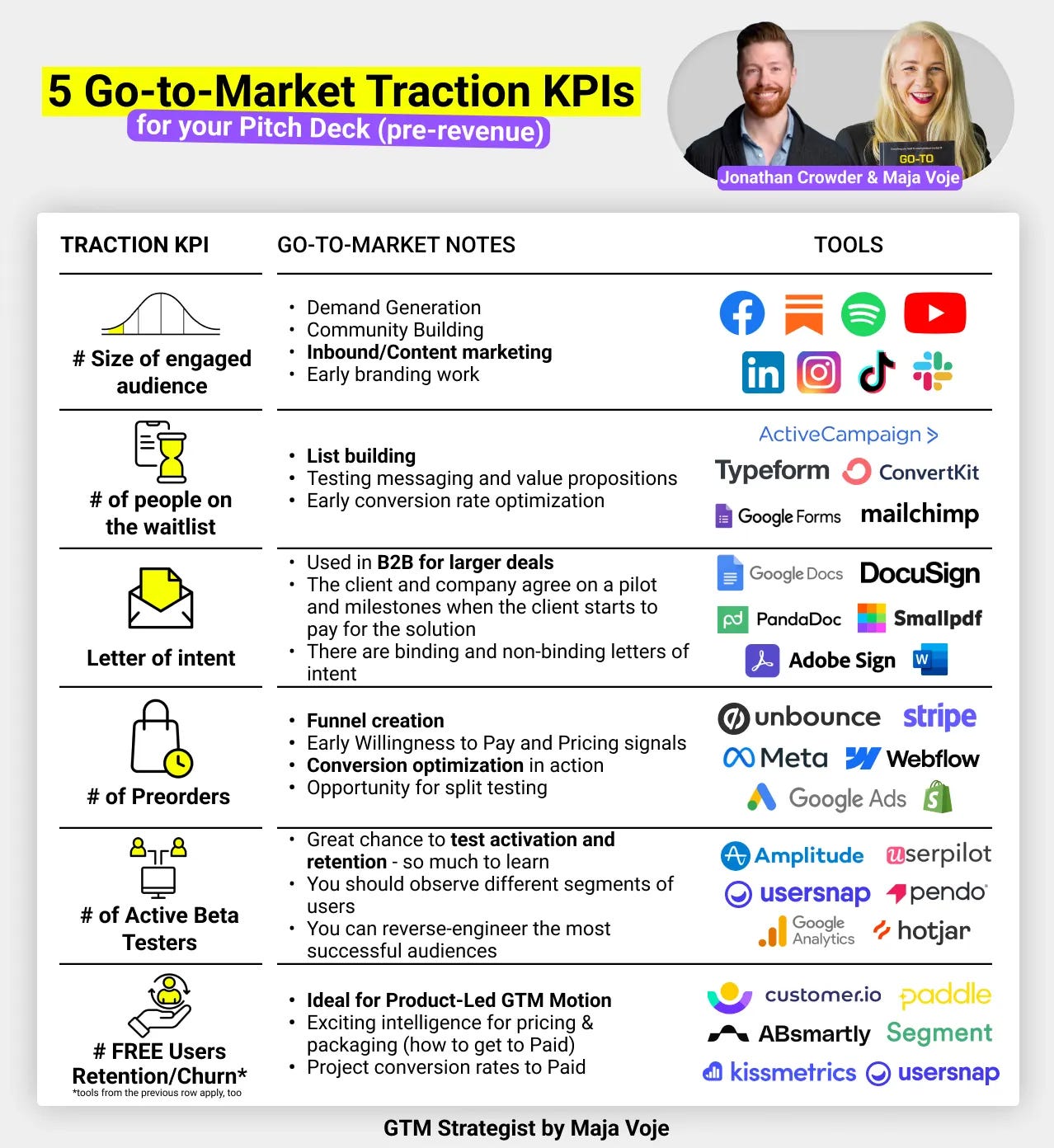
If you’re pre-revenue and want to focus on the traction, here’s what we have previously defined with Jonathan:
If you are already operating with revenue numbers, ARR (annual recurring revenue) is the gold standard. But for detailed talks about the valuation, investors will be interested in the economics behind the numbers. For example, how much does it cost you to acquire customers?
Kyle Poyar suggests that your gross margin adjusted CAC (customer acquisition cost) payback period should be healthy - ideally <12 months for SMB and <18 months for midmarket or Enterprise deals. But: “Make sure to zoom out; VCs aren’t looking for the details, they want to see that what you’re doing is ready to 10x.”
The killer GTM slide
The basics still hold. Your GTM slide has two jobs:
Communicate that you can predictably and successfully create traction.
To present the big opportunity you can pursue by securing funding.
Here’s what a template for the GTM slide in your pitch deck looks like in 2026:
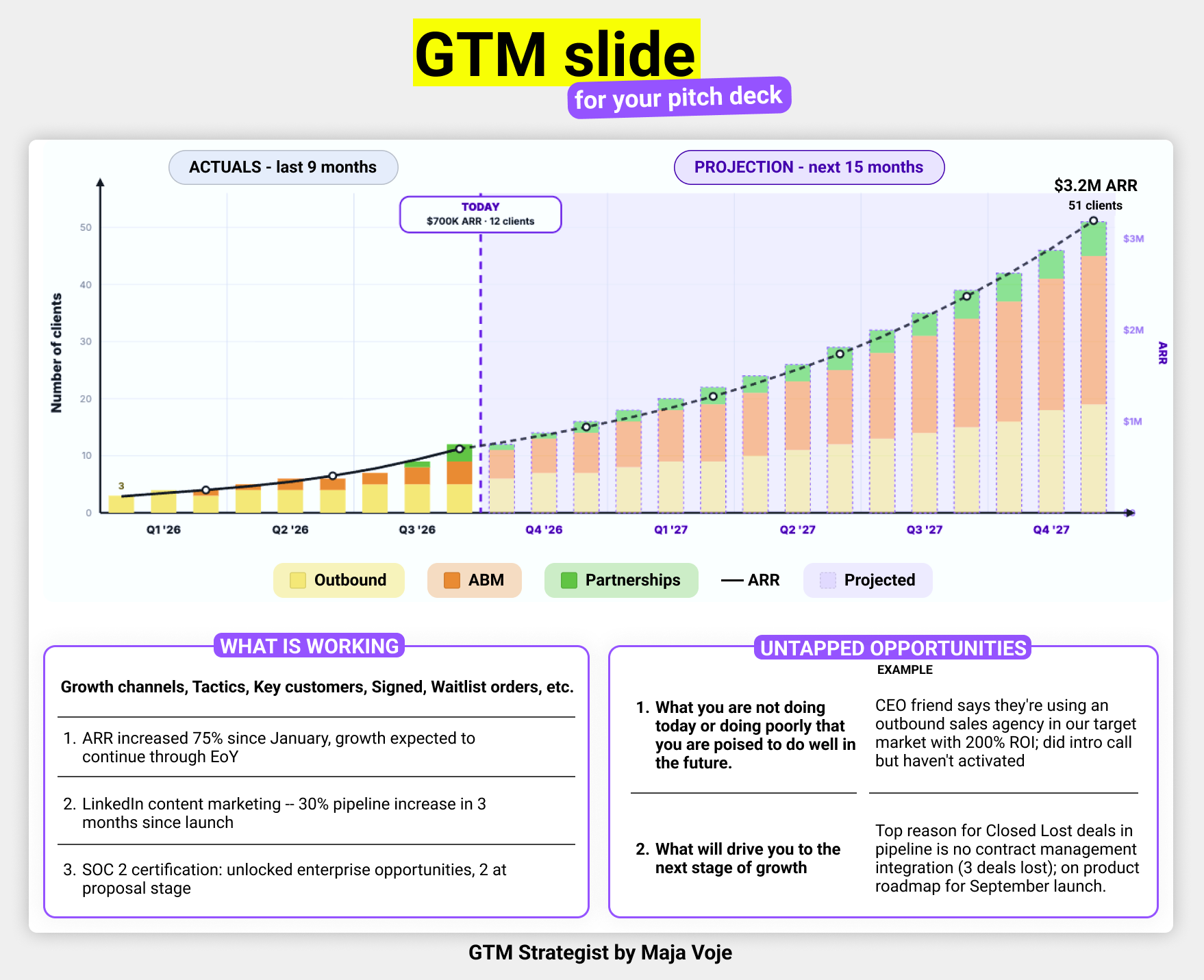
Let’s break it down:
Existing traction: a chart of your existing metrics: focus on the number of customers, ARR, and what GTM motions are driving growth. Explain key highlights of what’s working in a few bullet points. That could include learnings.
Projected growth: continue with a projection of how this growth will look if you get an investment that will support expansion of your activities.
Untapped opportunities: which are the additional opportunities that the investment will help you unlock.
“A company that is just getting started with founder sales and their first few customers should be focused on how they are going to get in front of their target audience, what they are learning, short-term milestones to prove value and product-market fit,” explains Liz Christo. On the other hand, a company with a team of 10 ramped sellers in seat should be sharing real data on the funnel, conversion, rep performance, and a believable path to scale that motion.
Where founders usually get it wrong
1) The math doesn’t add up
VCs talk in numbers every day, so the fastest way to lose them is numbers that don’t square. Paul Irving says: “ACV, customer count, revenue goal, and the pace to get there all have to line up, and often they don’t. Someone says they’ll hit $10M ARR; that’s 132 customers. They’re signing three a month — how do they get to twelve?”
Or the ACVs they’re projecting look nothing like the ones they have today. Sometimes there’s a real answer (they just turned on PLG onboarding, so velocity will climb). But often the numbers simply don’t square with the business.
2) Unrealistic targets
If you were on a first call with someone, this doesn’t mean pipeline yet. Liz Christo says: “I often see slides that make outlandish claims like “$15M in pipeline created last quarter” as a pre-seed company, and the company is layering in assumptions. For example, the first call with Bank of America enters pipeline at $3M, when in reality it probably isn’t even a qualified opportunity, let alone ready to have a $$ figure associated.”
Numbers also need to be put into context, explains Liz Christo. Random numbers on slide, like “Closed $300K in last 30 days” will raise questions on why that is important:
Did you only start selling 30 days ago?
Is this an acceleration?
Is this ahead or behind your target?
3) Faking traction
Most VCs have a well-developed bullshit detector, says Ivan Landabasso (partner at JME Ventures and author of Startup Riders). “Don’t use the term “design partners” and other buzzwords when trying to build an argument around product-market fit or validation. You either have an early client who’s hopefully paying you (even if it’s a small amount), or a full-on client.”
If you have a “design partner” who’s not paying you after a few months, it will raise a question if:
a) they are taking advantage of you (if you are solving a real problem, there’s no reason not to pay you even if it’s a small amount), or
b) if you are solving a problem that is not important enough.
How to say “design partner” in non-jargon? “Temporary non-paying customer until we prove value”.
What to do this week
GTM slide is not an overnight task. Get it drafted, gather some feedback, test the narrative, practice the pitch. That’s the best bet for you to get it right and win investors in the end.
Also, there’s nothing wrong with showing weakness as well - frame them as opportunities when you give them the attention they deserve. For example: if you haven’t figured out paid ads yet, you might do it when you can devote some budget to it.
The same goes for learnings. Liz Christo shares an example: “You might have tested events last quarter, launched a new geo, or tested a new partnership - these are all opportunities to learn about what is/isn’t working. Experimenting and learning fast (even failures) are critical to growth. This behavior demonstrates the mindset of the founder or the founding team. I don’t need to believe you have it all figured out, but willingness to learn, being introspective, and keep getting better means you will find a path.”
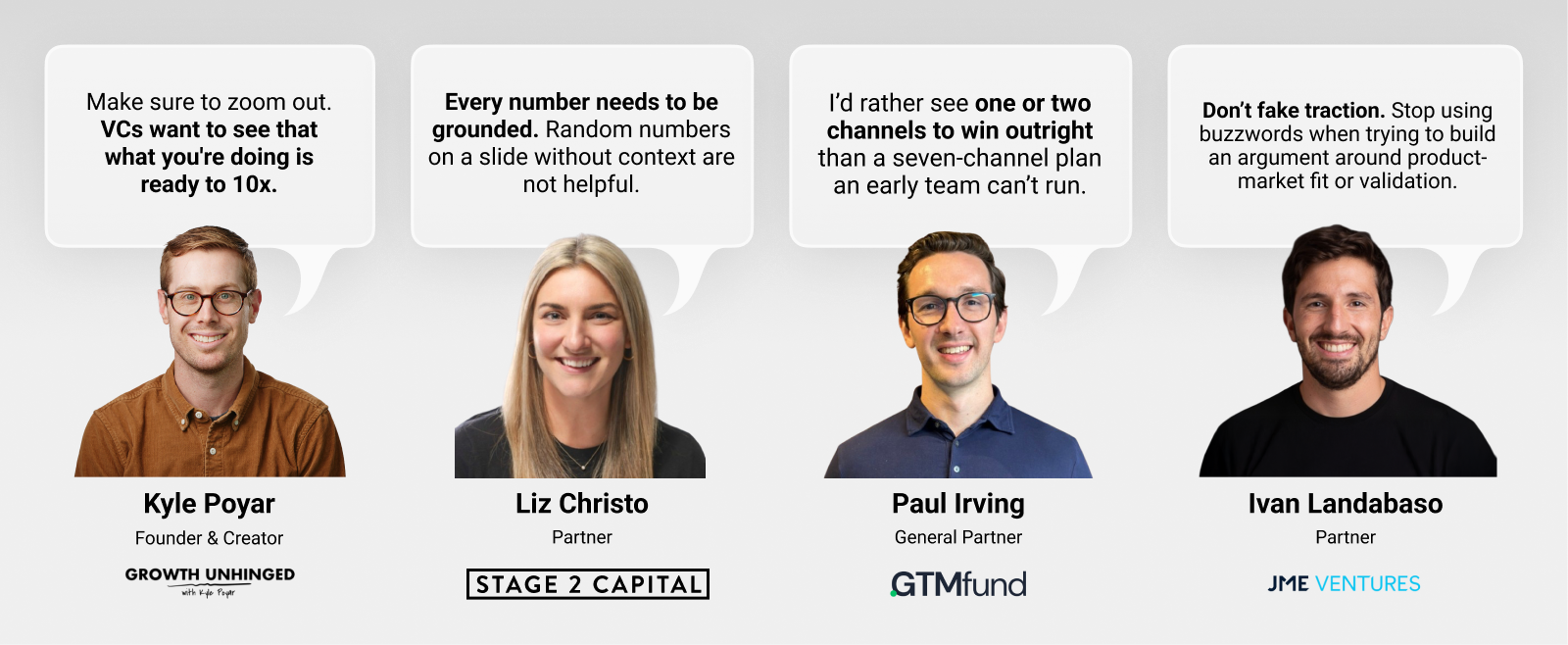
And to wrap up, here are the highlights from the experts that contributed to this post:
Till next time,
Maja

✅ Need ready-to-use GTM assets and AI prompts? Get the 100-Step GTM Checklist with proven website templates, sales decks, landing pages, outbound sequences, LinkedIn post frameworks, email sequences, and 20+ workshops you can immediately run with your team.
📘 New to GTM? Learn fundamentals. Get my best-selling GTM Strategist book that helped 9,500+ companies to go to market with confidence - frameworks and online course included.
📈 My latest course: AI-Powered LinkedIn Growth System teaches the exact system I use to generate 7M+ impressions a year and 70% of my B2B pipeline.
🏅 Are you in charge of GTM and responsible for leading others? Grab the GTM Masterclass (6 hours of training, end-to-end GTM explained on examples, guided workshops) to get your team up and running in no time.
🤝 Want to work together? ⏩ Check out the options and let me know how we can join forces.