


Presenting partner: Viktor
Viktor is an AI employee that lives in Slack and Microsoft Teams. Connects to 3,200+ tools. Does the work, not just answers questions. Hire Viktor for your team.

GTM partners:

Ahrefs Brand Radar - Make AI recommend your brand.
Attio - The agentic CRM built for modern GTM teams.
Clay - Build systems to grow revenue.
Hyperagent - Agents that ship real, powerful work. Sign up for a paid account and receive $100 in credits.
Miro - The collaborative workspace where GTM teams and agents converge to build together.
Dear GTM Strategist,
You work hard to promote your product … very hard.
Now imagine a world where the product promotes itself, and every new sale doesn’t have to come from you grinding the funnel or jumping on one more sales call …
Meet referrals - the closest thing in PLG to “making money while you sleep,” and a way to create leverage in your PLG or hybrid GTM motion. Heck, you can even consider them for services.
People have always referred stuff they like to their peers. Guess how I found my hairdresser and the gym I go to. 😀 That’s natural. That’s borrowed trust.
If your product/service/offer has sweet product-market fit and is loved by its clients, you can either live with the fact that referrals will always happen anyway - or you can actively leverage them into a powerful GTM motion that drives growth at marginal cost compared to everything else you’re doing.
Now, the tricky part: plenty of B2B companies build the program before the product has earned it, see nothing happen, and conclude that referrals don’t work.
So I went looking for how you tell the difference. I collected the best referral ideas from product and growth legends in the Cello Referral Atlas, a nine-chapter guide to B2B referrals with each chapter written alongside the operator credited on it. Elena Verna, Head of Growth at Lovable, makes the case for why word of mouth is the channel to bet on now. And Stefan Bader, interviewed by Kyle Poyar, walks through how to tell whether your product has earned a referral program yet.
Today we’ll go through:
the 3 conditions that decide referral fit, and the “death valley” outside them
what a good program’s numbers look like, from 10 million referral users
the 5 build steps, from where the button goes to who pays the tax
If you’ve been sleeping on referrals or taking them for granted, I bid you good morning with this one 😀
1. Growth is broken. Trust is the fix.
Author: Elena Verna, Head of Growth at Lovable. Her chapter is adapted from a post on her newsletter.
Elena’s argument is that the classic acquisition channels are all getting worse at the same time, and she doesn’t expect them to come back.
Her specifics:
SEO. AI made the content it depends on nearly free to produce, and the answers now show up in ChatGPT, Claude and Perplexity before anyone clicks a link.
Paid search. The pool of searches is fixed, so bidding on them costs more every year. You are also bidding against AI tools that solve the same problem for $20 a month.
Corporate social. Platforms have stopped paying out external traffic. You can still get attention there. You can’t turn it into a click off-platform.
What is working, in her reading, runs on trust: founders and employees posting as themselves, creators who stake their reputation on you, communities where users answer each other, and a product good enough to carry the brand by itself. All four feed word of mouth, which she calls both the strongest trust signal there is and the hardest one to fake. Elena puts it plainly:
“Features are easy to copy. Trust isn’t.”
She pushes the same idea into retention. Every product answers “why you?” one of three ways: cheaper, faster, or better outcomes. Most SaaS was built on the first two, and AI now beats both for about $20 a month. So customers stay with the products and teams they believe will keep getting better.
The part that stuck with me: every product she says she trusts (Lovable, Miro, Granola, Oura, Stripe, Superhuman, Substack, ChatGPT among them) she found through a referral.
3 more lines from her “what this means operationally” section:
Let the builders do the talking. Your CEO, your engineers, your designers. People don’t want the corporate account’s point of view.
Ship daily if you can. Users signed up for one version and keep getting a better one. It feels like a free upgrade, and it builds loyalty without you asking.
Accept less polish. A polished ad puts distance between the brand and the people watching it.
If next year’s growth plan is mostly more paid budget, read her chapter first. The 4 channels she lists cost less and don’t get pricier every year.
2. User referrals only work if you earn them first
Authors: Stefan Bader, co-founder of Cello, with Akash Bajwa, principal at Earlybird. Adapted from Stefan's interview with Kyle Poyar for Growth Unhinged.
Of the referral channels in the Atlas, user referrals convert best. Stefan’s point is that most companies still can’t run one.
It only works if people already recommend you for free. The program’s job is to make that easier. A reward can’t start a habit that isn’t there, and a bigger reward won’t either.
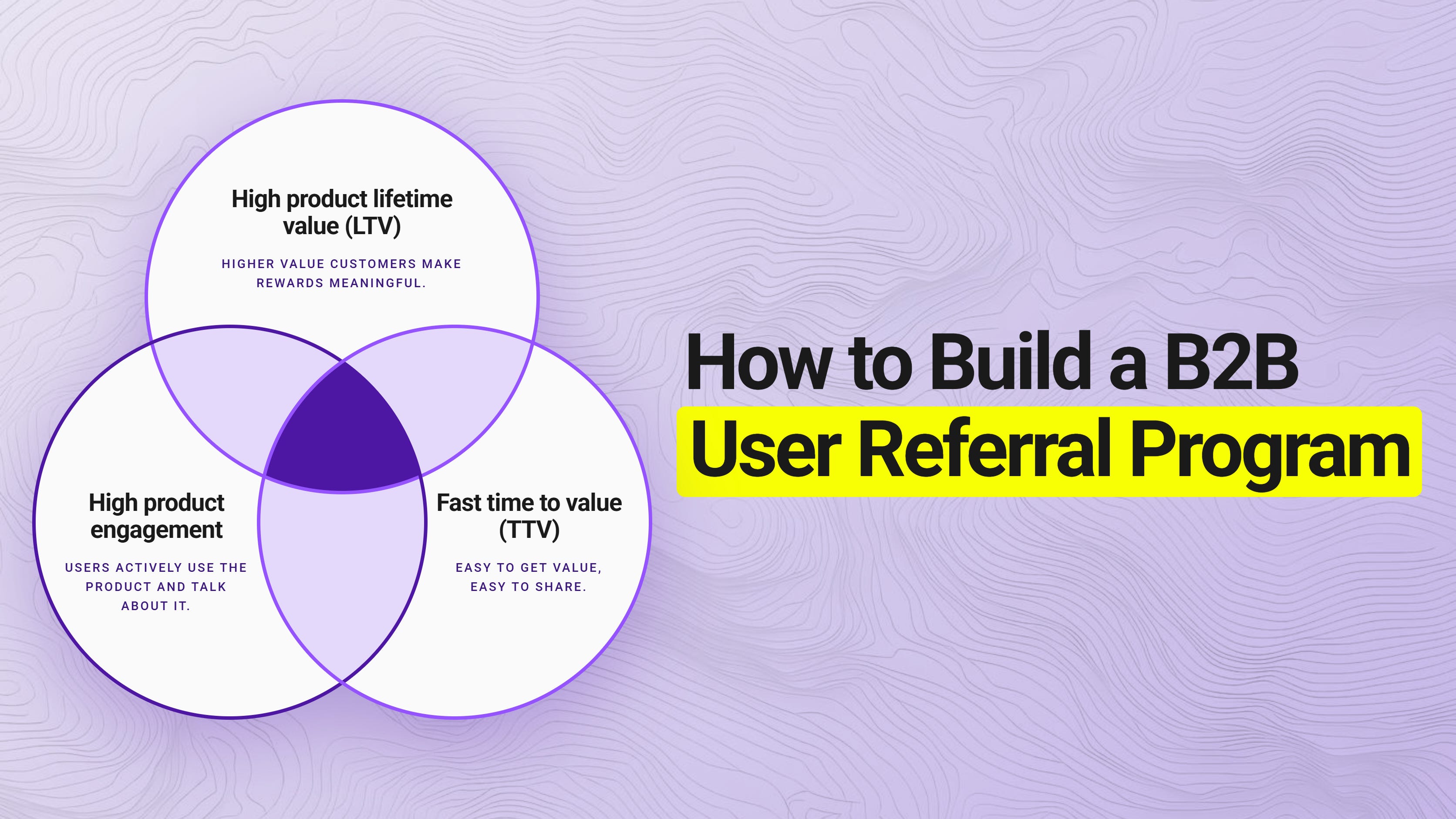
So the useful question is whether your product qualifies. Three conditions decide it:
High product lifetime value.
Fast time to value.
High product engagement.
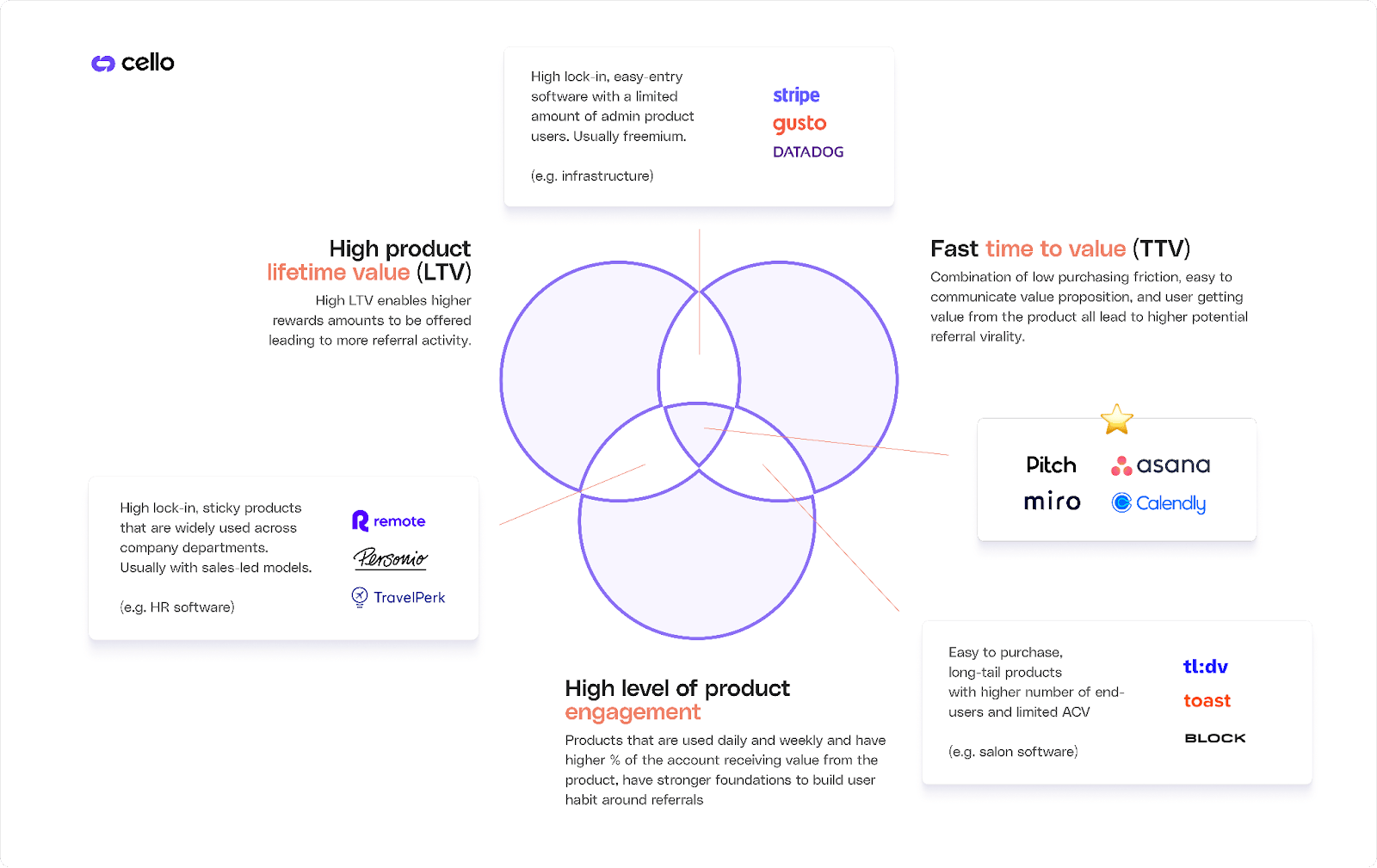
Top performers clear all three. Two is usually enough. Outside those ranges is what the chapter calls the referral program death valley. The chapter is specific about what that means: fewer than roughly 500 monthly active users, an ACV low enough that a meaningful reward eats the margin, and a sales cycle long enough that the referrer waits months to see anything.
Launch there and the program doesn’t die. It limps. A few signups a year, a steady drain on engineering and marketing time, and no way to tell whether the channel would ever have worked.
And here are the two words. Kyle’s chapter doesn’t soften them:
“The honest answer in that case is not yet.”
The fix is in the product, not the program. Get more users active, cut time to value, or raise ACV, then come back when two of the three hold. If you need reach before that work is done, affiliates are the program that runs without an engaged user base.
Why it’s worth earning:
Referred users stick. Wharton research (Schmitt, Skiera and Van den Bulte, Journal of Marketing, 2011) found referred users churn 18% less and carry a 16% higher lifetime value. The per-head margin advantage fades by around month 29, so the durable win is retention.
You’re undercounting it already. A growing share of B2B recommendations happens in Slack groups, LinkedIn DMs and WhatsApp threads. The chapter calls this dark social. Standard analytics can’t see it, so most GTM models undervalue the channel.
The reward has to matter to a person. Discounts and in-product credit are weak when the company foots the bill. And your users need a network worth sharing: the pool of people who want an AI writing tool is far larger than the pool who need an HR system.
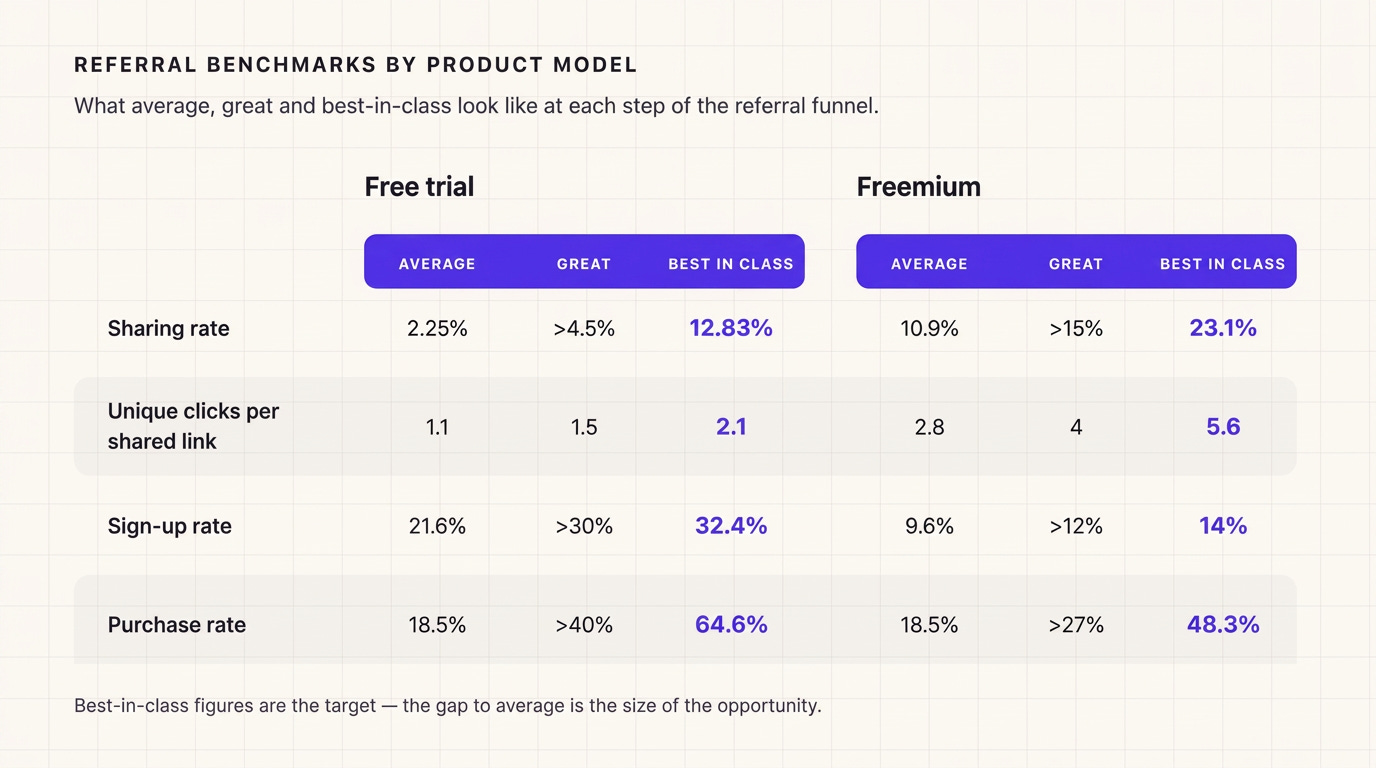
What good looks like: tl;dv got a first version live within a day, on about 4 hours of developer time. On Cello’s platform data (n = 10 million B2B SaaS referral users), best-in-class programs convert 64.6% of referred visits to purchases on free trial products and 48.3% on freemium.
The metric to plan against is your word-of-mouth coefficient: how many new users each existing user brings in organically. At 1 or above, growth compounds without spend. Most B2B products sit well below 1, so the realistic goal is raising it. The Referral ROI Calculator in the Atlas resources sizes it from your access model, ACV and MAUs before you commit anything.
3. The build, once you clear the test
Here are five build steps from Stefan Bader that will help you avoid common failure points and launch a high-performing referral program:
Put it inside the product. The referral flow and the reward tracking both live in the product, next to the features people already use. Ask for identity and payout details only after the user has earned something. Asking upfront cuts participation.
Work backward from ACV to the reward. Direct cash beats discounts, because nobody is motivated by savings on a product their company pays for. Set a reward cap (a one-off for a qualified signup or demo, plus a percentage of the referred customer’s revenue) and lead with the cap when you market it. “Earn up to $3,000 per referred user” is the version people share. Cello’s own survey of 100 SaaS users found most B2B programs under-reward: even for low-ACV tools, people expected $105 to $345 per referral.
Do the sharing work for them. Swipe copy, a landing page with an FAQ, and examples of what a good referral message looks like. Gusto scans contacts and suggests who to refer based on email domain.
Launch it more than once. Staged rollout to power users first, then email, in-app, social and a link from the login page. After that, nudge at the moments people are primed: NPS of 9 or above, a closed support ticket, a hit milestone, a monthly reminder.
Don’t run payouts from a spreadsheet. KYC falls on you even with a compliant payment gateway, tax treatment differs by country, and in the US you owe a year-end tax form to any non-corporate referrer who earns $2,000 or more.
What both chapters have in common
Put them side by side and they make one argument from two directions. Elena’s channels only work if the product is worth talking about. Stefan’s three conditions are the same idea, measured. A referral program removes friction from advocacy that already exists.
Where I stand: if two of Stefan’s three conditions hold for you, build it now and keep the first version small. tl;dv’s 4 hours is the right ambition for version 1. If they don’t hold, spend the quarter on time to value instead. Full disclosure: Cello sells referral software, and I’d still rather you launch nothing than launch into the death valley and conclude referrals don’t work.
The full Atlas goes deeper on each of those steps across 7 more chapters, plus affiliate and influencer programs, the reference tables and the calculators.
It’s free, ungated, and you can download the whole thing as one PDF.
Which products do you trust, and did a person send you to them? And if you just ran the fit test in your head, which of the three conditions are you missing?
Talk soon,
Maja
P.S. Kyle Poyar and I are organizing a BIG State of B2B GTM Summit on October 14th. We'll present the results of our survey - which tactics, channels and tools are hottest for 2027, and what’s working best in 2026. We'll have 12 amazing speakers (big reveal next week - some of the hottest names in GTM).
All we’re missing is you. Join us for a free community event: Save your seat here.

✅ Need ready-to-use GTM assets and AI prompts? Get the 100-Step GTM Checklist with proven website templates, sales decks, landing pages, outbound sequences, LinkedIn post frameworks, email sequences, and 20+ workshops you can immediately run with your team.
📘 New to GTM? Learn fundamentals. Get my best-selling GTM Strategist book that helped 9,500+ companies to go to market with confidence - frameworks and online course included.
📈 My latest course: AI-Powered LinkedIn Growth System teaches the exact system I use to generate 7M+ impressions a year and 70% of my B2B pipeline.
🏅 Are you in charge of GTM and responsible for leading others? Grab the GTM Masterclass (6 hours of training, end-to-end GTM explained on examples, guided workshops) to get your team up and running in no time.
🤝 Want to work together? ⏩ Check out the options and let me know how we can join forces.