



The GTM10 Awards recognize the best go-to-market leaders in software across Growth, Marketing, Sales, Customer, and Partnerships. Powered by Cello and Lightspeed Venture Partners, with a jury featuring leaders from Zapier, Vercel, Airtable, Sequoia, a16z, and Stripe.
I’m glad to be on the jury this year for the Growth category.
50 winners get announced starting June 1 and featured on the iconic NASDAQ billboard in NYC.
Know a GTM leader who deserves recognition? Nominate them. Think you qualify? Claim your own nomination.
Nominations close May 5.
Dear GTM Strategist,
You know those outbound messages that make you want to throw your laptop out the window?
“Congrats on your new role!”
“I noticed your company is growing.”
“Company X deserves more SEO backlinks.”
- followed by a pitch for something you’ll never buy from someone who clearly knows nothing about you.
Here’s why it won’t end anytime soon: mass outbound “spray and pray” tools - now powered by AI - generously include such templates, and sales noobs and lazy sellers eat them up.
But if you send out 500 emails and book zero meetings, treat that as a sign that something needs to change.
Claude Code and Jordan Crawford to the rescue. Jordan is the founder of Blueprint GTM, where he helps teams learn and work with Claude Code, and a co-creator of Cannonball GTM - a Substack that I cannot recommend enough!
And he’s here to help
Instead of sending out 500 “congrats on your recent promotion to the VP of strategy at X…”, you will learn how to craft an email that intelligent life will actually reply to because it talks to their pain points and adds value.
So in today’s post, I want to share what we learned and share more tips on how you can apply it to build better campaigns.
What you’ll learn:
Context engineering - how to load AI with deep, specific knowledge about your ICP, market, and to find data sources to get 10x leverage.
How to set up Claude Code as your GTM operating system with compounding context, persistent memory, and the ability to query databases, write scripts, and deploy sub-agents.
Why permissionless value prop (PVP) - a message that is independently valuable to the recipient, whether they buy from you or not - beats cringe personalization.
Why Most AI-Generated Outreach Fails
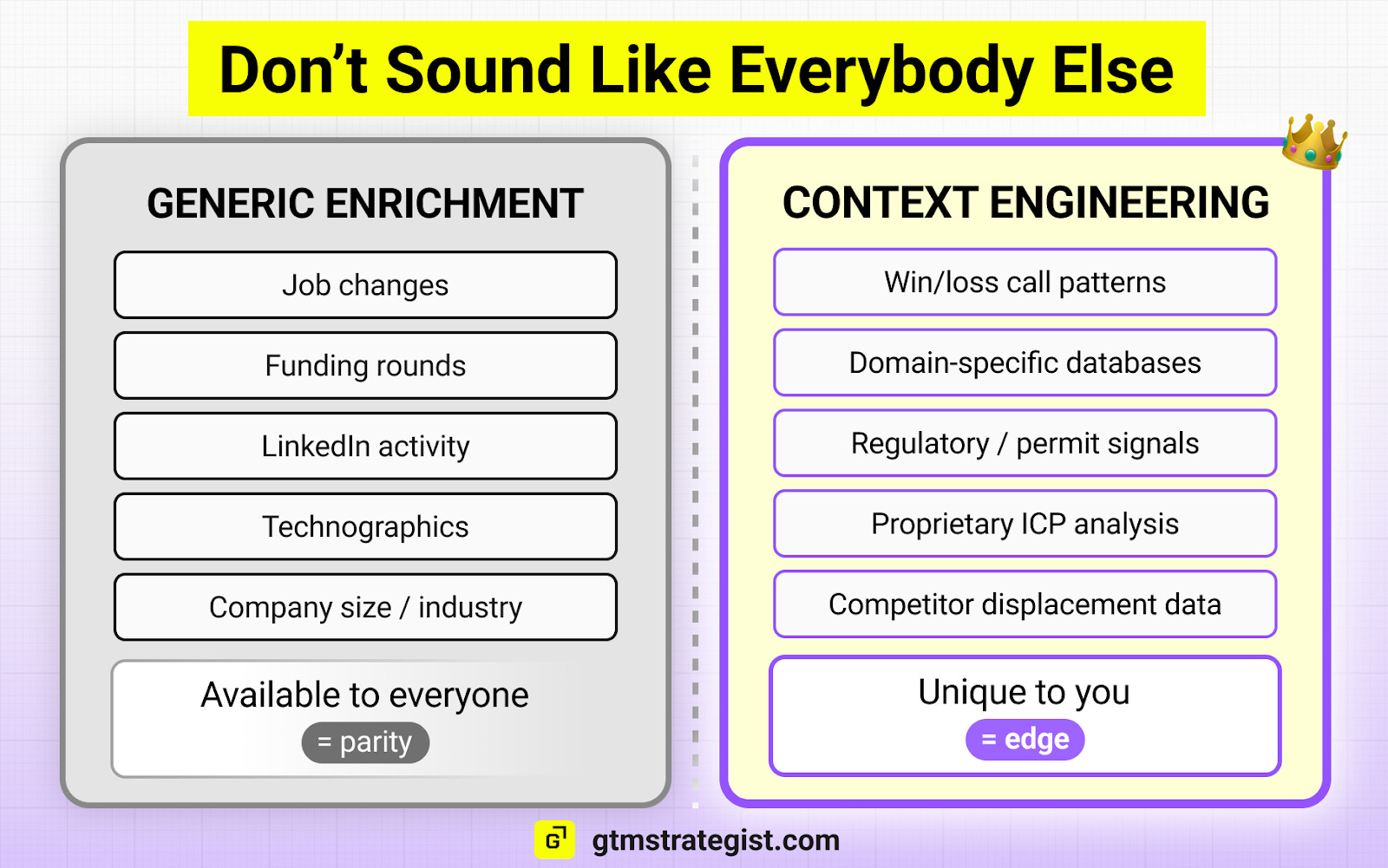
Problem: Everybody has access to the exact same signals and tools - and those are not the best.
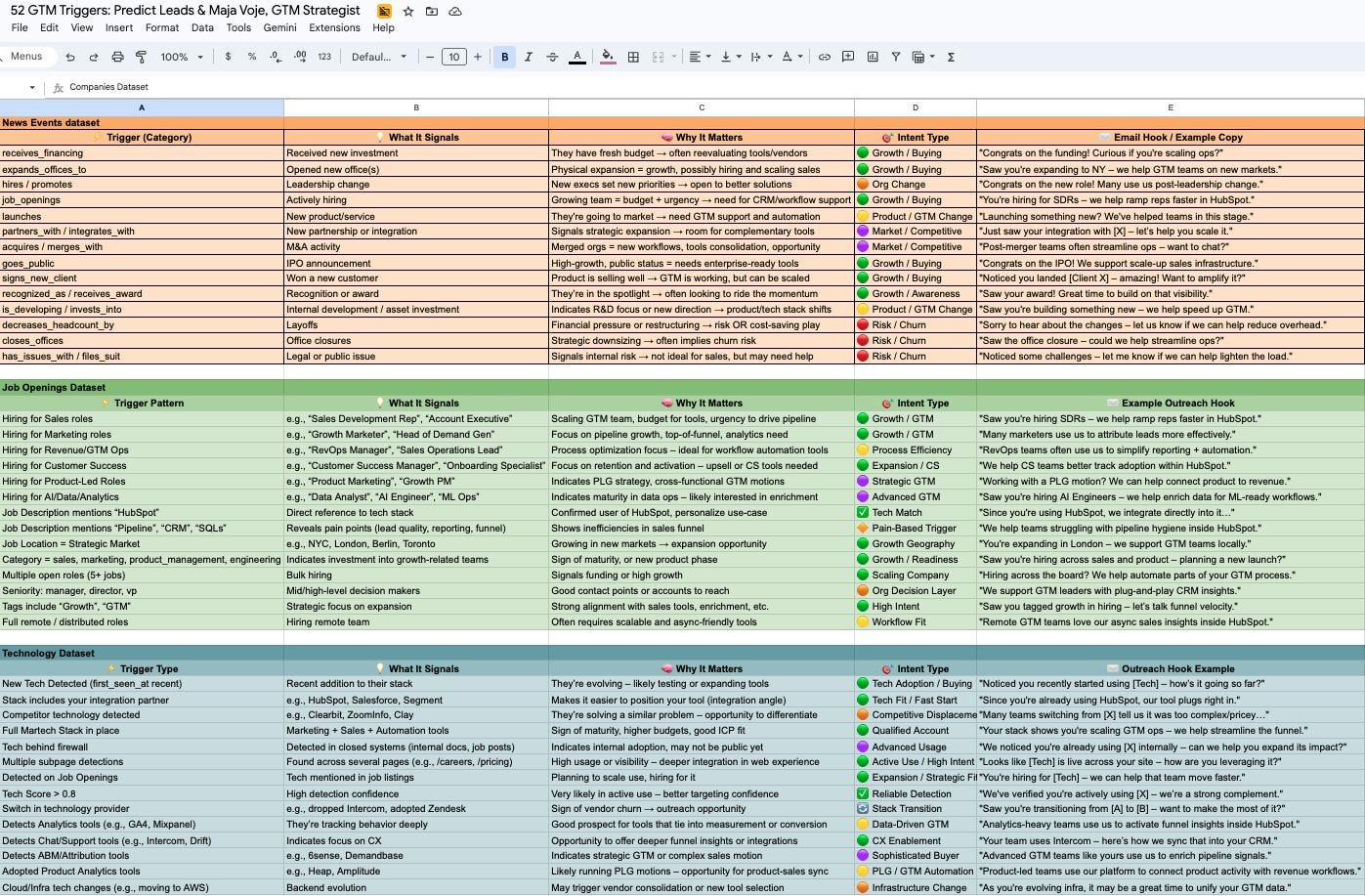
Job changes, funding rounds, LinkedIn activity, technographics - you can get all of this from a dozen enrichment tools. And so can every one of your competitors.
When everyone enriches from the same signal pool, the “personalization” is identical across the board. You’re all writing the same email to the same person with the same data points.
Solution: Take a step back - deep dive into your ICP, buying committee, and fall in love with their problems
The generic enrichment layer has become the baseline. The teams pulling ahead are the ones who layer proprietary context on top: their own win/loss patterns, domain-specific data sources, industry signals that no enrichment vendor packages out of the box.
As you build your proprietary intelligence, you unlock first degree signals.
Jordan Crawford put it perfectly: “We are currently limited not by our tools anymore, but by our imagination. What’s the greatest thing you can imagine with the best possible data?”
Most teams use AI to write faster. Very few use it to think deeper about what would actually be valuable to say.
The question worth asking: what is the most valuable thing I could say to this person, and what data would I need to say it?
Often in GTM, you have one shot to do it - so you better do it right
That’s a fundamentally different starting point - and it leads to fundamentally different messages. And it motivates you to put in more thought and love instead of thinking that changing names and companies is the level of personalization you need.
Context Engineering: The Skill That Separates 10x From 1x
Context engineering goes way beyond prompt engineering. A clever prompt still works with whatever the model already knows. Context engineering is about loading an AI system with enough specific knowledge - ICP docs, call recordings, competitive intel, product data, market signals, database access - that it stops guessing and starts reasoning like your best rep.
Why Claude Code specifically? Because, unlike a regular Claude or ChatGPT chat, Claude Code offers compounding context:
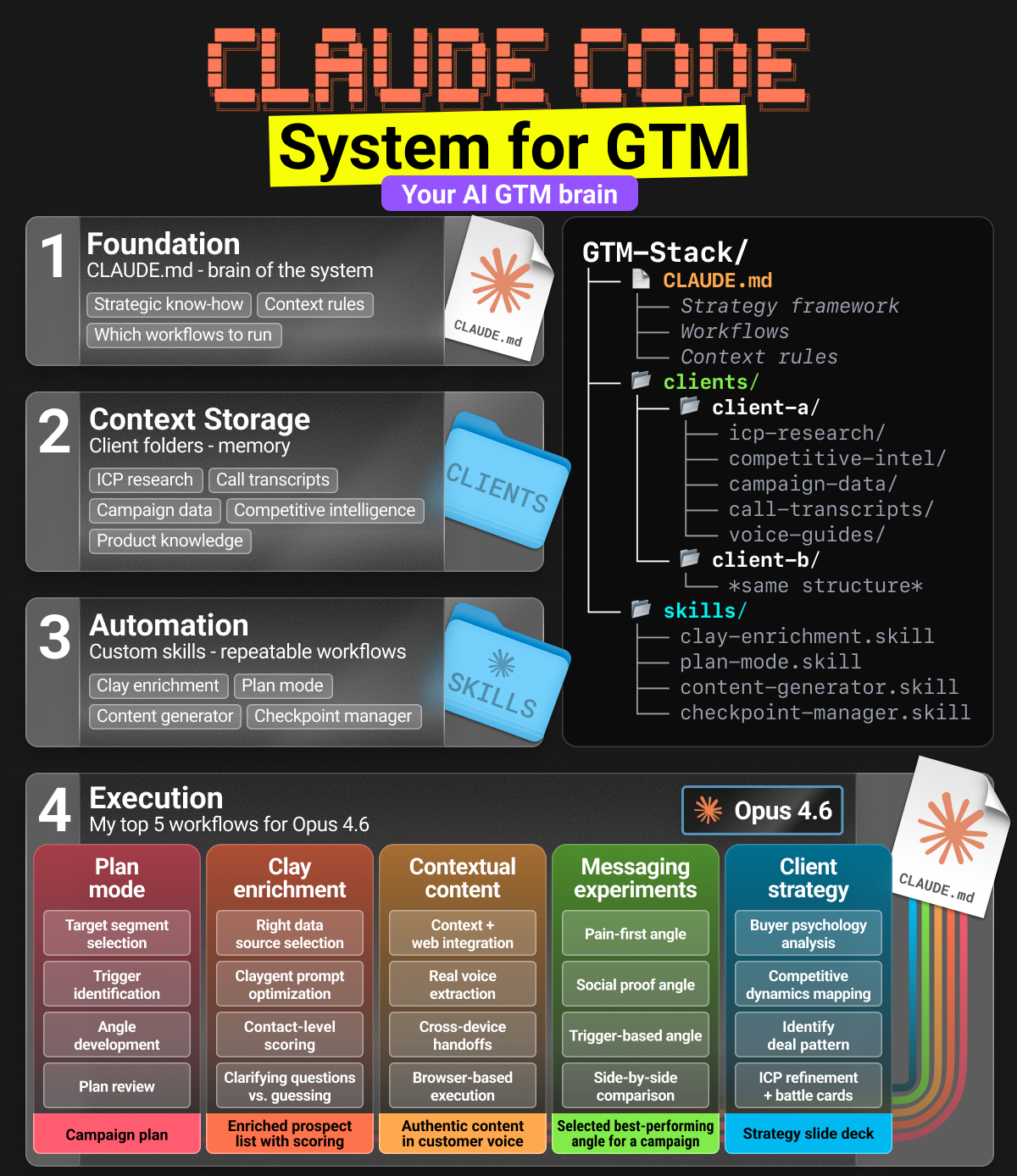
Persistent memory. It remembers what you’re working on across sessions. Each client gets a folder with accumulated knowledge that builds over time.
Skills. These MD files are reusable workflow instructions - think of them as playbooks that teach Claude Code how to perform a specific set of tasks - like validating a LinkedIn profile, querying a specific database, or structuring a particular type of analysis. (Here’s Anthropic’s official guide for building Skills).
Sub-agents. Claude Code can spawn specialized agents for subtasks without polluting the main context. Think of it like a manager delegating to employees - the manager doesn’t need to know every detail of how the floor got swept, just that it’s done.
Script execution and API calls. It can write and run actual code, query databases, call APIs and write to other systems, and save results locally. Think of it as an operating system, not a chatbot.
The first campaign is the heavy lift. Every one after that builds on the context you’ve already loaded - so the intelligence compounds while the time to deploy drops.
The setup on your computer should be simple: one folder per project or client. Inside that folder lives everything Claude Code needs - the company context, the ICP definition, access to relevant data sources. When you open that folder, Claude Code already knows what it’s working on and it doesn’t mix it with the context and memory from other projects.
“The process matters more than the prompts. Long prompts are the past. What matters is your goal, the order of operations, and the context you load before you start building.”
Example: A Campaign for GAF That You’d Actually Send
To demonstrate what building a GTM campaign with Claude Code looks like, Jordan picked a deliberately unexpected company: GAF, one of the largest roofing manufacturers in the world. GAF sells roofing tile through independent contractors. About as far from the B2B SaaS bubble as you can get.
Why? Because great outbound isn’t limited to B2B SaaS. If you can find discoverable pain and public data, you can build a killer campaign for anyone.
Here’s what happened in roughly 30 minutes:
Step 1: Context loading. Jordan told Claude Code to research GAF’s website and understand the business - who their customers are, how they tier their contractors, what their reward programs look like. No manual briefing doc. Just: “Go understand this company.”
Claude Code ran web searches, built a markdown (MD) file summarizing GAF’s business model, contractor ecosystem, and competitive landscape - and saved it as persistent context.
Because context windows in AI tools are limited (and can fill fast with data-intensive research), storing relevant data in MD files ensures that Claude can always reference key information while you clear the context window for a new task. You can even ask Claude to save important info to its memory.
Step 2: The plan. This is where it got interesting. Think of where you could find relevant, unique data that is not sourced in standard enrichment tools and can give your messages an edge - like public databases or industry associations. For the GAF case, Jordan used the Shovels database, which contains 185+ million building permits. He told Claude Code: figure out what intelligence in this data would be incredibly valuable to GAF.
That’s the magic of Claude: you can tell it your goal and it will find the best way to do it.
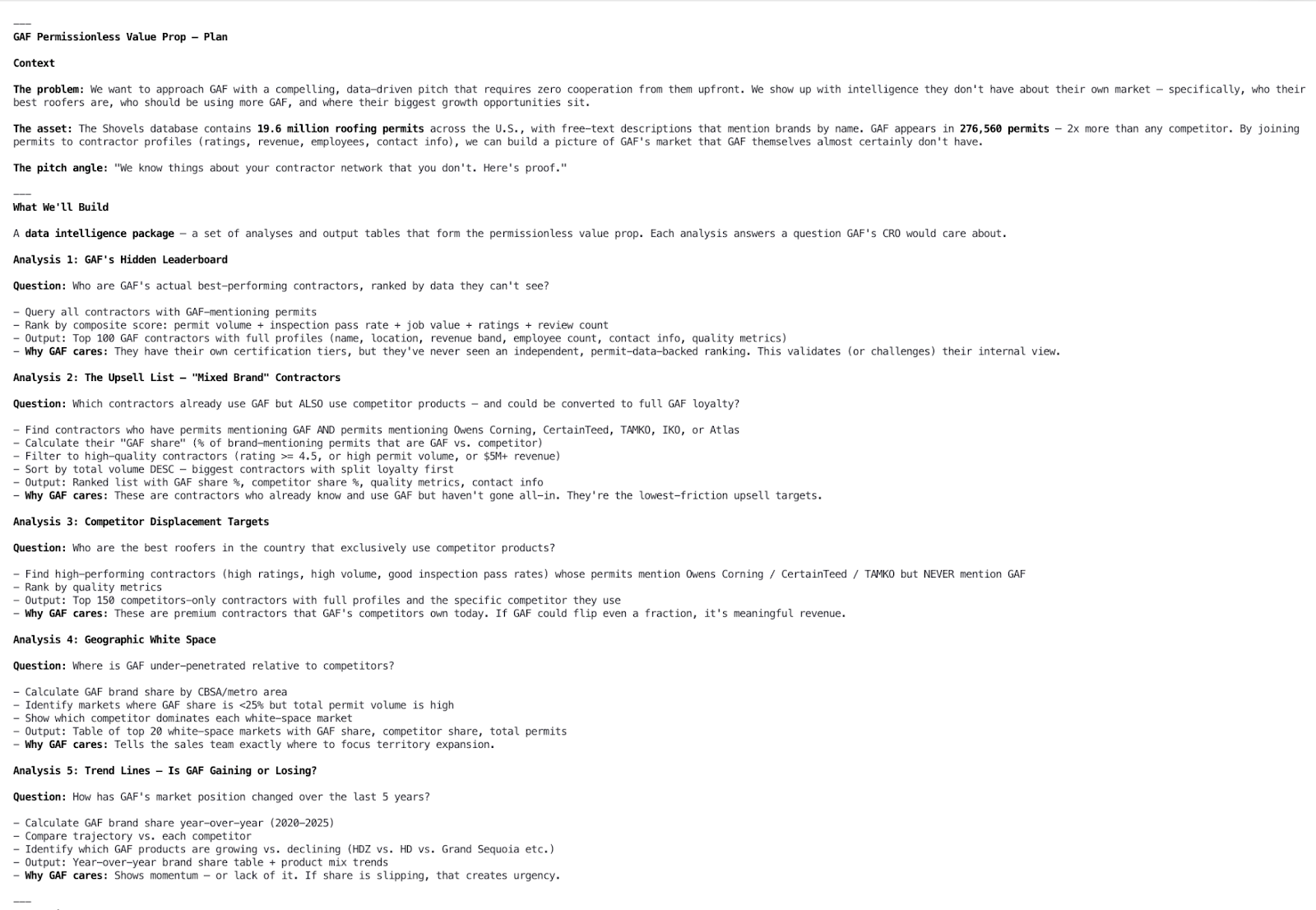
Claude Code found 19.6 million roofing permits in the Shovels database, with 276,560 permits mentioning GAF. Based on this, it identified the play on its own: upsell targets. Contractors who already use some GAF products but give 60–90% of their business to competitors like Owens Corning and CertainTeed. Claude Code even identified GAF’s competitors from the permit data without being told who they were.
Still, use your brain. You should be the final judge of the plan and ruthlessly tell Claude where it went wrong. In our example, the pitch it initially suggested was wrong and Jordan told it how to correct it.
Step 3: Data queries and message generation. Claude Code queried the database multiple ways - loyalty splits, geographic white space, competitive displacement targets, brand share trends over time. It found 154 high-quality contractors that represent massive upsell opportunities.
Then it identified the right decision-makers and drafted messages with actual data:
“There are 200+ roofing contractors who’ve used GAF in at least 10% of their permitted jobs, but they’re giving 6y just haven’t committed. Here are the top five - with their revenue, Google reviews, total permits, and exact brand mix.”
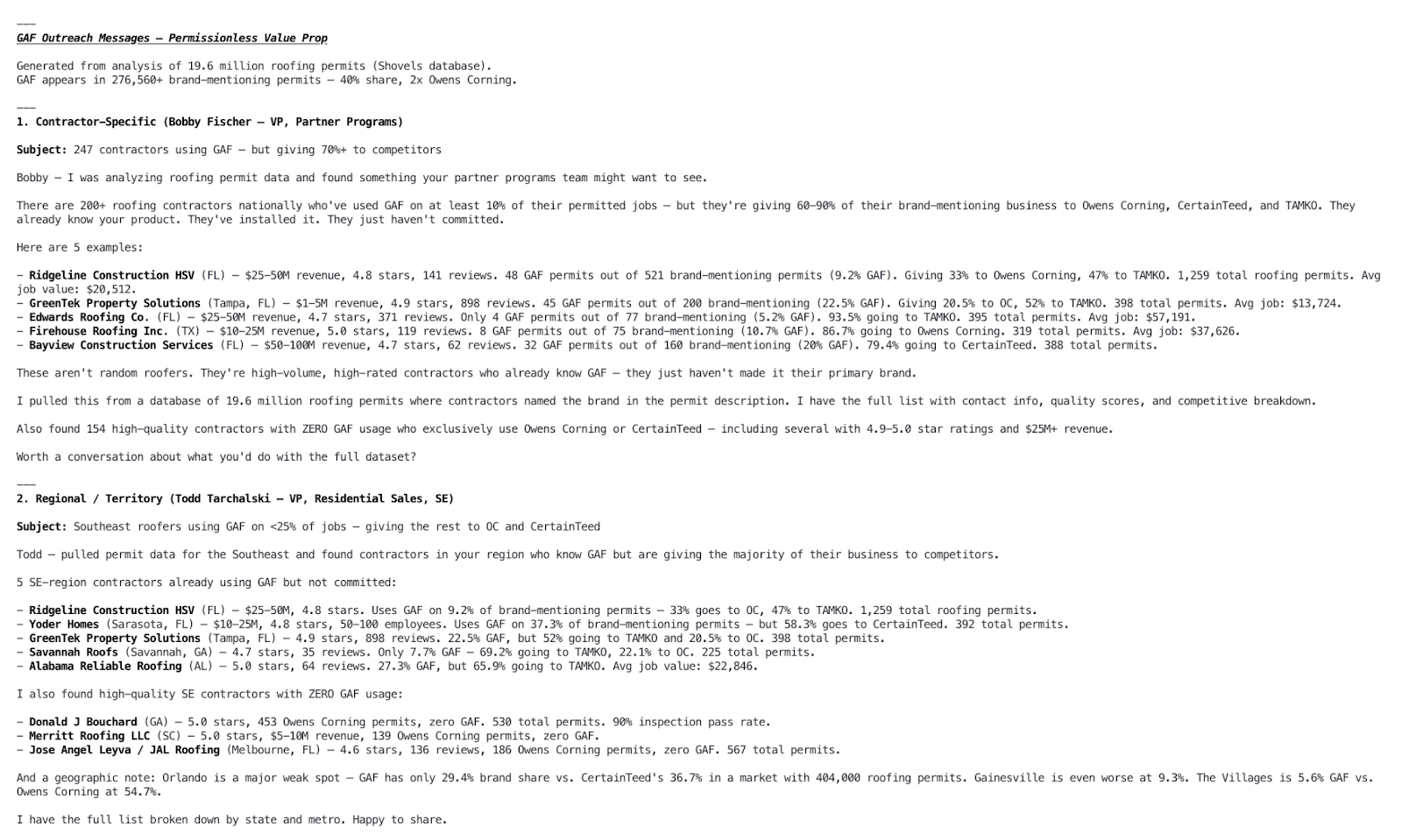
That’s market intelligence disguised as outreach. And it compels a response because it’s independently valuable - the recipient benefits from reading it whether they take a meeting or not.
Jordan calls this a Permissionless Value Prop (PVP) - a message so valuable that prospects would literally pay to receive it. You’re giving away an insight, and the meeting is just a natural next step. For this, you don’t need a large database of potential leads - but a highly focused one.
“I’m giving you valuable data on your market. That’s worth a response. Nobody ever called market intelligence ‘creepy.’”
👉 Watch the full livestream recording to see how Jordan Crawford built this whole campaign live.
The Playbook: How to Build Your Own Context-Engineered Campaigns
Ready to try this yourself? Here’s the framework Jordan uses with every client.
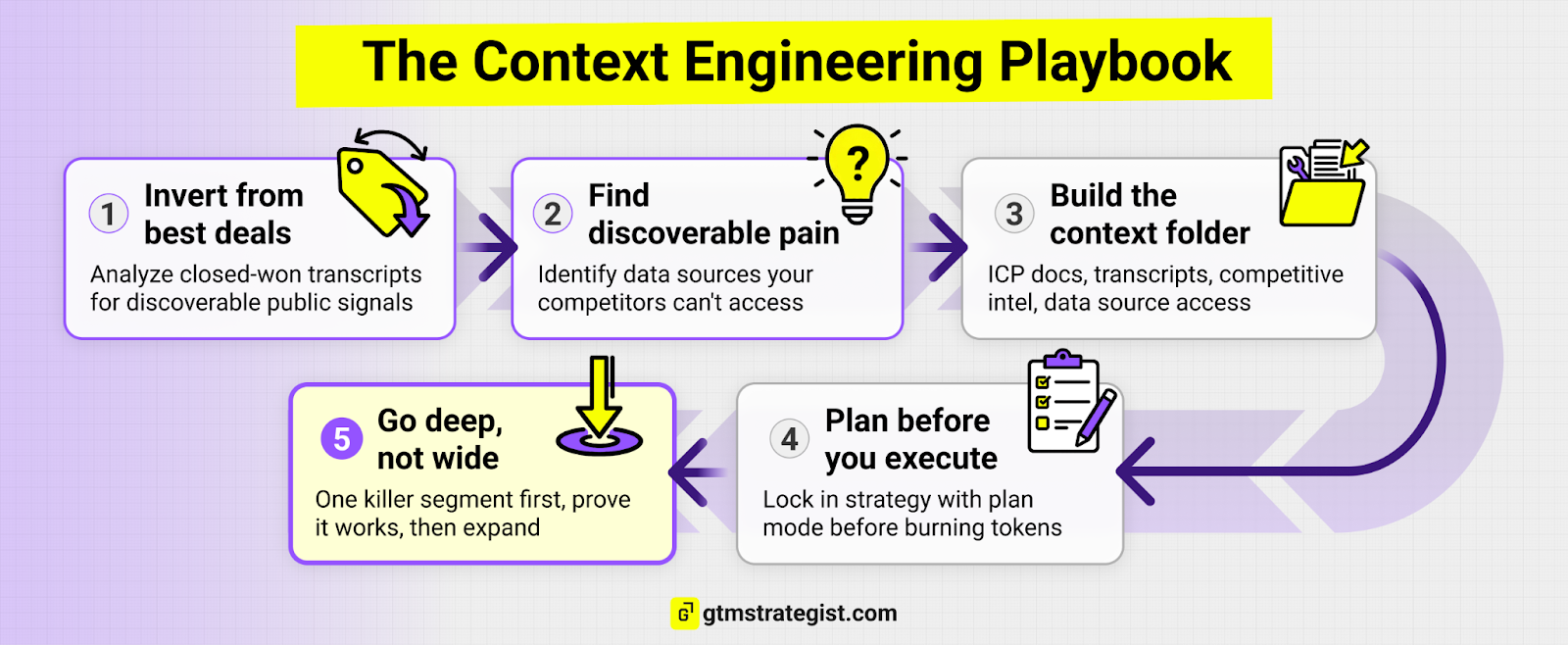
1. Invert from your best deals
This is Charlie Munger’s advice applied to GTM. Download all your call recordings (or ask Claude Code to create a script to get them for you). Deploy Claude Code against every transcript and ask: what likely made this person convert? Compare closed-won against closed-lost.
Then ask the harder question: what public data could have predicted this? For each conversion signal, search for publicly discoverable evidence. If your best customers tend to be companies with outdated tech stacks going through rapid hiring - can you find that signal before they ever hit your website?
2. Find discoverable pain
Not every company is a good fit for this approach. You need two things: a differentiated product and high public data availability. Regulated industries - healthcare, construction, finance - have a treasure trove of public filings, permits, compliance data, and regulatory signals.
But even in lower-data environments, you can often find something - job postings, technology stack signals, press releases, SEC filings.
3. Build the context folder
This is the “context engineering” part. Before Claude Code writes a single message, load it with everything your best rep knows:
ICP documentation
Call transcripts and win/loss analysis
Competitive intelligence
Product positioning and objection handling
Access to relevant data sources (Exa.ai, Blitz API, OpenWeb Ninja, Apify, or whatever fits your market)
4. Plan before you execute
Jordan uses Claude Code’s plan mode religiously. This will get Claude to draft the strategy right before burning tokens on heavy lifting. What data do you need? How should you query it? What’s the angle? The plan will be saved as an MD file, so Claude can reference it even as its memory resets across tasks - so it has to be airtight.
5. Go deep, not wide
Jordan’s “drill, not peanut butter” analogy is the best mental model here. Don’t spread thin across thousands of accounts. Pick a specific segment where you have deep data and a strong value prop. Build one killer campaign. Prove it works. Then expand.
“Scaling this to a thousand companies without doing the hard thinking first is like pointing a thousand cars off a cliff. The best campaigns start narrow and go deep.”
But I’m Not Technical - Can I Still Do This?
If you can write a Google Doc, you can use Claude Code.
The terminal might seem scary at first glance, but you will quickly get used to it. There are just a few commands you actually need:
cd + drag and drop a folder (to navigate to your project)
claude (to start Claude Code)
shift + tab (to switch to plan mode)
clear (to reset the context window)
ctrl + V (to paste - note that it differs from cmd + V even on macOS)
That’s it. Everything else, you just write (or even talk - speech-to-text tools like Wispr Flow can be a huge time-saver). You describe what you want to do. Claude Code figures out how. If you don’t know how to do anything in the terminal, just ask Claude in chat and it will guide you through every step.
The Bigger Picture
Any SDR tool can send a thousand emails in an hour. The real unlock is deep research that is scalable.
The analysis Jordan did live - querying building permits, identifying competitor usage patterns, finding geographic white space, building data-rich messages for specific decision-makers - would have taken a research team weeks. Claude Code did it in 30 minutes.
The teams that win in 2026 won’t be the ones sending the most emails. They’ll be the ones sending messages that make prospects think: “How do they know this about my market?”
That’s the bar now. Context engineering gets you there.
Here are your next steps:
Open Claude Code this week and start with one thing: load it with context about your ICP. Upload your best call transcripts. Ask it to identify what made your best customers convert. Work backward from there.
Grab my 12 Claude Code skills for GTM. I turned my entire GTM methodology, tested with 1,000+ companies, into a set of Claude Code skills that cover everything from competitor analysis and positioning to pricing, launch assets, outbound, and ABM. 100+ tasks across 12 phases, where each phase builds on the last. Add them to Claude Code or Cowork, ask for what you need, and the right skill activates with tailored output based on your product context. Get them here for free on GitHub.
The AI model is table stakes - everyone has access to the same LLMs. The context you feed it is your moat. Start building it.
Claude Has Taken Over GTM: Now Tell Us How You’re Actually Using It
Q1 2026 made one thing crystal clear: Claude didn’t just enter the GTM stack. It started eating it.
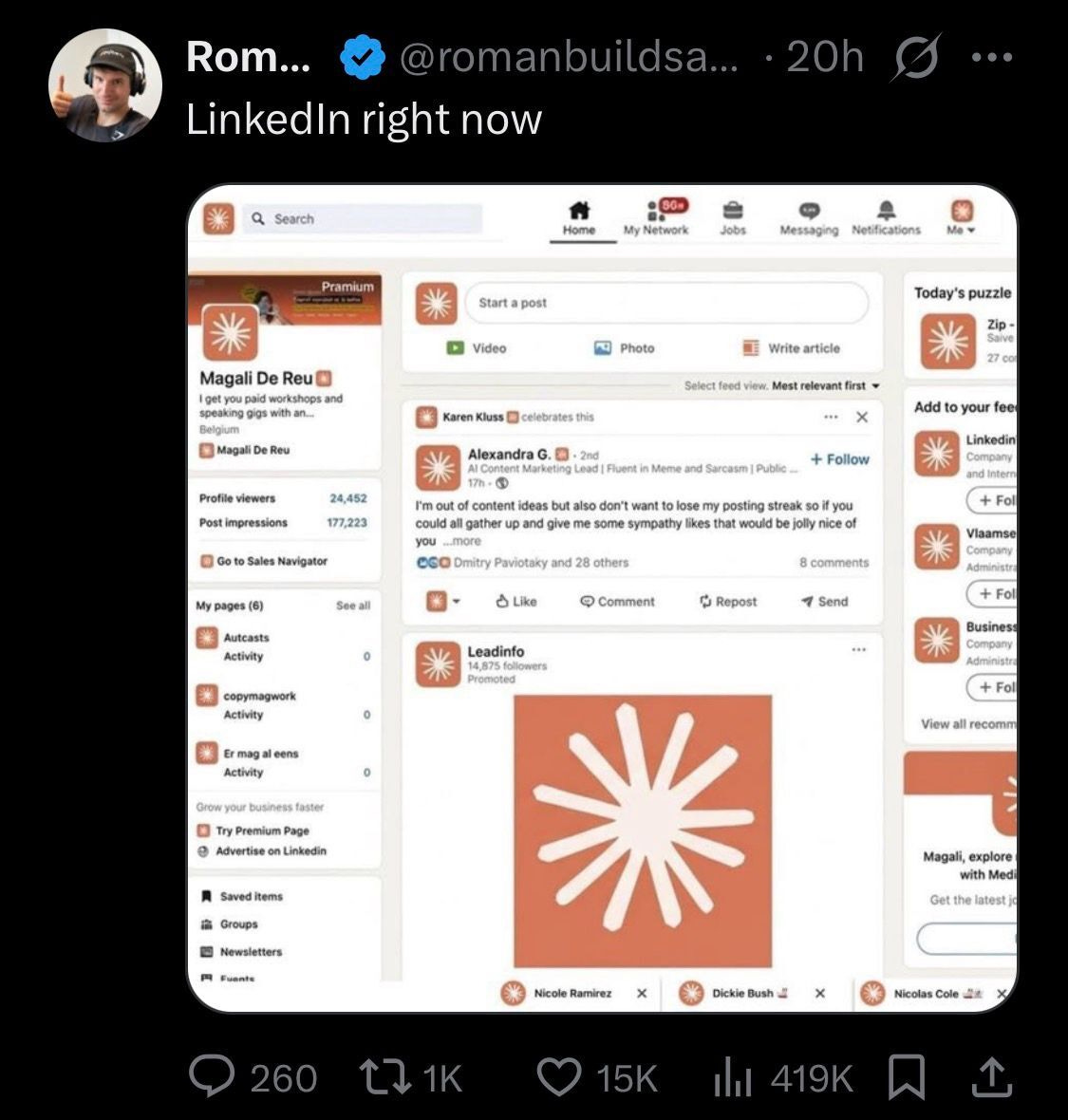
Teams are using it to scrape niche directories for non-obvious prospect lists, build trigger-based outbound sequences, create programmatic AEO pages at scale, reverse-engineer competitor ads, build custom lead scoring logic, and clean up CRMs without touching a single line of code. And that’s just what we already know about.
Kyle Poyar (Growth Unhinged, 80K subscribers) and I are running the first-ever Claude Code Pulse Survey to map what GTM teams are actually building with Claude right now, in production, not what looks good in a YouTube demo.
This is what you get for 5 minutes of your time:
Early access to the full results before anyone else, including real workflows and setups from practitioners across outbound, content, CRM, growth, and sales
A chance to be featured as a guest contributor in Growth Unhinged or GTM Strategist. If your setup is interesting, we want to write about it.
We’re going all-in on Claude use cases and workflows in Q2, and we need your help figuring out what’s already working (and what’s still broken) so we can curate content that brings tangible value to your business.
It takes under 5 minutes. I did it in 3 minutes. Can you beat me?

✅ Need ready-to-use GTM assets and AI prompts? Get the 100-Step GTM Checklist with proven website templates, sales decks, landing pages, outbound sequences, LinkedIn post frameworks, email sequences, and 20+ workshops you can immediately run with your team.
📘 New to GTM? Learn fundamentals. Get my best-selling GTM Strategist book that helped 9,500+ companies to go to market with confidence - frameworks and online course included.
📈 My latest course: AI-Powered LinkedIn Growth System teaches the exact system I use to generate 7M+ impressions a year and 70% of my B2B pipeline.
🏅 Are you in charge of GTM and responsible for leading others? Grab the GTM Masterclass (6 hours of training, end-to-end GTM explained on examples, guided workshops) to get your team up and running in no time.
🤝 Want to work together? ⏩ Check out the options and let me know how we can join forces.