


Presenting partner: Viktor
Viktor is an AI employee that lives in Slack and Microsoft Teams. Connects to 3,200+ tools. Does the work, not just answers questions. Hire Viktor for your team.

GTM partners:

Ahrefs Brand Radar - Make AI recommend your brand.
Clay - Build systems to grow revenue.
FullEnrich - 80+% find rate for emails and phone numbers.
HubSpot for Startups - The GTM engine that grows with you. See if you qualify for 90% off.
Miro - The collaborative workspace where GTM teams and agents converge to build together.
Ploy - The marketing platform that turns your website into a growth engine.
Primer - Target your ICP across LinkedIn, Meta, Google, Reddit, and more.
Dear GTM Strategist,
This week, I hung out with the Viktor team in Warsaw.
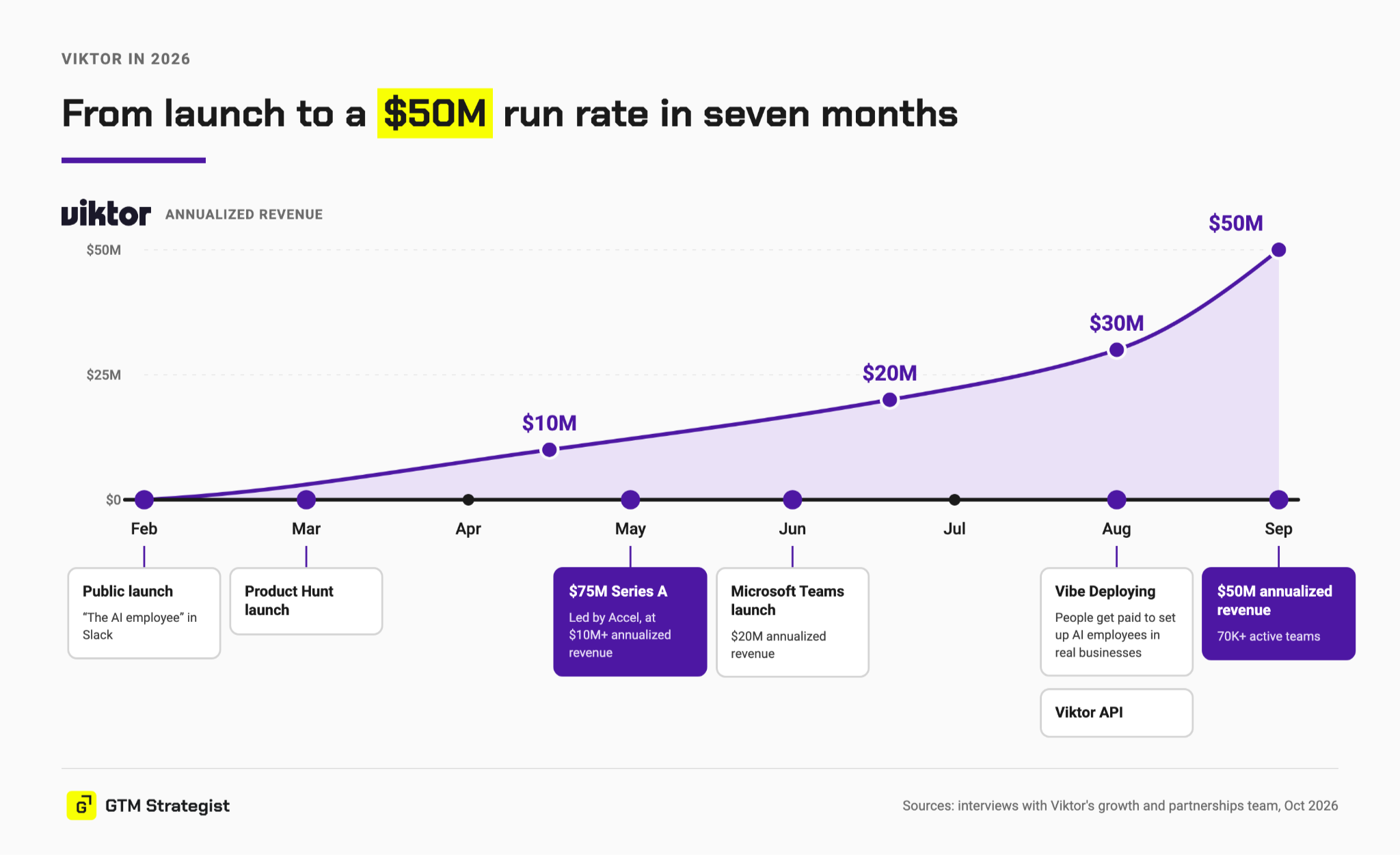
Viktor is an AI employee that lives in your team’s Slack or Teams and takes on real knowledge work: reports, ops, customer support, lead qualification, even building internal tools. And the traction data backs up its bold promise. In less than seven months since launch, Viktor raised a $75 million Series A, passed a $50 million run rate, and signed up 70,000+ teams.

In Q4, I’m on a mission to explore how AI-native companies run their go-to-market playbooks. A lot of us GTM folks are stuck sprinkling AI capabilities on top of how it “should” be done, SOPs we’ve used for years. This is an anti-pattern for unlocking AI’s full capabilities. While most of the industry is debating the best way to “keep the human in the loop,” AI-native companies are rewriting those SOPs and achieving great scalable traction surprisingly fast.
When I am in research mode, I go all in. We boarded a plane to spend a couple of hours with Viktor’s engineers, the co-founder Fryd Wiatrowski, and Nazar Mozgovoy, who leads partnerships at Viktor. Nazar showed me the most scalable partnership program I have seen so far, and I hope it wows and inspires you as much as it did me.
In this edition, I’ll take you behind the scenes:
The traction: how Viktor validated willingness to pay from day one, and why teams pay up to $60,000 a month for an AI employee
Viktor’s GTM motions: how a primarily self-serve PLG company acquires customers, using Viktor to make and test its own ads
The AI partnership OS: how they built a very scalable AI native OS to manage thousands of relationships without massive overhead - we’ll go through it layer by layer and share the results
What’s next: how the OS is scaling beyond creators (to implementation partners and affiliates)
Let’s unlock the secrets of an extremely scalable partnership program, straight from the playbook of an AI-native winner.
How Viktor got to a $50M+ run rate in under seven months
Their growth is impressive. But what blew me away is how differently Viktor thinks about pricing and positioning.
Most AI assistants launching right now optimize for adoption. They’re free or cheap, and they get judged on token consumption and a few simple automations.
Viktor did the opposite. As Matt Swulinski, Viktor’s Head of Growth, told me, monetization was part of product-market fit from the start. Even in the early days, customers paid $5,000 to $10,000+ a month, because Viktor replaced whole roles. Today, top teams of 20 to 30 people pay $20,000 to $30,000 a month, and one 80-person US marketing agency spends around $60,000 a month.
An SMB would never pay that much for another software tool. ROI has to be indisputable because these numbers compare better to payroll than software spend.
Positioning and pricing play a massive role in delivering that kind of value. Matt walked me through Viktor’s trust ladder: AI agent → AI coworker → AI teammate → AI employee. “Employee” changes the comparison the buyer makes: not a $100 subscription, but a $100,000 hire. While budgets for traditional SaaS tools shrink, I hope more companies will start pricing per outcome or use value pricing instead of a typical subscription model.
Deep dive into Viktor’s GTM motions and loops
Viktor’s GTM is primarily driven by a self-serve PLG motion. A decision-maker at a sub-100-person company sees an ad or a post, installs Viktor, and experiences the magic for themselves.
Three channels get 80%+ of the focus:
Meta ads are number one. The founders come from Meta, so pulling in ads early was natural. With Meta’s current algorithm, the creative is the targeting. The growth team runs on its own product. Viktor builds the team’s creative analytics (a 3D map of which ad sequences work, sized by spend), turns any creator story video into a landscape ad for YouTube and connected TV in about a minute, and maintains a single dashboard of every product event and ad dollar, extending it himself when a new channel launches. Production is no longer the bottleneck. With a high ARPU and a high CAC, Matt puts the limit at 50-60 net new ad concepts per channel per week. Beyond that, the testing budget gets too big.
Partnerships: Influencers, implementation partners and affiliates. Influencers are number two, mostly across LinkedIn, X, and YouTube. We’ll really dive into this one in the article.
Google Ads, across all placement types, are the third-biggest channel, with a heavy focus on YouTube ads that look and feel like organic content. The longer format gives Viktor room to show not just what it is, but how teams use it in real workflows, and to speak directly to the pain points many business owners face.
There’s also a sales-led motion (owned by a CRO), but it’s not a focus of this overview.
Why do creators matter so much in this process? A brand less than a year old can’t be the only voice saying, “look at us.” When buyers research a tool, they look outside the ads: reviews, how-to videos, real people showing real use cases. If they don’t find them, they choose the competitor that seems trustworthy. Creators provide educational content to their audiences and therefore have inherited trust for the campaign.
So the founders made an early bet: thought leadership is worth investing in, and they had to move fast. The target: 5,000 ambassadors talking about Viktor every month by the end of 2026.
But here is a twist: Viktor didn’t hire an influencer marketing team
They gave the goal to an ex BD & RevOps leader, not an influencer marketer
They gave the goal to Nazar, whose background is business development, corporate sales, and revenue operations. At his previous company, Nazar ran a team of 12. At Viktor, he started solo by design, building a database of roughly 10,000 creators. And no - he had never run an influencer program before. Now he is leading 3 partnership tracks: influencers, implementation specialists and affiliates.
Nazar’s first task, two days after joining, was to make Viktor’s Series A announcement go big in the US. He found a few creator marketplaces (Passionfroot among them) and agencies, and with Viktor’s help, he recruited around 200 creators practically overnight. That sprint taught him the lesson that shaped everything after:
Creator partnerships should be treated as business development: pipeline, sourcing, qualification, negotiation, and account management.
His mission now: building the world’s biggest partnership engine and driving scalable, predictable revenue growth.
The three layers of Viktor’s AI partnership OS
Viktor is connected to Nazar’s 12 mailboxes and runs up to 20 autonomous jobs for the program. I’ll walk you through the OS using influencers as the example, since that’s where Nazar built it first. I’d group it into three layers.
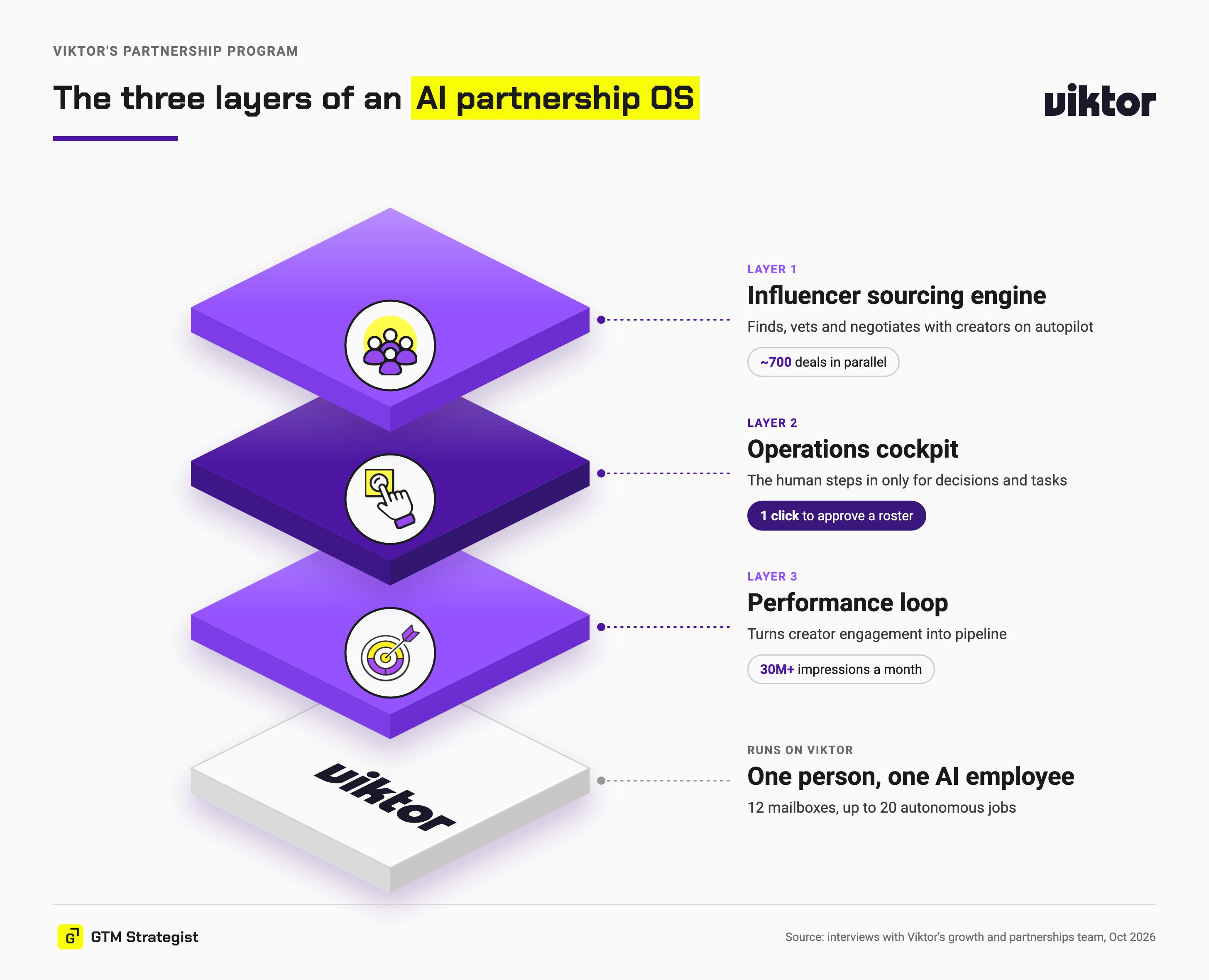
Layer 1: The influencer sourcing engine
Sourcing, in parallel. Nazar runs several pipelines at once:
Platforms. New creator marketplaces pop up every week. Nazar’s job is not to test them by hand but to connect them to Viktor (via MCP, API, or the desktop app), so Viktor can work across all of them in parallel. Side effect: many platforms are now shipping MCPs and APIs for the first time, because Viktor is becoming their customer.
Competitor ambassadors. Viktor maps who creates content for comparable tech companies, how often they post, which narratives and visuals they use, and what performs. Other brands’ ambassadors become his target list.
Agencies. In month one, Nazar reached out to 6,000 agencies across the US, UK, Canada, and Australia.
Vacancies. Viktor posts jobs through agencies to hire new creators.
Power users. Every Viktor user can post about their experience, receive credits in return and apply for Viktor ambassador program
Direct Search. Continuous search for ICP folks across LI and X that are not influencers-as-a-business and drafting them into the program.
Partners. Partners from other tracks can apply or be invited for Viktor ambassador program.
The math explains why this has to run on autopilot: roughly 30% of creators churn every month for various reasons (performance being one of them). Getting from 1,200 to 5,000 ambassadors means sourcing around 3,000 new creators a month.
Qualification: hunting engagement pods. Before Nazar signs anyone, Viktor runs a quality script: he pulls the creator’s placements from the last 60 days, splits them into organic and sponsored, and analyzes everyone who engaged. So far, he has found 54 engagement pods in his target verticals. The largest had about 900 accounts engaging with every placement from a group of creators. On the surface, a thriving post. In reality, irrelevant people pumping each other’s numbers.
Nazar’s rule: if more than 20% of a creator’s engagement is coordinated, they are disqualified. Viktor also checks whether profiles look real: a work history that adds up, not just a few big-tech logos and a “content creator” headline. I’ll be honest: I live in a pretty nice bubble of creators I know and trust. Seeing how inflated the market is outside was not pretty.
Negotiation: 12 plays, 700 deals in parallel. Negotiation runs on 12 structured plays, picked by creator tier and category. Each play defines the opening ask, the target terms, and how much room Viktor has to maneuver. An example play: ask for a 70% discount on a test placement, with the promise of a bigger deal for the next six months (say, one placement a week) if the test performs.
At the time of our conversation, around 700 deals were in negotiation at once. Viktor pulls Nazar in only for defined cases: when a creator wants to talk to him directly, wants to hear the company story, or asks for something unusual.
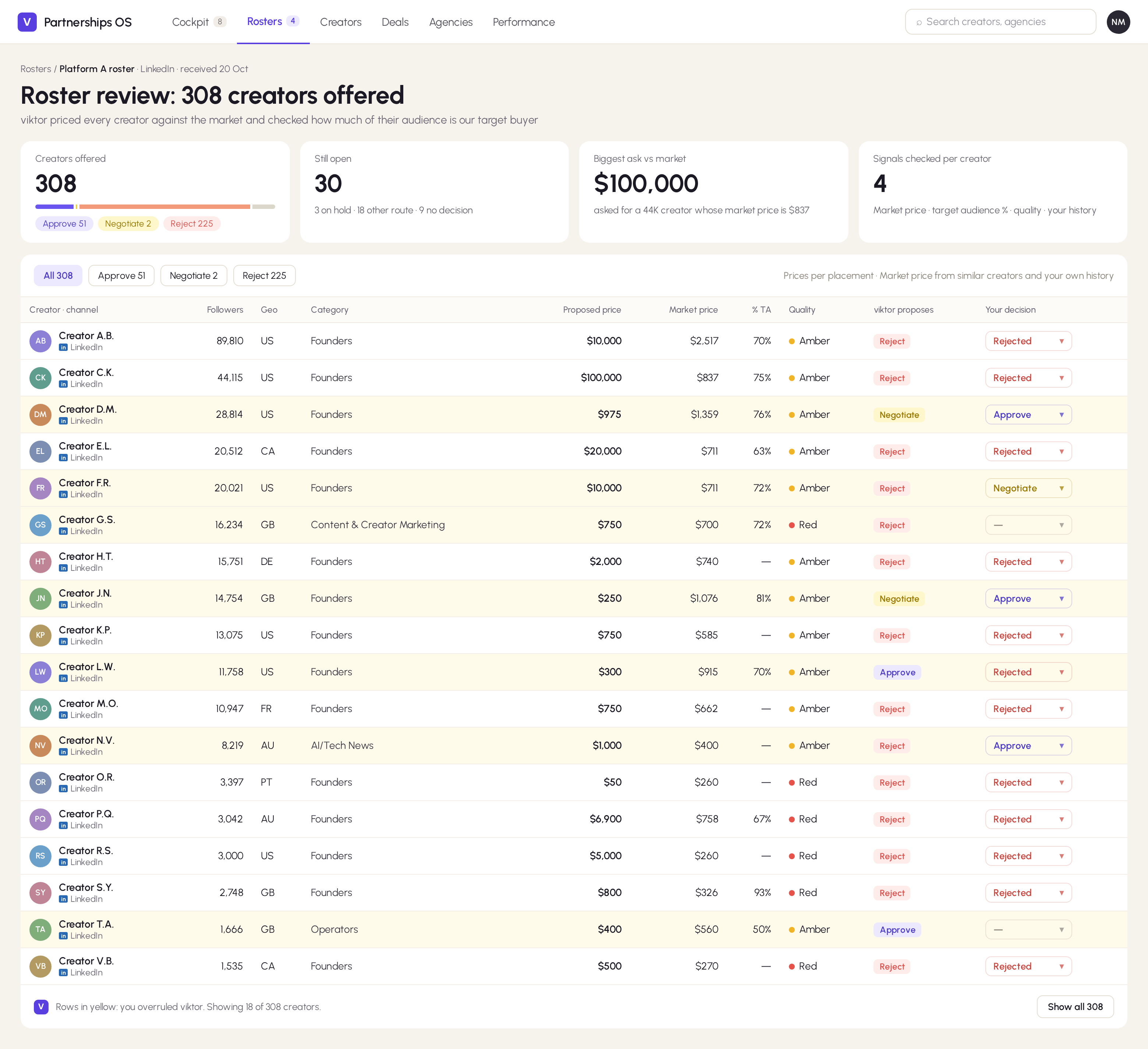
Layer 2: The operations cockpit
This is where the human stays in the loop, but only where a human adds the most value.
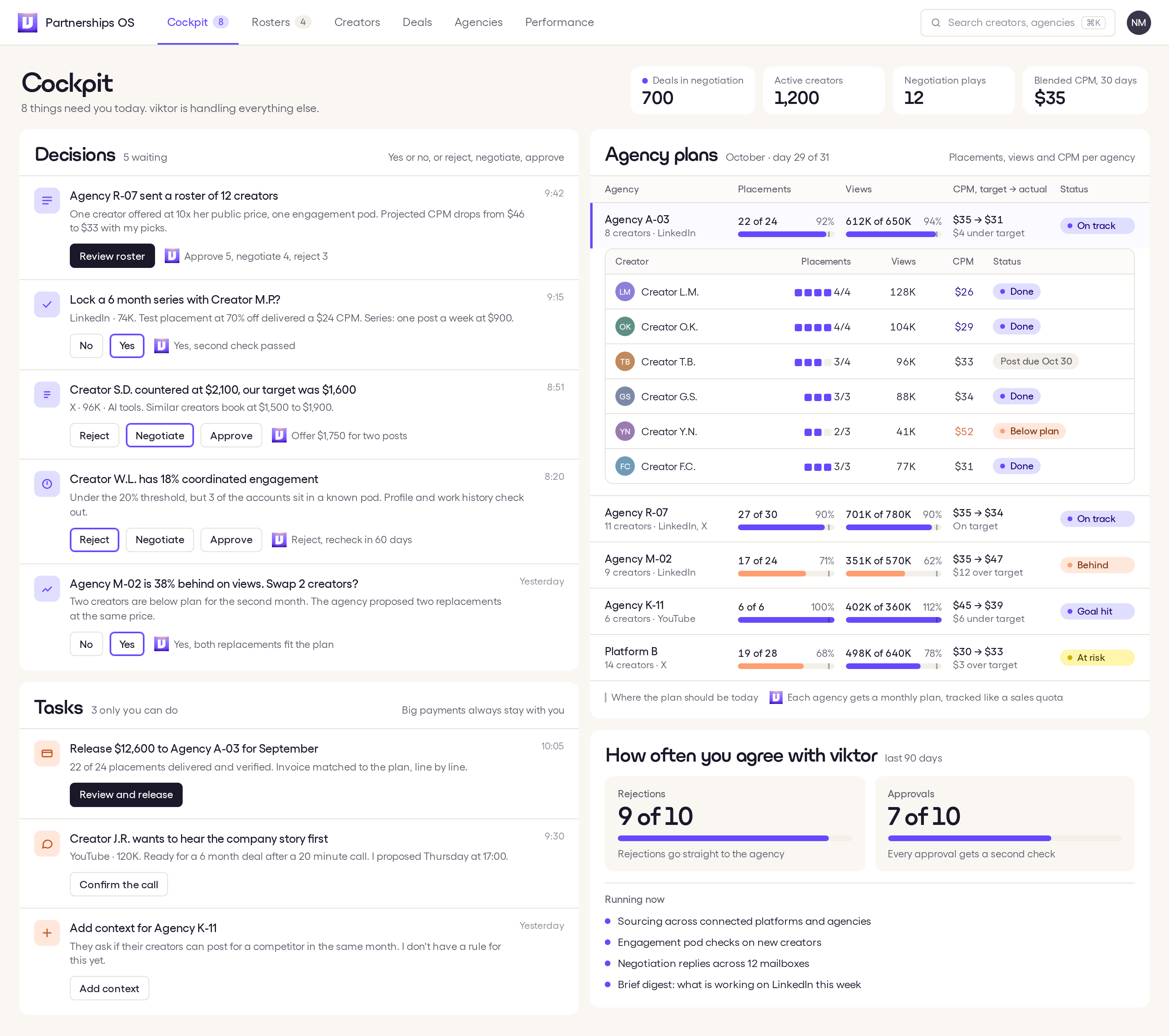
A 360 view on price. When an agency or platform submits a roster (list of creators to choose from), Viktor shows Nazar, for every creator: the agency price vs. public prices across the web, the market price for similar creators, the historical price and CPM for that exact creator, projected CPM, and overlaps (whether Viktor already worked with them through another channel). Nazar has seen the same creator offered through different channels at up to 10 times the price.
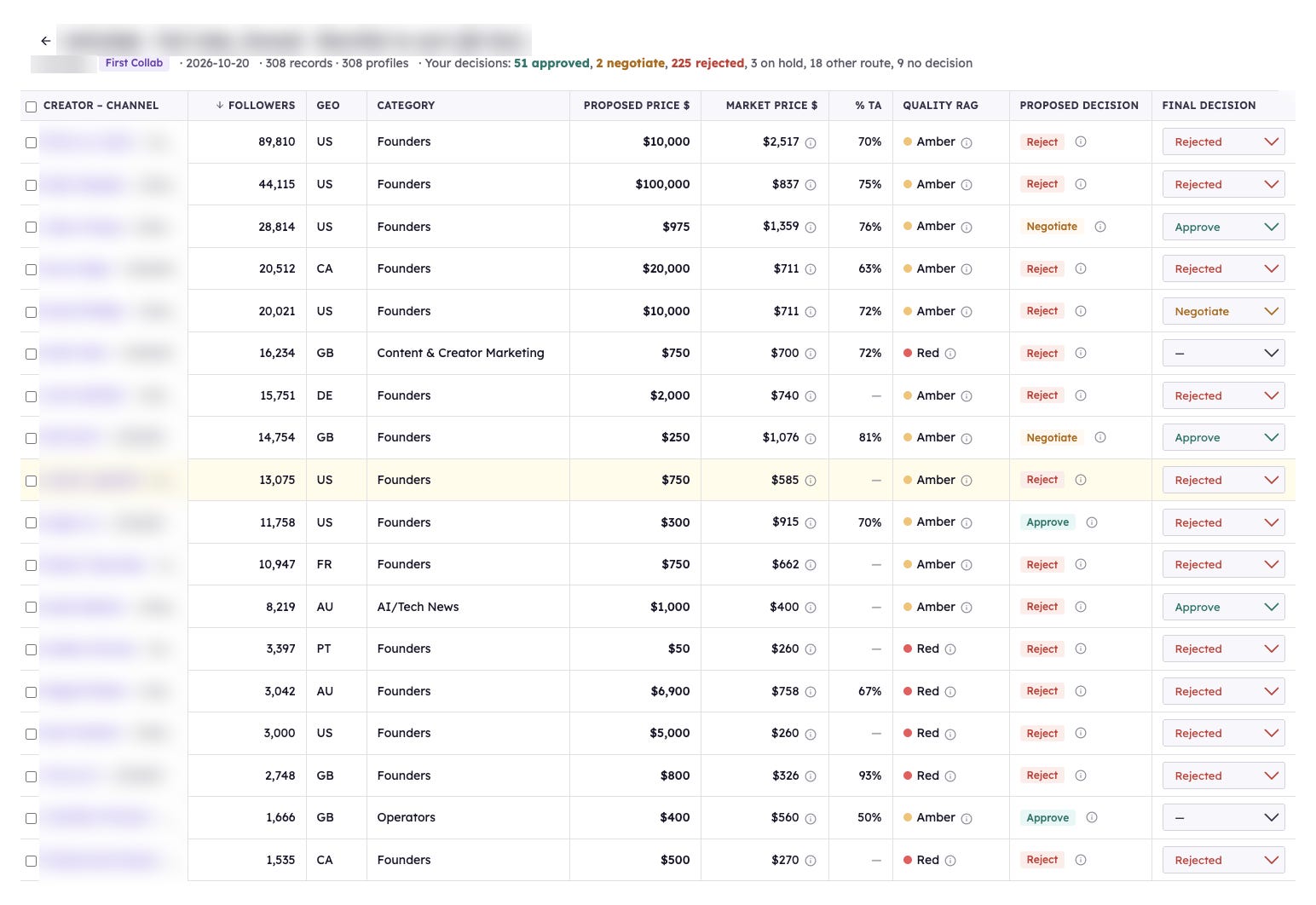
Everything that needs Nazar lands in one cockpit:
Decisions: yes or no, or pick one of three options (reject, negotiate, or approve)
Tasks: things only Nazar can do, like providing extra context or releasing a large payment
Keep Nazar in the loop. He trusts Viktor’s rejections about 9 times out of 10 and his approvals about 7 out of 10, so approvals get an extra check. Big payments always stay with the human.
Onboarding and execution. Once Nazar approves a roster, one click is enough. Viktor knows where each creator came from and acts through the right channel: a platform’s MCP, an agency’s Slack channel, or email. From there, he handles the back-and-forth on content planning, drafts, revisions, and approvals, with the full history of every collaboration in one place. The brief is a living document. Viktor compiles digests on what’s working (and on platform changes, like LinkedIn’s recent push for posts that state their subject in the first lines) and feeds them straight into the briefing process.
Partners managed like employees. Here’s the secret sauce, in Nazar’s words: they treat creators and agencies like employees. Every agency gets a monthly plan: placements to deliver, views to generate, and a CPM to maintain, broken down creator by creator. Viktor tracks delivery against the plan, like a sales manager tracks quota.
The program doesn’t scale because Nazar works harder or hires more people. It scales because every partner has a target, a reporting line, and a dashboard.
Layer 3: The performance loop
From engagement to pipeline. Everyone who engages with a placement gets enriched with Clay. Contacts that match Viktor’s ICP land in the sales CRM, so the sales team can engage with potential buyers right under the post. Creator content stops being “awareness” and starts producing buying signals.
Measuring what creators actually drive. Attribution is the hard part, because most people see a placement and convert days later through another channel. So Viktor’s team:
Correlates the impressions they drive with traffic dynamics
Uses timestamps to attribute traffic spikes to the placements that went live at that moment
Tracks conversion trends before and after creator campaigns, as a proxy for the brand effect
Maps CPM by creator tier and category, to see which niches are overpriced
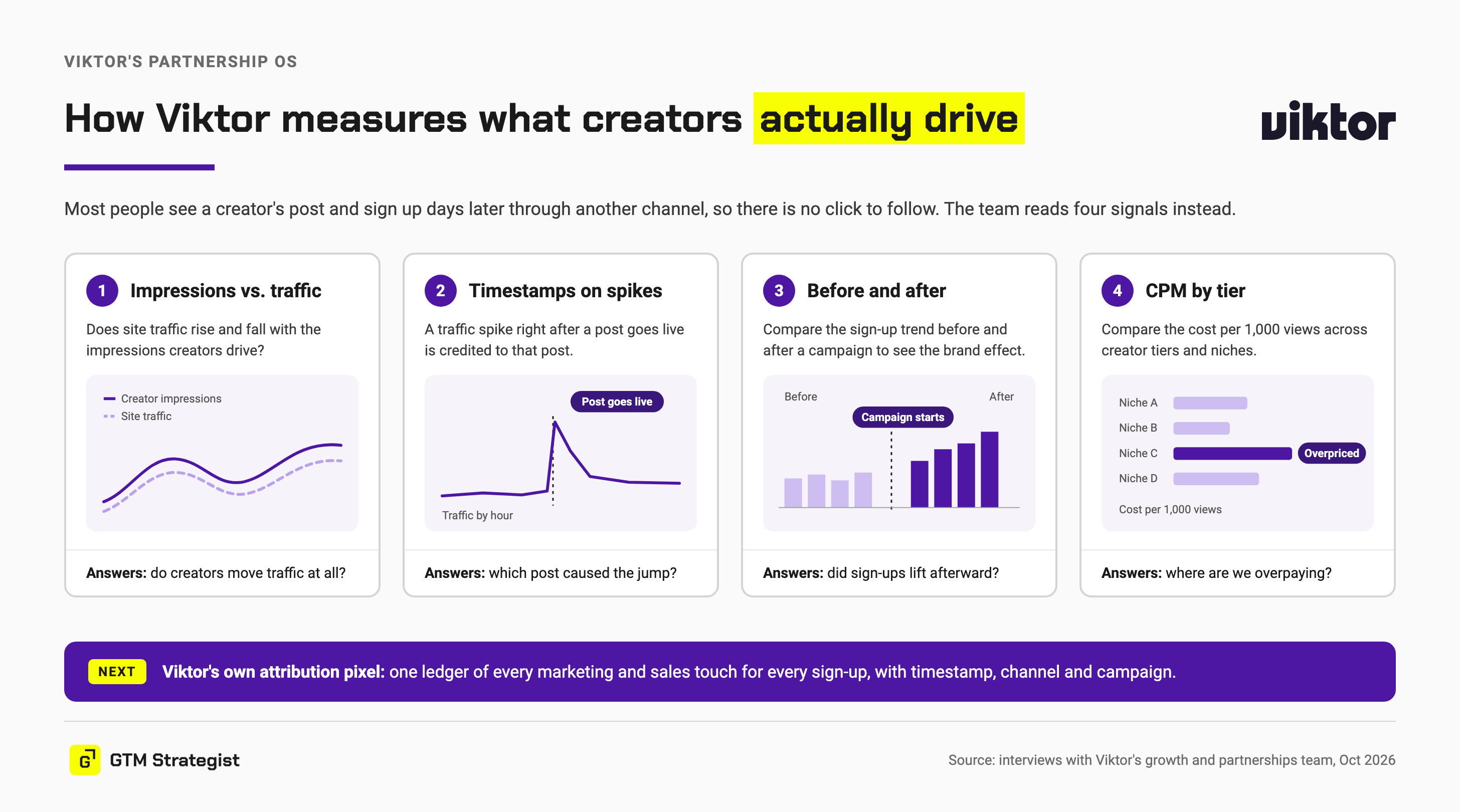
The next step is Viktor’s own attribution pixel: one ledger of every marketing and sales touch for every sign-up, with a timestamp, channel, and campaign, plus rules that split sign-ups into categories.
It’s also why Viktor isn’t running its creator program on Meta yet. Meta tends to credit conversions to itself, and Viktor’s sign-up used to require a Slack login. People who saw a placement inside an app’s built-in browser had to switch devices to sign up, and the cookie trail broke. The team is fixing that, and it shows why Matt’s number one advice for every growth leader is to overinvest in tracking and attribution before you scale.
The results
Here’s what this one-person setup delivers today:
1,200 active creators, out of a database of ~10,000
30+ million impressions a month, mostly on LinkedIn and X, with YouTube ramping up
Blended CPM of about $35, which is competitive for B2B
$2.4 million spent in two months, with $600,000+ saved through negotiation
A system that cost $21 for version one, ~$900 in total, and $100-200 a month to run (excluding third-party enrichment tools)
Nazar built the custom CRM behind it in Viktor Spaces, which lets anyone build internal tools on top of the context Viktor already has (email, calendar, tasks, Slack).
What’s next: scaling the OS beyond creators
The system is built to stretch. Nazar is already extending the same logic to the 20+ agencies working for Viktor, to affiliates, and to 100+ implementation partners.
The implementation partner program started when the team noticed people were already implementing Viktor for clients, for money. Today there are 130 partners, mostly in the US, and most are former digital marketing agencies that pivoted into AI implementation. They sit with a client, list their routines, write SOPs, and automate one to three SOPs a month, charging implementation fees per SOP.
The top 10 partners generated $2.5 million in new ARR in two months. Viktor’s team envisions partners as one of the key acquisition channels. When other businesses build their revenue on top of your product, that’s one of the strongest product-market fit signals out there - it builds a powerful ecosystem moat.
On the creator side, the roadmap points toward deeper relationships:
Long-term ambassador offers once the program hits scale, locking in the distribution channel for years
Reputation-based pricing, where creators with real experience and proven work earn more than those with reach alone
More revenue for creators beyond a retainer, additional option to monetize the knowledge through Viktor ecosystem (skills, templates, ads partnerships, etc.)
Partners community, with events in New York and San Francisco next year
Final thoughts
Creator programs at companies like Wispr Flow and Gamma are very connected to performance marketing (ads): creators produce content that runs as ads, and the ad spend tells you what works. Viktor’s program leans on organic distribution, where attribution is far more complex. That’s exactly why the team is building its own pixel, and why it measures everything it can.
Because at the end of the day, it’s all about ROI. No amount of brand awareness can save a program that doesn’t deliver results.
And this is how AI-native companies think. Instead of putting AI on top of what humans already do, they reimagine the process with AI and place humans only where they add the most value.
The irony: Viktor’s team spent hours with me explaining this system, which is definitely not scalable. But I hope it inspires some new ideas for you: how to take some of the busywork off your plate, and how to make your existing SOPs far more scalable.
If you want to try Viktor, your AI employee, use code MAJA100 for $100 off your first invoice.
Rooting for you,
Maja