

ABM in 2026: AI + Contact-Level Targeting Playbook
How AI-orchestrated, composable stacks unlock real intent, faster deals, and 60–70% lower ABM costs


This newsletter is sponsored by Clay.
Clay connects 100+ data sources into one platform where you can enrich and orchestrate GTM workflows without switching tools.
I prepared a free playbook with 7 Clay plays for ABM you can deploy immediately: from identifying high-intent accounts to auto-triggering sequences when they match your ICP. No theory, just the exact Clay workflows that convert. Get it here (no email required):

Dear GTM Strategist!
Today, we’ll dive into a topic that I was actively avoiding for 2.5 years - ABM. Why?
While generic “spray and pray” outreach is taking its last breaths, people on social media and newsletters misrepresent ABM (Account-Based Marketing) hardcore.
Yes - theoretically, it makes sense to “do multiple touchpoints” if you are dealing with a small list of potential buyers that will buy $100K ARR products from you. But it is misrepresented as “running LinkedIn ads”, “liking someone's posts”, and my all-time favorite: “organizing webinars.”
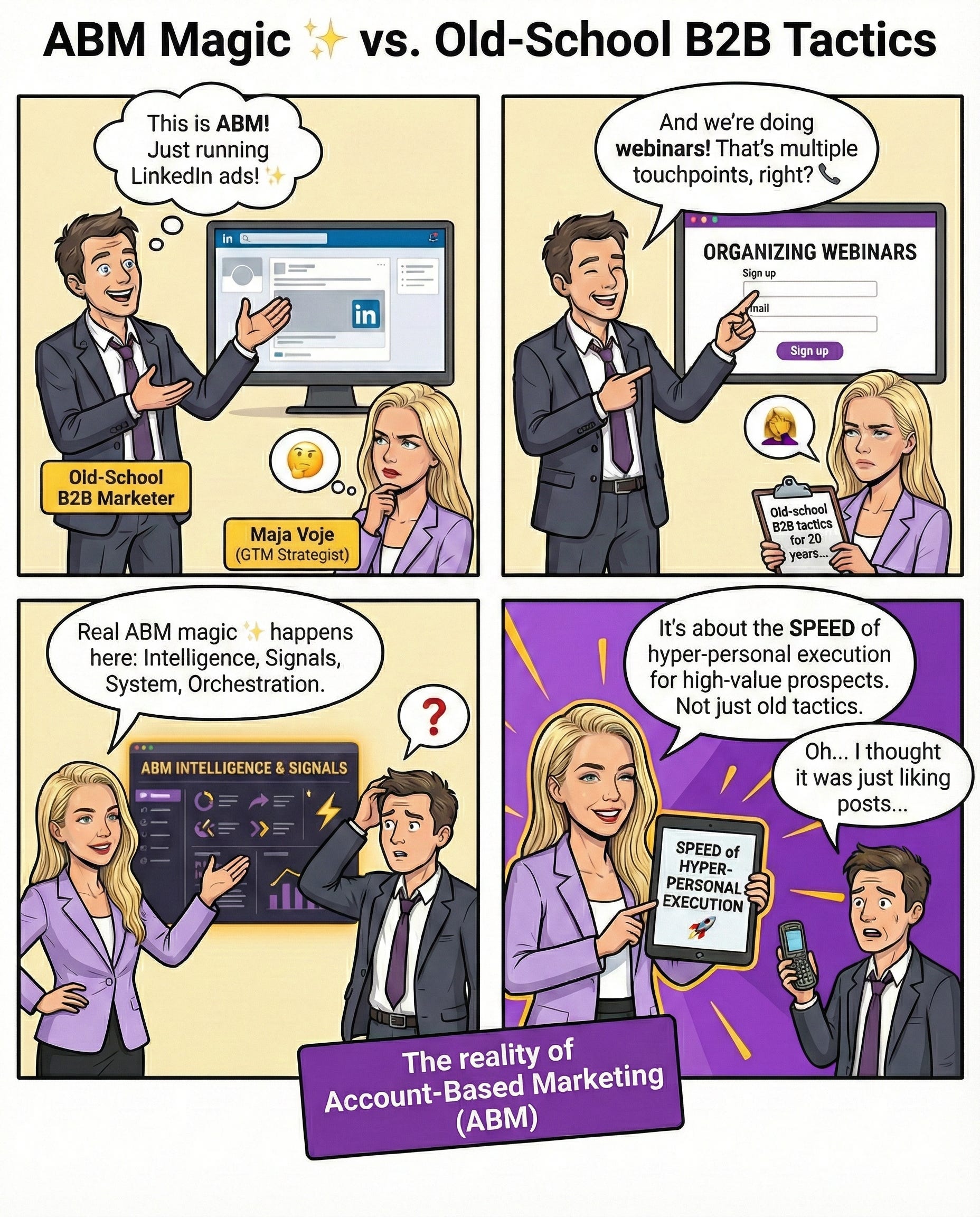
You see, these are old-school B2B marketing tactics that we have been using for nearly 20 years - nothing super intelligent about it. Where ABM magic ✨ really happens is in the background: intelligence, proprietary signals, system, orchestrations of touchpoints, and speed of hyper-personal execution.
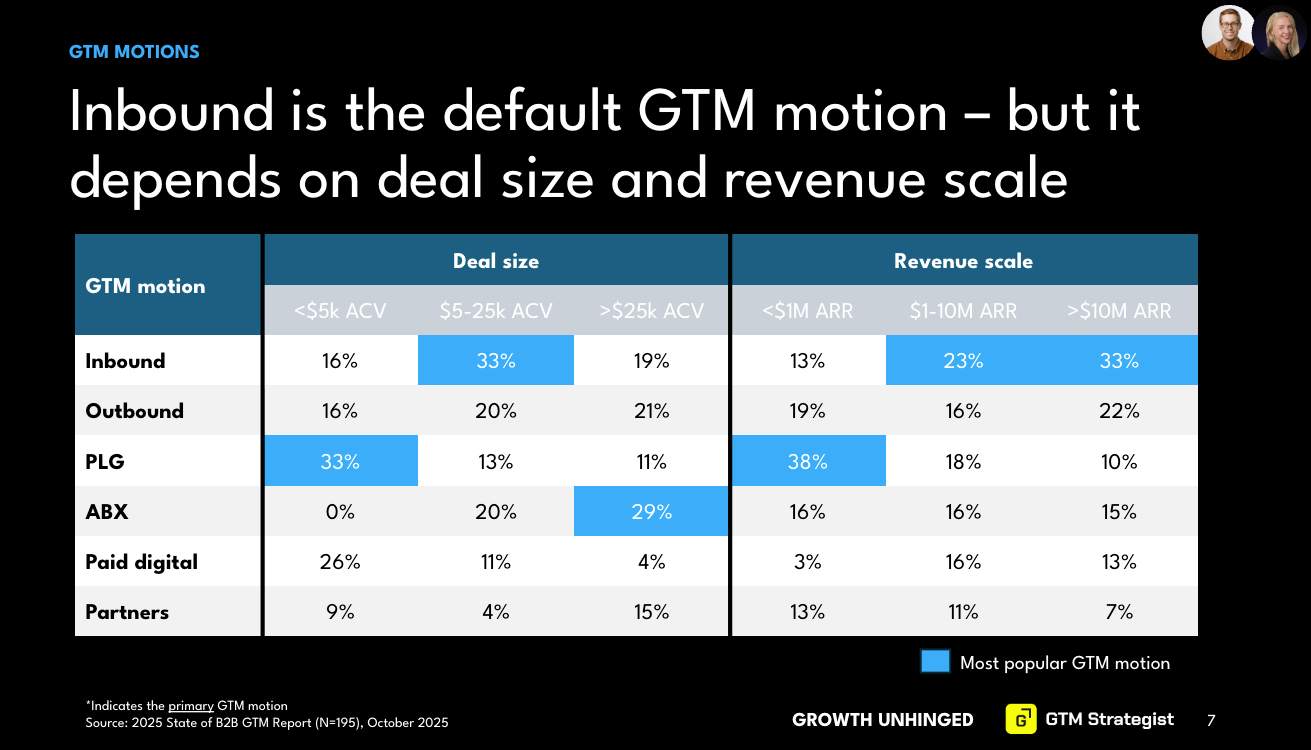
This is why Kyle Poyar and I prefer to call it ABX - account-based everything, because it does overlap with sales and GTM engineering IRL.
What I am saying is: “Please don’t just run LinkedIn ads and call it ABM” :)
To make this area a lot more tactical for you, I created a list of 7 ABM plays in Clay (for selecting target accounts by challenge type, for multi-threading, advanced personalization, and much more) and invited Katya Tarapovskaia, who has generated millions in revenue by running ABM campaigns for Snowflake, Twilio, and Mastercard, and now runs YouStellar, an AI automation agency. She’ll teach how ABM really works beyond pretty LinkedIn infographics.
What you’ll learn:
Why contact-level intent beats account-level intent — and how top teams push data coverage from ~40% to 85% without platform lock-in
How composable ABM stacks cut costs by 60–70% while increasing win rates by 15%+ and speeding up deal cycles
A real AI-orchestrated ABM workflow that saves 40 hours per rep per month and turns intent into pipeline the same day
ABM should be about precision over volume, signal over noise, and owning your GTM engine.
Now, let’s hear it from Katya.
Real ABM in 2026 is different. It’s contact-level. It’s composable.
The teams winning aren’t touching more accounts, they’re identifying which specific people inside target accounts are showing buying intent, reaching those individuals with hyper-relevant messaging, and orchestrating sales follow-up with intelligence about their personality and decision-making style.
In 2026, Intent is no longer account-level. It’s contact-level. And it requires AI at every layer, orchestrated across best-of-breed tools you control.
What ABM Actually Is?
ABM is a go-to-market strategy where Marketing, Sales, and Success align on a named set of accounts and the specific decision-makers within them. You’re not optimising for more leads. You’re optimising for account velocity by getting the right message to the right person at the right time.
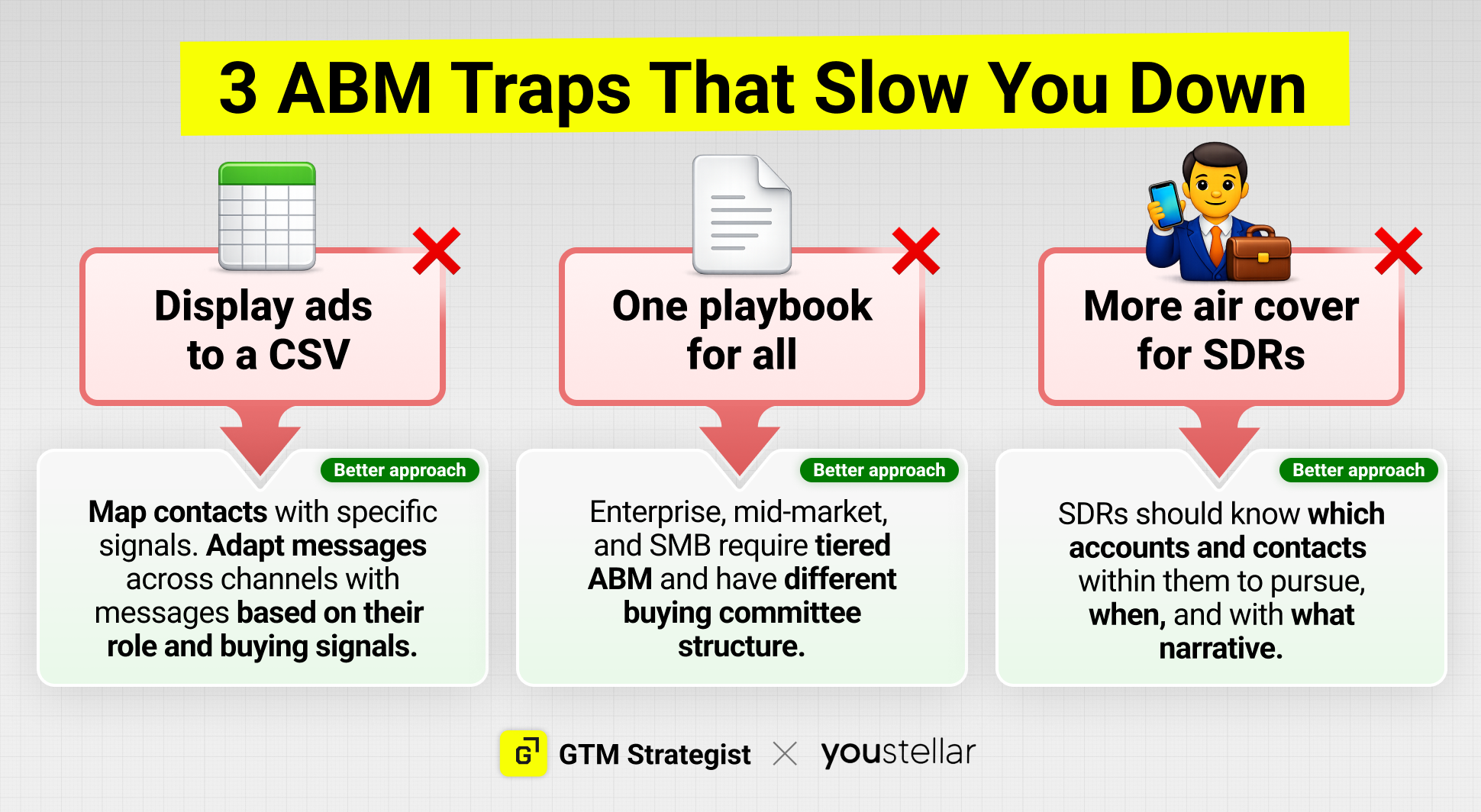
The three ABM traps that slow down programs:
1. “Display ads to a CSV“ is just targeted demand gen, not ABM. Real ABM means knowing which specific contacts are showing intent signals and reaching them across channels (ads, email, sales) with messages grounded in their role and buying signals.
2. “One playbook for all” doesn’t work. Enterprise, mid-market, and SMB require tiered ABM (high-touch, mid-touch, scalable) with different buying committee maps and contact-level personalisation for each.
3. “More air cover for SDRs” misses the real value. ABM’s superpower is prioritisation, knowing which accounts and which people within those accounts to pursue, when, and with what narrative. It stops wasted outreach.
The Composable GTM Orchestration Stack & Plays
Here’s the fundamental shift: Traditional ABM platforms bundle everything (data, intelligence, outreach, ads, automation). You’re locked in, paying platform markups, and constrained by their roadmap.
Composable ABM orchestration flips the model:
Choose best-of-breed tools for each function (enrichment, intelligence, outreach, ads, automation)
Connect them through an orchestration layer (Clay, Zapier, Make, n8n) that makes them work together
Pipe everything into your CRM (HubSpot/Attio/Salesforce) as your single source of truth
Own direct relationships with data providers and AI tools (BYOK - Bring Your Own Keys)
The outcome: Better data coverage (85% vs 40%), lower costs (60-70% savings), complete flexibility, and true ownership of your revenue engine.
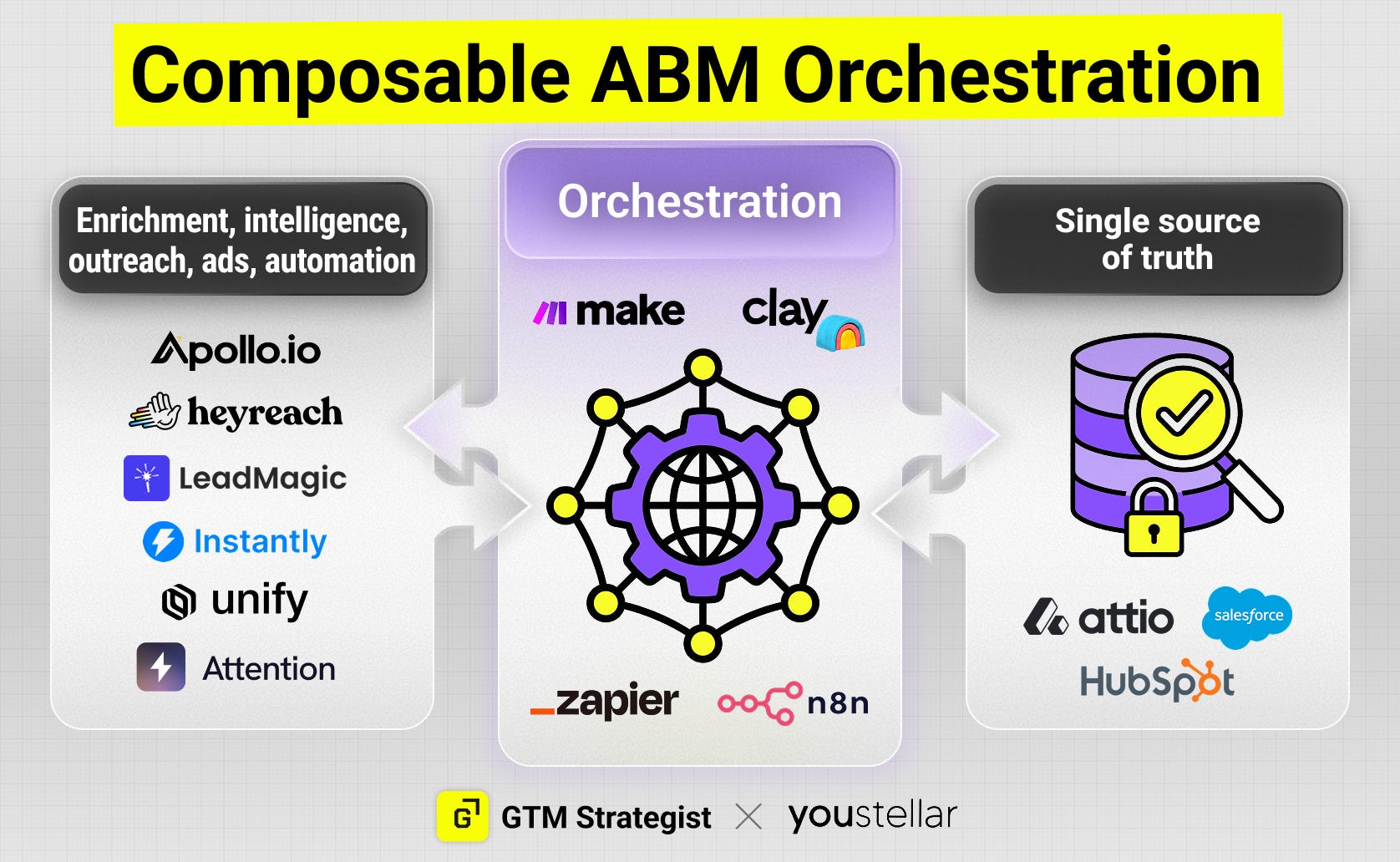
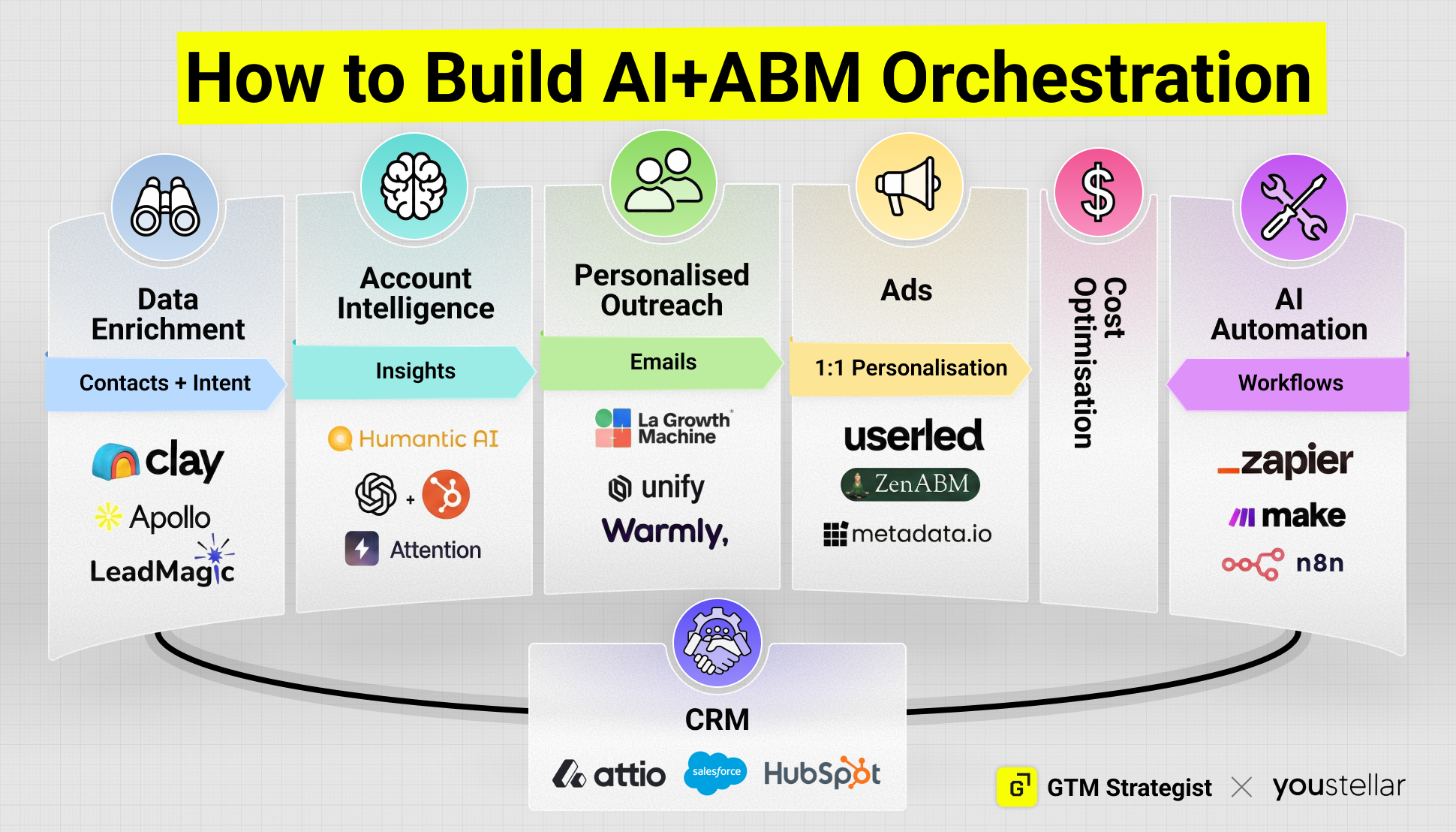
Here’s my 6-Pillar ABM Orchestration Framework powering modern GTM teams:
Pillar 1: Data Enrichment
The problem: Single data providers give 40-50% coverage. Half of your target accounts are enriched; the other half are missing critical information. You can’t personalise what you don’t know.
The solution: Waterfall enrichment across multiple sources, orchestrated by Clay:
Apollo.io (speed + breadth, 275M contacts) → LeadMagic (accuracy + depth, 99% on direct dials) → Hunter.io, Clearbit, or 75+ other sources (specialised signals) → stops when found.
The outcome: Coverage 40% → 85% | Cost per enrichment: $0.06-0.10 (direct API) vs $0.17 (platform credits) | Save $700-1,100/month at 10K enrichments
Pillar 2: Account Intelligence
The problem: Two contacts with the same title might require opposite approaches. One wants data-driven ROI proof; the other wants references and partnership stories.
The solution: Layer multiple intelligence sources:
Humantic AI analyses LinkedIn profiles on a Contact-level + Agent Miia by Humantic AI researches any Account in minutes → predicts DISC personality types, communication preferences, decision-making styles + Account Intelligence | HubSpot + LLM integration surfaces patterns from your CRM history | Attention AI transcribes sales calls, flags objections, and surfaces deal intelligence
The outcome: 15% higher win rates | 30% faster deal cycles | 40 hours saved per rep monthly on call notes
Pillar 3: Personalised Outreach
The problem: Generic outreach yields a 2-3% response rate. True personalisation doesn’t scale manually.
The solution: AI generates personalised first lines at scale, coordinated across channels:
Clay enriches account data → GPT-4 (via your OpenAI API key) writes personalised first lines referencing specific triggers (funding, job changes, tech adoption) → La Growth Machine sends coordinated email + LinkedIn + Twitter sequences → Warmly identifies when they visit your site and personalises the experience → Clay as an orchestration platform ensures message consistency across touchpoints.
The outcome: 72% higher engagement vs generic | 50%+ lift in website conversion | 4x account reach without adding headcount
Pillar 4: Contact-level Targeting
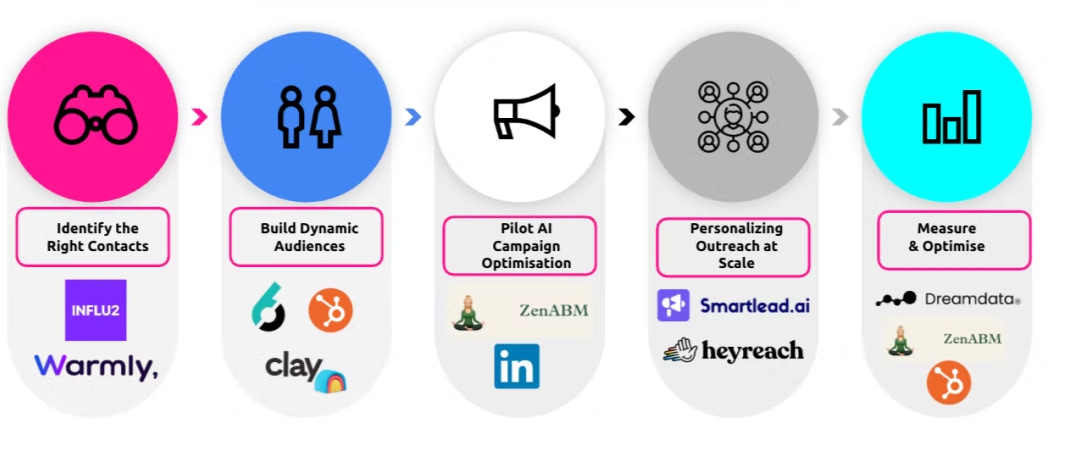
The problem: Generic ads waste budget. You need specific accounts to see messages tailored to their industry, stage, and pain point.
The solution: ABM ads platforms with dynamic creative and autonomous optimisation:
Export target account list from HubSpot → Influ2 targets decision-makers on LinkedIn → Metadata.io auto-optimises budgets across LinkedIn, Google, Facebook → ZenABM shows different creatives based on account attributes and stage and measure results and optimise
The outcome: 50%+ engagement lift with personalized ads | 3x ROAS improvement | 90% reduction in manual campaign management time
Pillar 5: AI Automation (Workflow Orchestration)
The problem: Each tool creates manual work. Copying data between systems. Triggering sequences manually. It doesn’t scale.
The solution: Automation platforms that connect your entire stack into unified workflows:
Zapier (simple, 6,000+ integrations) | Make (powerful logic, visual builder) | n8n (open-source, full customization) + Clay as a Central Data Orchestration PLatform
Example intent-to-pipeline workflow (zero manual steps):
Attention AI flags high-intent phrase in sales call → Zapier triggers Clay workflow → Clay enriches account across Apollo + LeadMagic → Humantic AI analyses buyer personality + Account Insights → GPT-4 generates personalised follow-up email → La Growth Machine sends multi-channel sequence → Metadata.io launches targeted ads → Warmly syncs website activity → HubSpot creates deal + assigns to rep → Slack alerts rep with full context.
The Outcome: 40 hours saved per sales rep monthly | 95% reduction in data entry errors | Same-day response to intent signals (vs 3-5 days manual)
Pillar 6: Cost Optimisation
The problem: Platform credit systems create unpredictable costs. Scale = surprise bills. You’re paying platform markup on everything.
The solution: Bring Your Own Keys (BYOK) to data and AI. Own direct relationships.
Subscribe directly to LeadMagic, Apollo, Hunter (not through Clay credits) | Use your own OpenAI API key (not platform AI credits) | Own Instantly.ai or Smartlead (not platform email credits)
The outcome: $2K/month for a composable stack supporting $1M+ pipeline | Full cost transparency | BYOK prevents vendor lock-in price hikes
One ABM Play to Test it Out Today
Play: Competitive takeout with Clay-powered list building
This play targets accounts that use key competitors or where you previously lost, but where conditions have likely changed. It is ideal for pipeline creation in defined verticals.
How it runs:
Source accounts from CRM:
Past closed-lost in CRM tagged with competitor.
Net-new accounts identified via tech-detection sources and fed through Clay.
Enrich with Clay:
Pull decision-makers and influencers per account.
Append intent-like proxies (e.g., job postings, role changes indicating new mandate).
AI workflow:
Cluster accounts by likely “why change now?” story (e.g., cost pressure, missing features, performance issues).
Drafts outbound and paid angles per cluster instead of “one message to all competitor users”.
The impact is a realignment of pipeline creation around realistic conversion opportunities rather than a long tail of “someday” accounts.
Why Composable AI+ABM Orchestration Is Winning
Key factors:
Flexibility: Swap components as better tools emerge
Cost control: BYOK prevents vendor lock-in price increases
Data ownership: Your enriched data works across multiple use cases
Speed to value: 2-4 weeks to launch
Innovation: You control your stack evolution
What works is execution discipline + architectural thinking: alignment across marketing, sales, and RevOps on buying committee mapping, contact-level signal orchestration, composable tooling, and personality-informed personalisation.
That’s where revenue lives in 2026.
Thanks, Katya, for this hands-on guide to ABM in 2026.
If you want to learn directly from Katya, check out a free 4-week ABM Bootcamp (starting Jan 26th) by ZenABM. It includes guest lectures from other top experts I highly recommend (Ali Yildirim, Patrick Spychalski, Tas Bober…). Apply here.

Last but not least: I’m hiring! We’re looking for a designer (part-time) and a content manager (part-time or full-time) to join the GTM Strategist team. Check out more about the positions - or share with anyone who'd be perfect for the role.
Until next week,
Maja

✅ Need ready-to-use GTM assets and AI prompts? Get the 100-Step GTM Checklist with proven website templates, sales decks, landing pages, outbound sequences, LinkedIn post frameworks, email sequences, and 20+ workshops you can immediately run with your team.
📘 New to GTM? Learn fundamentals. Get my best-selling GTM Strategist book that helped 9,500+ companies to go to market with confidence - frameworks and online course included.
📈 My latest course: AI-Powered LinkedIn Growth System teaches the exact system I use to generate 7M+ impressions a year and 70% of my B2B pipeline.
🏅 Are you in charge of GTM and responsible for leading others? Grab the GTM Masterclass (6 hours of training, end-to-end GTM explained on examples, guided workshops) to get your team up and running in no time.
🤝 Want to work together? ⏩ Check out the options and let me know how we can join forces.
 | A guest post by
|
Thank you for inviting me!!🩷
This article comes at the perfect time providing vital clarity on ABM's intelligent orchestration versus superficial tactics a truly insightful distinction you've adeptly articulated.