


Presenting partner: Viktor
Viktor is an AI employee that lives in Slack and Microsoft Teams. Connects to 3,200+ tools. Does the work, not just answers questions. Hire Viktor for your team.

GTM partners:

Ahrefs Brand Radar - Make AI recommend your brand.
Clay - Build systems to grow revenue.
FullEnrich - 80+% find rate for emails and phone numbers.
HubSpot for Startups - The GTM engine that grows with you. See if you qualify for 90% off.
Miro - The collaborative workspace where GTM teams and agents converge to build together.
Ploy - The marketing platform that turns your website into a growth engine.
Primer - Target your ICP across LinkedIn, Meta, Google, Reddit, and more.
Dear GTM Strategist,
I used to believe that unless you were a $20-a-month PLG product, or your buyer persona happened to be deep into conspiracy theories, serious B2B should stick to Google and LinkedIn. Everything else was “experimental” …
No longer true - in their latest study, Wynter published that 47.2% of B2B SaaS marketing leaders plan to increase their advertising budgets. Spend is rising while the headcount is shrinking - teams are buying pipeline they used to grind for.
Advertising is making a comeback in 2026. While our inboxes, feeds, and LinkedIn DMs all sound and look the same, clever brands are seeking attention on Meta, Reddit, YouTube, and other channels where their ICPs pay more attention.
AI-native companies are leading the shift. They put 43% of their paid spend into LinkedIn (vs. 13% for everyone else) and only 38% into Google (vs. 69%). They’re not buying clicks from people already searching. They’re using ads to educate a market that doesn’t know their category exists yet.
All of this made me curious about what is actually working for these trends, and there is someone who has really solid data on this shift. Keith Putnam-Delaney, CEO at Primer, analyzed 379 B2B advertisers (their actual ad accounts, not a survey), and I’ll share some of the key learnings from his study with you. This time you’ll learn:
Which channels beyond LinkedIn B2B advertisers are now putting real budget into, and why
How AI-native companies use paid ads to build a new category, not just capture demand
How non-PLG companies are using Meta without wasting spend
What the shift from headcount to media budget means for how you plan your 2027 GTM
A practical playbook for testing a new paid channel without betting the farm
Before we begin: if you haven't registered for the State of B2B GTM report launch event, this is your last chance. With Kyle Poyar, we are revealing the findings live on October 14th. We’ll be joined by speakers from SpaceXAI, Lovable, Granola, Vercel, and more. Save your spot here.
Now let’s dive in 🤿 and find some paid gems for your 2027 budgeting process.
Paid advertising can support multiple GTM motions
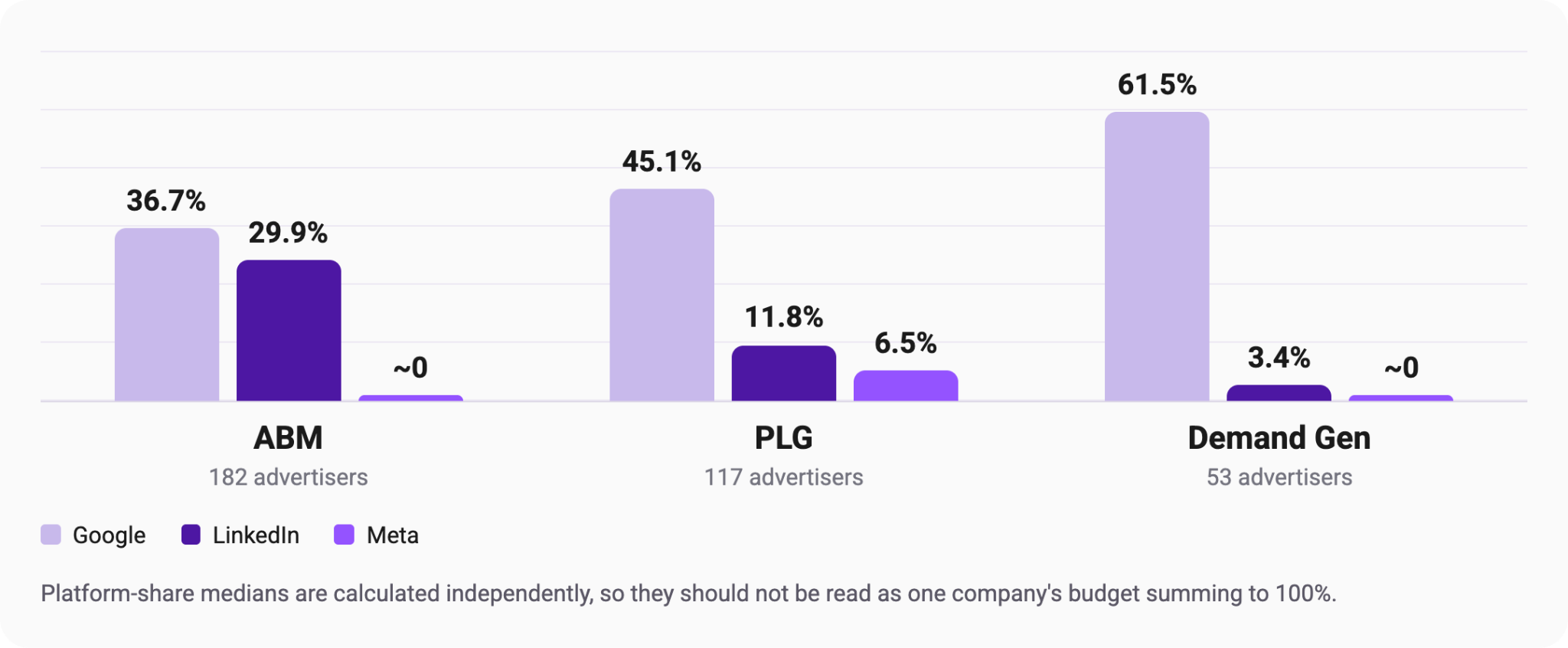
The advertisers in the report were grouped into three groups - based on their main GTM motion:
Product-Led Growth (PLG): companies selling self-serve products
Account-Based Marketing (ABM): companies selling to a narrow set of target accounts (demo-only)
Demand gen: demo-only, but broadly sold across mid-market
One of the clearest findings is that when crafting your paid strategy, it’s more important to look at your GTM motion to define your paid channel mix. GTM motion seems to predict channel strategy more strongly than industry.
Some industry specifics still matter, though, so the next step is still to look at where your ICP can be reached (if you’re selling to Finance & Accounting buyers, they are usually less present on LinkedIn and Reddit, for example).
AI-native companies advertise differently
AI-native advertisers (companies whose core product is generative AI) have significantly different media spend patterns. They allocate much less to Google (38%, vs. 69% for the rest) and more to LinkedIn (43%, vs. 13%). There’s also a difference in their LinkedIn strategy: whereas other advertisers are focused on lead generation campaigns, AI-native advertisers focus more significantly on engagement objectives.

When AI-native companies advertise on Meta, they also tend to spend more on traffic, awareness and engagement objectives.
The pattern is clear: since they are establishing new categories, their paid strategy is less focused on direct demand capture and more on market education.
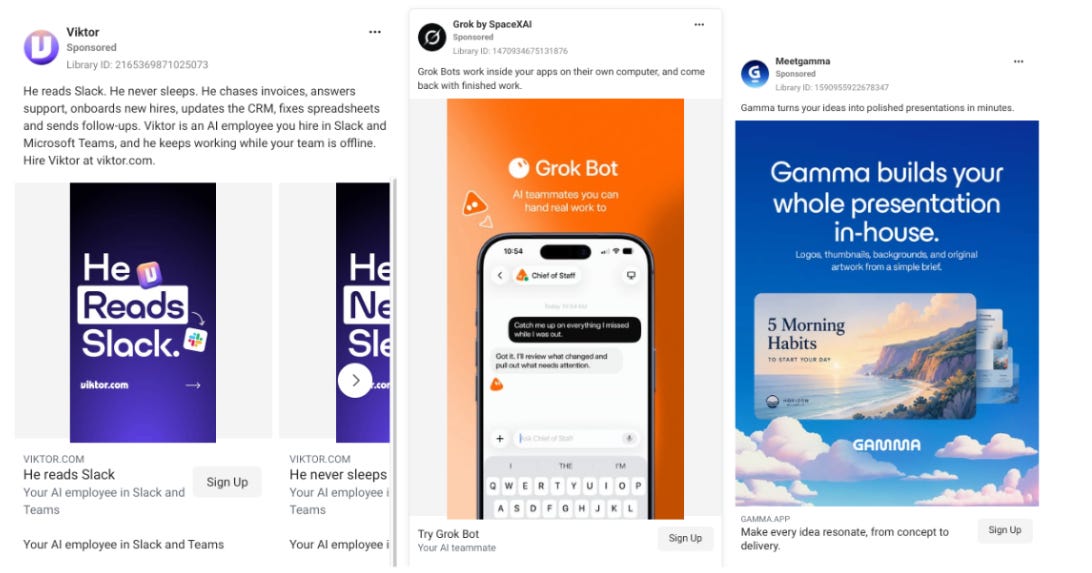
Primer has an in-product Account Research feature that allows users to analyze the creative of any company.
B2B advertisers are doubling down on Meta
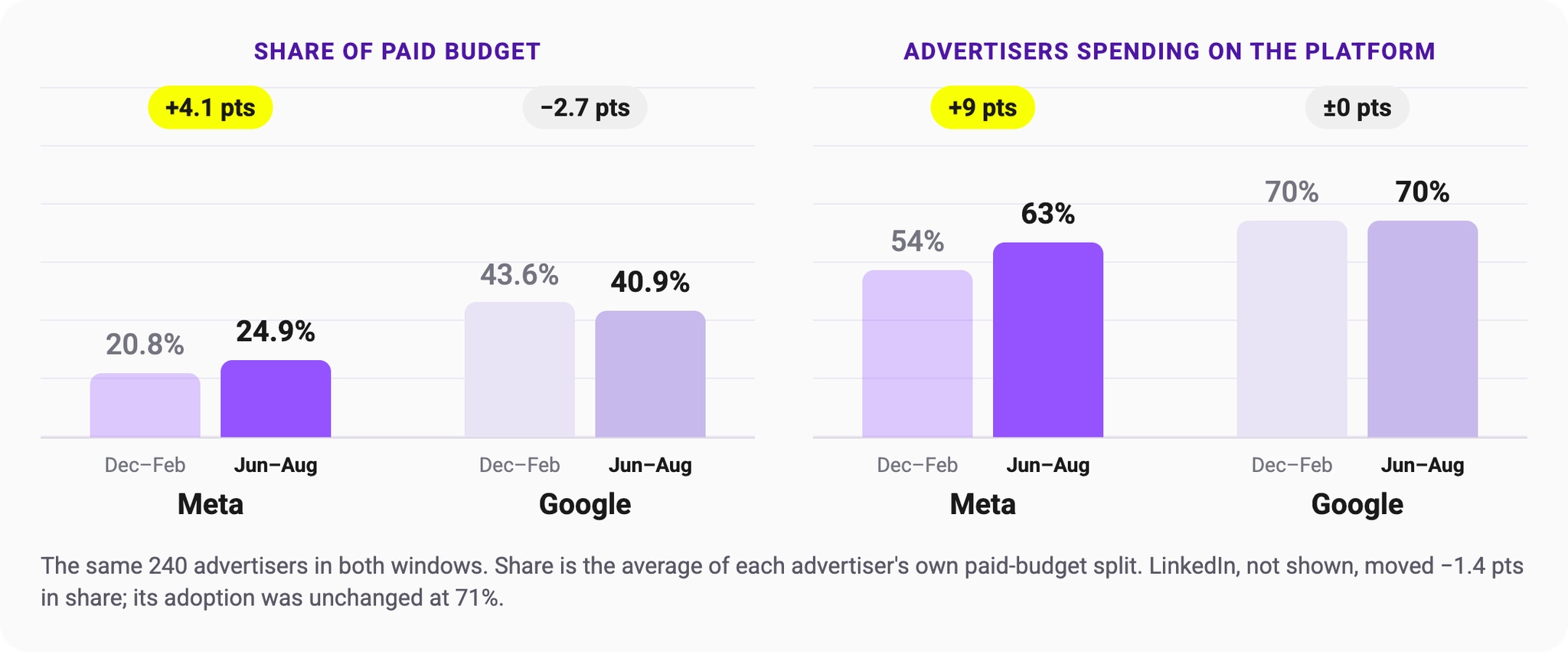
Meta is becoming a meaningful B2B channel fast. The report tracked advertisers over the past 12 months, and comparing the first 6 months vs. the last 6 months, there is an obvious trend of increasing budgets on Meta.
The average share of paid budget on Meta increased from 20.8% to 24.9%, and the share of B2B advertisers that advertise on Meta grew from 54% to 63%.
Meta is taking a larger share of the B2B advertising budget primarily at Google’s expense. Google has become saturated and is at the same time getting harder to drive clicks because users are increasingly finding answers already in AI overviews. Both of these are leading to skyrocketing CPCs (cost-per-click) there.
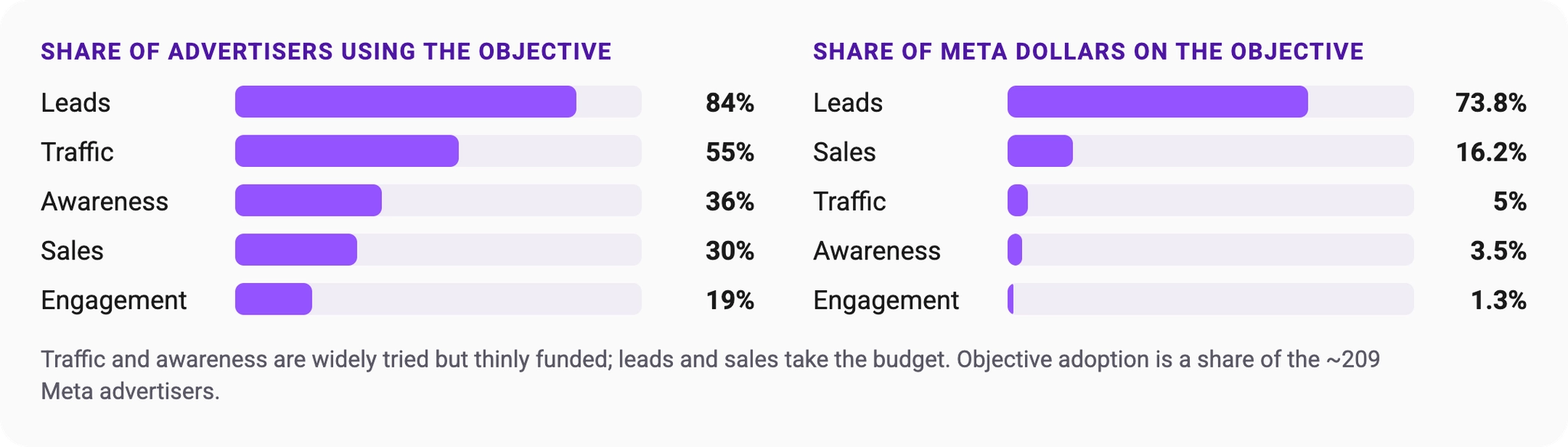
There’s an important difference in how B2B advertisers are using Meta. It’s not a traditional “awareness + retargeting” game as seen in B2C and e-commerce. Most B2B companies use Meta ads for lead-generation and sales objectives.
Yes, paid channels are still getting more expensive
Primer’s data shows that media costs are still rising, with PLG companies seeing some of the steepest increases across both LinkedIn and Meta. LinkedIn remains the most expensive major B2B channel by a wide margin: its CPM is typically 5.3x higher than Meta.
That premium exists for a reason. LinkedIn gives marketers direct access to professional identity and targeting that is much harder to replicate elsewhere.
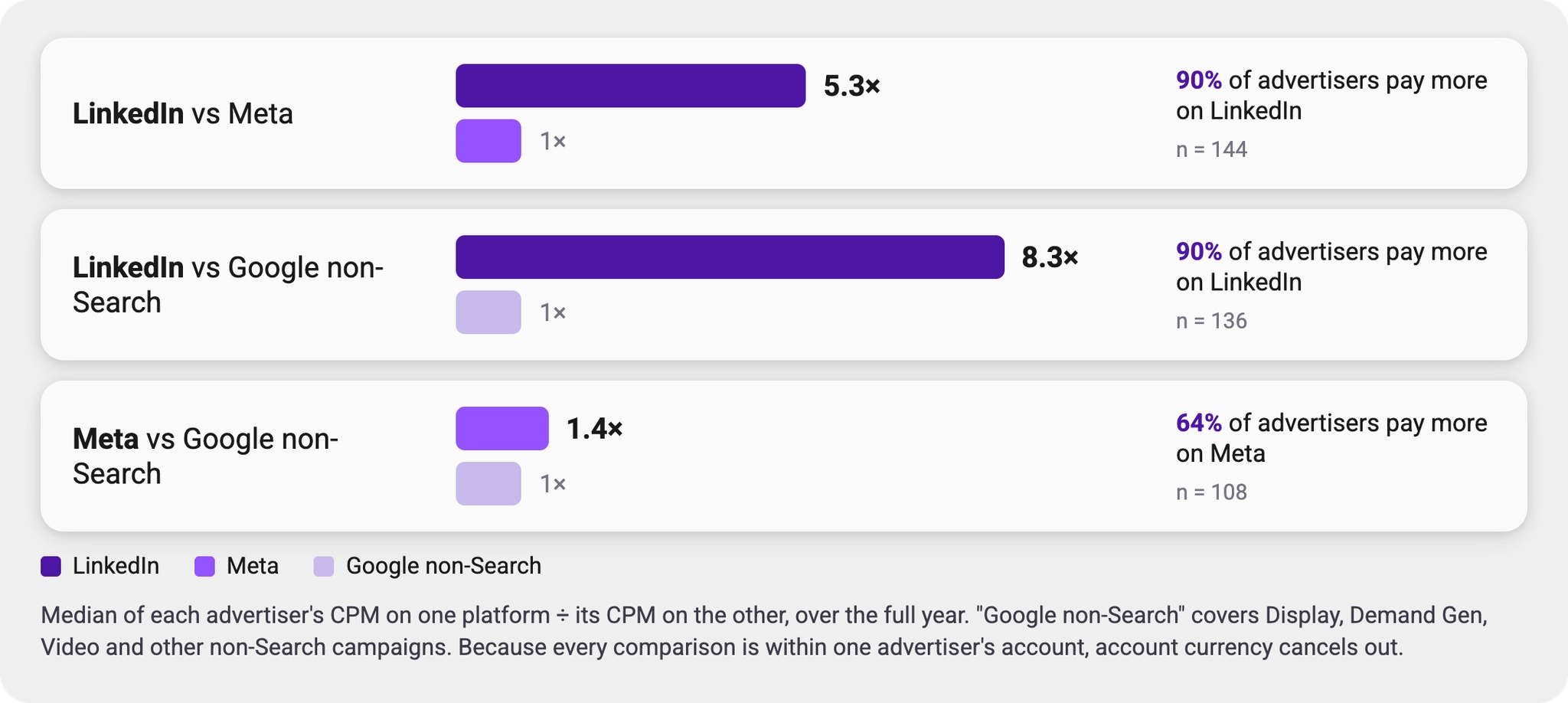
But higher CPMs don’t mean B2B marketers should simply accept higher costs.
One way to respond is to chase cheaper inventory on channels that were traditionally considered B2C - Meta, YouTube, Reddit, and others - while bringing your own B2B audience targeting with you.
Historically, the problem was targeting. These platforms have enormous reach and cheaper inventory, but weak native controls for reaching specific companies, job functions, or buying committees. If you can solve that audience problem separately, the economics start to look very different: you can use cheaper consumer-scale media without giving up B2B precision.
That’s increasingly how we think about it at Primer: separate the audience layer from the media-buying layer. Build the audience you actually want, then decide where you can reach it most efficiently rather than defaulting to the platform with the best native B2B targeting.
There are also ways to find less-saturated inventory within LinkedIn itself. Connected TV can be expensive on an absolute basis but gives marketers access to a different format and buying environment. Thought Leader Ads are another example; they can materially outperform traditional company-page creative because buyers are often more responsive to people they trust than to brand ads. TLAs tend to have a 252% higher CTR.
One thing to avoid: paying LinkedIn prices without actually getting LinkedIn inventory. If you’re buying on LinkedIn, be careful with the LinkedIn Audience Network, which can extend campaigns onto third-party sites and apps.
The practical takeaway: don’t optimize only for the cheapest CPM. Optimize for the cheapest way to reach the right audience. Sometimes that means paying the LinkedIn premium. Increasingly, it can also mean taking a high-quality B2B audience and activating it against cheaper inventory elsewhere.
LinkedIn: the most complicated advertising playbook
Analysis of B2B advertising strategies reveals that (compared to Google, for example, where search clearly dominates), there is no one typical LinkedIn playbook. It really depends on who you sell to and how you sell.
For PLG advertisers, direct response (lead gen and website conversion) is the most effective. ABM companies tend to invest more in top-of-funnel ads there (engagement objectives, brand awareness, and videos).
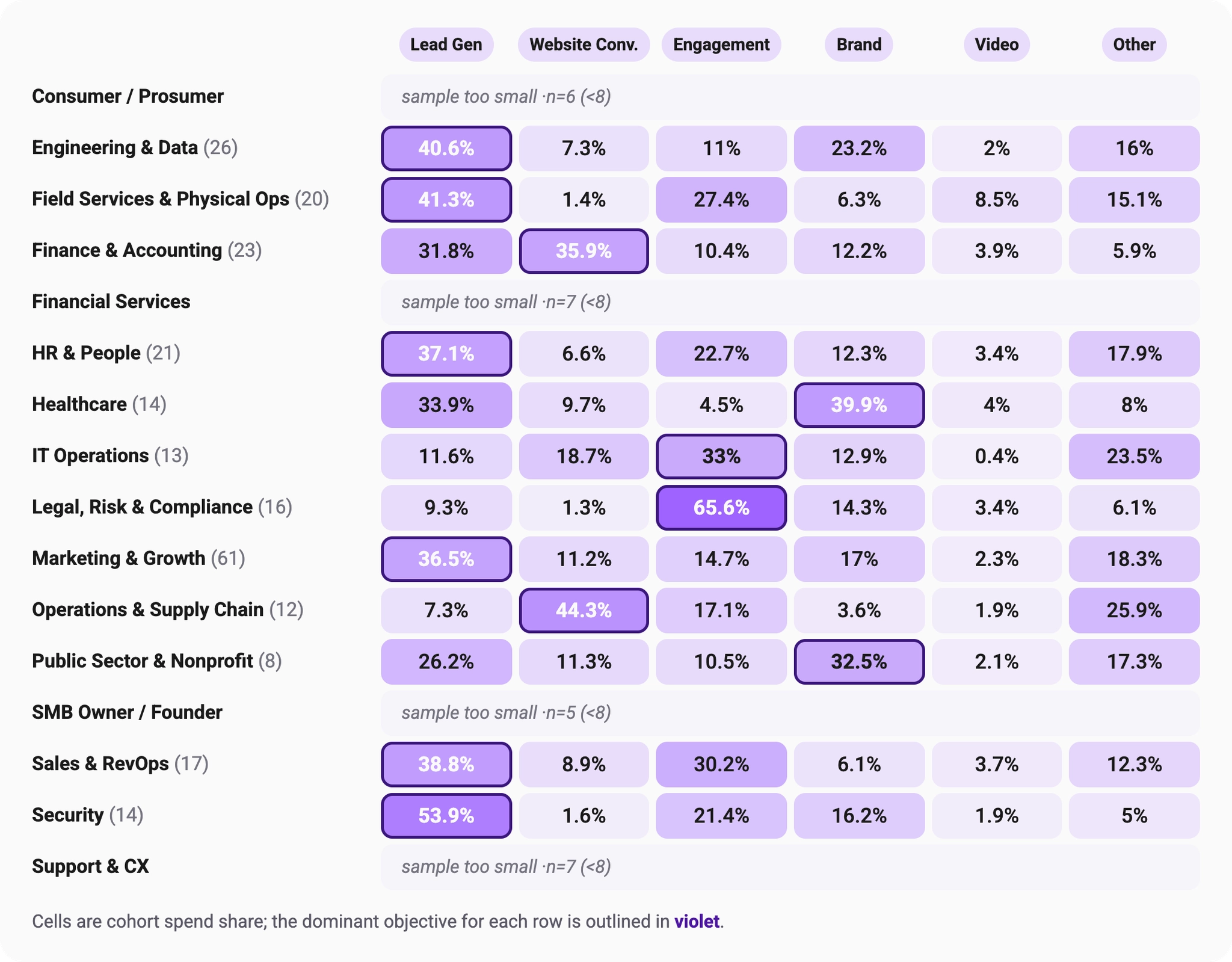
One of the best opportunities on LinkedIn is native lead forms. It makes it much more likely to capture the lead, but the reality is that most of them will never reach your website.
Collaborations with content creators, which can be boosted by Thought Leader Ads we mentioned before, are also an untapped opportunity for many brands.
Is paid working for you? A 5-step checklist
No single metric can tell you whether your paid strategy is working. CPL can look great while pipeline is terrible. A channel can look inefficient while doing an important job upstream. And platform-reported conversions can make almost anything look successful.
Keith Putnam-Delaney suggests working through these five questions in order:
1. Are you comparing yourselves to companies with the same GTM motion?
Benchmark your metrics with other PLG, ABM, or demand gen companies first (depending on your GTM motion). Only then compare channels or CPL.
2. Is your channel mix unusual for companies like yours?
Being an outlier isn’t necessarily bad, but you should know that you’re one.
3. Are you using each platform for the same job your peers are?
Especially on LinkedIn, objective mix changes substantially by motion and buyer. Test the objective before concluding that “LinkedIn doesn’t work for you”. For lead-gen motion, skip the landing page and try on-platform lead generation forms.
4. What are you paying for a lead you’d actually want?
Not every lead is equally valuable. Track ordinary CPL, but pair it with a qualification metric - Website Known Qualified CPL: the amount you spend for each identifiable website visitor or lead who also matches your ICP criteria.
The goal is to move from “How cheaply can I generate a lead?” to “How efficiently can I generate the right lead?”
5. Are you measuring attribution, influence, or incrementality?
These answer different questions, and they should not be treated as interchangeable.
Use first-touch, last-touch, and any-touch attribution to understand where paid showed up in the buyer journey.
Influence is especially important in ABM, where the person who sees or clicks an ad may not be the person who ultimately converts.
Incrementality asks: Would those outcomes have happened without the ads?
Holdout tests can help answer it by comparing a group eligible to receive advertising with a similar group intentionally withheld from advertising.
Then measure the difference in outcomes: revealed website visits, form fills, opportunities, pipeline, or revenue.
This will get you closer to answering the question that actually matters: Did paid create more business, or did it simply take credit for business that was already going to happen?
When to bring in ads?
According to Keith, paid ads start to make sense when you can have at least a 5000-person audience. For starting with ads on LinkedIn, here’s a guide we previously published on GTM Strategist.
How much should you budget for a paid channel test? Start with three numbers:
how many results you want,
your funnel conversion rates (ad click > landing page > lead or customer),
and the cost per acquisition (CPA) you’re aiming for.
Then multiply results by target CPA. For example, 200 demo signups at $100 CPA means a $20,000 test budget. The most common mistake is running a one-week campaign with less than $500 and concluding the channel doesn’t work. Once you find what works, split your budget: about 90% into one ongoing campaign and about 10% into a separate experiment campaign.
Meta’s algorithm for ad serving is increasingly powerful, but it’s important to push conversion data back to the platforms (so the algorithm can then optimize to serve the right audiences for more conversions).
A benefit of ads is also for testing your messaging. And a secret power is if you can test more videos (which is increasingly easier with AI and platforms like Higgsfield).
With search and LinkedIn ads getting crowded and expensive, B2B platforms are increasingly testing other channels, like Meta and Reddit. It also depends on your ICP: for example, IT and engineering audiences are more present on Reddit.
And then there are always new opportunities - the latest one seems to be ChatGPT ads. “I’m pretty bullish on the opportunity for ChatGPT ads, but I don’t think anyone has really figured them out yet,” says Keith Putnam-Delaney.
“There’s a huge gap right now between the buzz and proven performance. It’s still a very early, work-in-progress ad product. I expect it’ll get better, but today I don’t think anyone has really cracked the playbook.”
If you’re running paid ads or considering them, read the full Primer’s report on The State of B2B Paid Advertising:

My hand-picked selection of the latest news, data you shouldn’t miss, and job posts.
Kyle Poyar and I host the State of B2B GTM summit on Wednesday, October 14, online and free: new State of B2B GTM research plus 10 operator field reports. This is the last call, so grab your seat!
Clay wrapped up its “hot summer” of product updates that include an Agent Plugin and CLI for coding agents. They have also launched the GTM Skills marketplace with 40 community playbooks for Claude Code, Codex, and Cursor. My value-first cold email skill is one of them, and it is free to copy.
G2 interviewed 153 B2B marketing decision-makers for its State of AEO 2026 report. 76% said AI answer engines are becoming buyers’ first research step, and 17% use monitoring they would trust for decisions.
GTM roles worth a look
VP, Product Marketing at Greenhouse, anywhere in the US. Their first-ever VP of product marketing reports to the CMO, and the posting is up only until today.
GTM Strategy & Operations, FDE at Anthropic, San Francisco or New York. You plan headcount, capacity, and engagement pricing for the Forward Deployed Engineering team, where demand is “well ahead of the team’s capacity”.
Growth Lead, France at OpenAI, Paris. You work with the France GM on the growth plan for ChatGPT, and the same role is open for Japan and Southeast Asia.
Product Marketing, GTM at Clay, New York, $200K to $250K plus equity. You build the core narrative and the sales asset library for Clay’s revenue teams.
Head of Growth at Momentic, San Francisco, $210K to $250K plus equity. Momentic is an AI testing platform that Notion, Retool, and Webflow use, and you build the growth strategy with the CEO
Until next week,
Maja