


Presenting partner: Viktor
Viktor is an AI employee that lives in Slack and Microsoft Teams. Connects to 9,800+ tools. Does the work, not just answers questions. Hire Viktor for your team.

GTM partners:

Ahrefs Brand Radar - Make AI recommend your brand.
Clay - Build systems to grow revenue.
FullEnrich - 80+% find rate for emails and phone numbers.
HubSpot for Startups - The GTM engine that grows with you. See if you qualify for 90% off.
Miro - The collaborative workspace where GTM teams and agents converge to build together.
Ploy - The marketing platform that turns your website into a growth engine.
Primer - Target your ICP across LinkedIn, Meta, Google, Reddit, and more.
Dear GTM Strategist,
Most AI outbound in our inbox follows one script: a first name in the subject line, a compliment, and a request for 15 minutes. AI made that email cheaper to send, and that is about all it changed.
Jordan Crawford has worked against that script since 2020. He is the founder of Blueprint GTM, his Substack ranks No. 31 in Substack’s business top 100, and he coined PVP - the permissionless value proposition. We featured it in the newsletter before.
In this episode, he did two new things.
He turned PVP into an equation for the first time.
Then he ran it live on a real company: First Due, a fire and EMS software platform. One prompt went to ChatGPT and Codex side by side: find three fire departments that need First Due right now, with public evidence.
What you’ll learn:
The PVP equation, and the terms that kill most messages
How “hops” find data that no single prompt can reach
Three kinds of edge: hops, time and structure
How to prompt an agent for a target list
Why to grade every sentence with Jev before reviewing the output
Enjoy the episode!
SPONSORED
Most startup content is written for people who are just starting to look around. Much less of it helps someone decide to buy.
HubSpot for Startups made a free Content Gap Finder to show you where your own content falls short. Add what you’ve published, and you’ll get:
→ Each piece sorted by where it fits in the buyer journey
→ A clear picture of which stages are covered and which are empty
→ Five ranked ideas for what to publish next
Eligible startups can also get up to 90% off HubSpot to help close those gaps.

TL;DR:
→ PVP as an equation. Hops x Edge x Value x Automation x Humanity, divided by Friction x Time x Slop. If one term on top drops to zero, or one on the bottom grows large, the whole message is worth nothing. Jordan’s split: AI is great at hops, edge is teamwork with AI, automation is science and humanity is almost all art.
→ Hops are the questions a plain chatbot can’t answer. For FullEnrich, Jordan pulled B2B companies with Blitz, found their case study pages with Exa, used Jev to spot the named customers, then ran FullEnrich to see who changed jobs. The message to a sales team: the champion from your case study moved to a new company, and here is their new email and phone. Jordan has published a full walkthrough of hops on his Substack.
→ Edge is what only you know. Two examples: A plastics ERP founder sees resin prices five days before his customers do, and resin is 80% of their margin. That is a time edge. Skimmer, a pool service software, has a structural edge: it can tell a pool cleaner what to charge in their zip code, and every new customer makes the data better.
→ The value test. Remove every sentence about the sender. If nothing useful is left, don’t send it. Jordan’s bar is even higher: the buyer should be willing to pay to receive your message. Almost everything else lands in the spam folder.
→ The live build starts from an example. Jordan first describes the message he wants (a department that misses grant money because of its reporting), then asks for three real departments backed by audits, regulatory findings and budget records. Codex and Claude Code can reach his own tools - Exa, Parallel, federal fire data - while the ChatGPT app only has its own. You still check before you send.
→ Ambition has four directions. From a post by Felix Rieseberg at Anthropic: speed, altitude, depth and range. Jordan scored his own prompt live.
→ Grade every sentence. Jordan sends each sentence, paragraph, section and the full draft to Jev on its own, and loops until all of them score well. A small context window catches the empty lines a big model lets through, and it costs pennies.
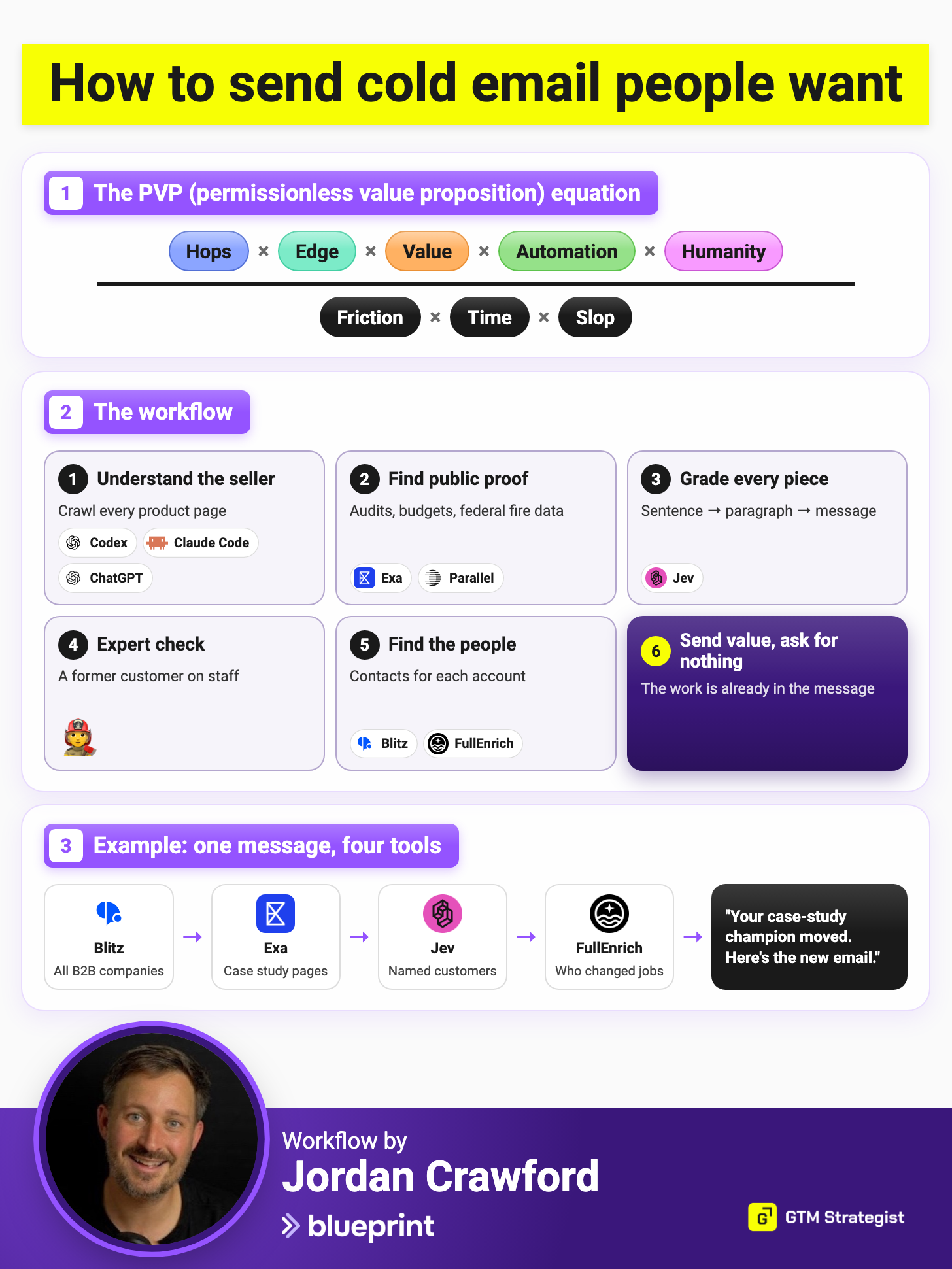
Thanks to Jordan for building in front of us. He also runs an excellent Substack, On the Edge by Blueprint, which is a must-read for any GTM engineer.
Which email in your current sequence would pass Jordan’s value test?
Anze & Maja