
How to Future-Proof Your Career in GTM
5 GTM superpowers that will be mission-critical in 2026
Dear GTM Strategist!
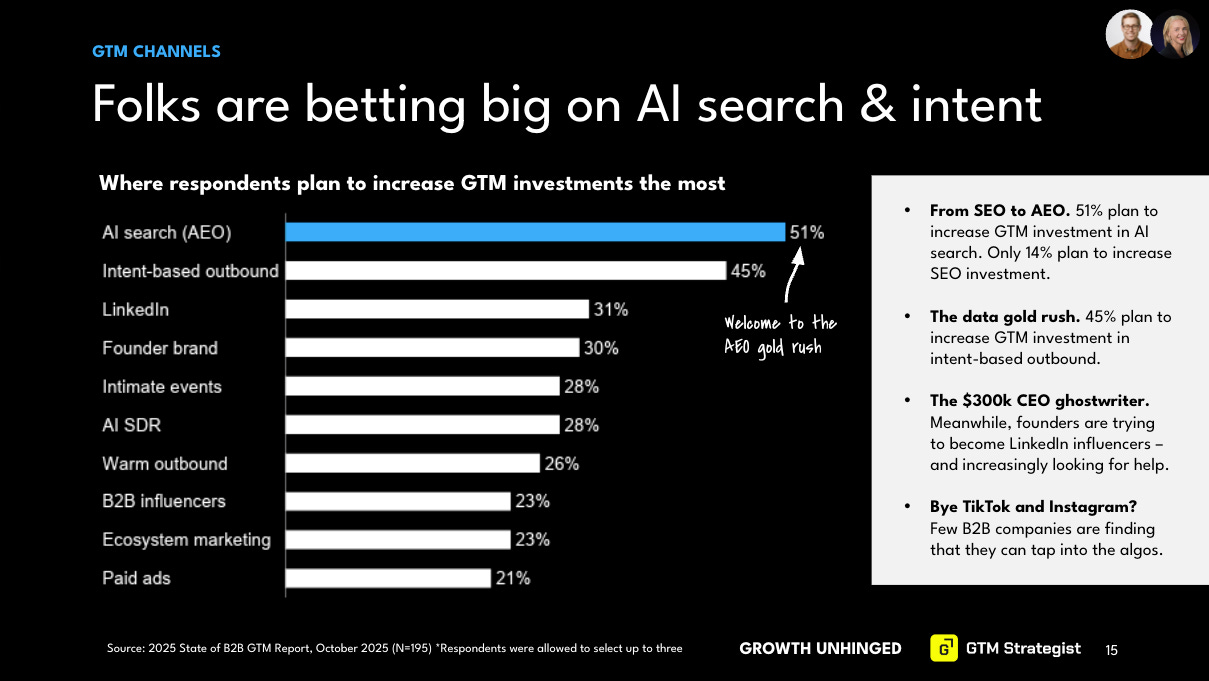
It is the wonderful time of the year when everybody is budgeting, sharpening their 2026 strategic plans, and thinking about what’s next. We have shared our community’s vision of what GTM Motions and channels will be ♨️ in 2026 and beyond - you can read highlights from the report with Kyle Poyar - but long story short …. These are the bets that our communities will be making.
This time, I want to take us more to a micro level - what does it mean for us, for our careers in GTM, for people who are hiring future superstars of GTM, and for young talents who would like to fast-track their careers in the space. In this Substack, I’d like to serve you some ideas and snippets of conversation with the brightest leaders in the GTM space on what our hiring and education investment plans look like for 2026.
We’ll dive into:
Is the idea of a T-shaped marketer turning into AI-powered generalists + highly functional specialists
What am I looking for when I am hiring and accepting new projects - 5 GTM superpowers for the age of AI
If you are thinking about how to build a dream GTM team for 2026 or how to future-proof your career to remain relevant and shine in the days and age of AI-powered GTM - look no further, let’s do this.
This edition of the GTM Strategist is kindly supported by Momentum - the AI Revenue Orchestration Platform that captures unstructured data from every customer interaction, routes insights at speed, and automates execution across your revenue systems.
The Momentum team wants to close this year by celebrating the people who actually move work forward. The builders. The experimenters. The Innovative Doers.
If you know someone in GTM who’s doing impressive work and moves things forward, nominate them for the 2025 GTM AI Awards.
T-shaped experts are harder to find than 🦄: But when you find them, they are the best chance for your company to become a unicorn
Back in 2017, Buffer presented this chart that became the norm of the new wave of “growth marketers and hackers.”
We were all FOMO-ing that we should learn to code, at the time we were a/b testing for the sake of a/b testing; but this idea brought a much needed empowerment to marketing that was back then a very silosed function. And it brought a more scientific, data-driven approach to it, which I loved because my brain does not function well if I cannot establish causation of what and why something is working or not.
Yet, if a company presented a job description listing all these magnificent skills, we would smirk and think of it as a wishlist, or worse, they would get roasted for having unrealistic standards.
But T-shaped marketers exist, they are just extremely rare and hard to find. Usually the safest bets are people who “have done it before”. The other day I got my referral commission from “Bruno from Clay” and it was such a cute deja-vu - of course their VP of Marketing no longer manages their referral program, but last year he did. He joined back when the marketing department was super tiny. Bruno got Clay’s marketing operations up and running, then found people to take over different areas, and the marketing team has now grown to 23-24 people. Each person oversees a specialized area — one handles all events, another manages the 40+ Clay clubs worldwide, and a third oversees LinkedIn influencer content — while the company functions as a near-single-handed marketing engine, having built virtually all core marketing systems: partnership and influencer programs, events and communities, university outreach, big-brand branding, and impressive PR. Sure he had help, but his approach of DIY-ing a channel/tactic and then handing it over to functional specialists is something quite extraordinary - especially since the time he joined the team, Clay achieved 10x year-over-year growth for two consecutive years and is on track to reach $100 million in revenue by the end of 2025 (source).
So what is going on with the idea of T-shaped eight years after in the era of AI transforming the way we work?
I recognized three important trends in my line of work:
AI became a part of Base Knowledge
We no longer “have to code” (very well) - Claude/ChatGPT does the job for us, and the movement of vibe-coding enables faster creation than ever. All the elements in the Marketing Foundation layer became AI-assisted - either with the natural evolution of the tools we use to get the job done or transformed as workflows with AI.
Channel expertise needed to stay competitive got deeper - waaaaay deeper. You have to be hands-on, and it is close to impossible that a single operator will be the best email copywriter as well as advertiser. This layer calls for deep, deep expertise and hands-on knowledge. While you can “somehow validate” the channels, such as Google ads or LinkedIn ads, to see if there is a good opportunity there by watching a YouTube video, because the tool interfaces have gotten easier - as soon as we are talking about serious GTM motions and budgets, you need specialists with highly relatable experience in the place.
So here’s my take - 2026 GTM edition:
I also don’t think there is a single best way to adjust to the new reality that could be offered as a cookie cutter way to future-proof your GTM. I firmly believe that every trend has an anti-trend and in the day and age of AI generated (some would say polluted) content, branding, in-person events, communities, trusted relationships and genuine human interactions (authenticity) become more valuable.
Now, there are not my all-time-favorite things to talk about - I always saw them more as an art than a science and either you are talented to do it or not - but I’ve seen enough evidence around to believe it to be relevant and true.
Evidence:

And this exact line of thinking is my compass for where I am increasing investments and what I think will no longer work or sell that well in 2025.
If you want to sharpen your skills for 2026, check out the book Ignite Your GTM with AI. I think it is one of the best GTM books in 2025. Not only because I am really enjoying reading it at the moment, but because it brings together insights from 28 of the sharpest minds in our industry - including leaders from Stage 2 Capital, Winning by Design, ElevenLabs, Luster.AI, and Owner. Honestly, I’m learning so much from it that I’m already recommending every serious GTM operator to grab a copy.
My 2025 Hiring and Education Budget Plans
The biggest mistake people at the beginning of their career or entrepreneurial journey make when they are planning for the future is to ask themselves:
“What can I do best?” or even “What do I like doing most?”
While they should be asking:
What does the market need most?
What are the underserved niches?
And within these underserved niches - Where am I best skilled/positioned to win?
Easier said than done, I know, but please do not skip this part.
DYOR - do your own research,
I ain’t an astrologer 🔮.
What I can do to help you make the right calls is to share my line of thinking and what companies in my ecosystem are thinking and doing.
Based on everything that I have seen and heard so far, I will invest in five fields:
GTM engineering, or however you wanna call it
Brand, design and positioning
“Builders” - convince someone from the product team to work in growth/marketing/sales (junior friendly)
Strong Key Relationships Management
End-to-End Operators who get s*** done really fast to validate new things and run campaigns
Now, let’s dive into each and every one of those desired skills and profiles, shall we?
1) GTM engineering, allbound, signal-based outbound, AI GTM ….
However you wanna call it, friends, the truth is that we need to be able to not only capture our prospects at earlier stages of their buyer journey than ever, we need to predict their behavior. And now we have the tools that make this possible.
Unfortunately these tools made it so accessible that “everybody can do it - even your competitors” - so we need to be able to extract unique insights and signals to have a fair chance to catch them first.
I am trying to be as vendor agnostic as possible in my communications because we are IRL implementing different technologies to different clients - depending on their sales maturity, compliance requirements and budgets. But outbound as we knew 2-3 years ago no longer works (and we’ll dive into why that is and what’s next next week :)) - we need a new skill set.
The market is literally creating new GTM job families in real time. GTM engineering roles are up 205% year-over-year, with LinkedIn now showing hundreds of GTM Engineer job postings in the U.S. alone, up from fewer than ten per month in 2024.
When you dive into these job postings, they are looking for experts to “leverage intent signals”, “optimize and automate BDR outreach workflows using AI and data signals”, “design signal-based campaigns”, and so on.
How to acquire these new skills? The best GTM engineering that I have seen in practice is deeply connected with industry insights and in-depth understanding of who are decision makers, what is important/adds value to them, and how to craft messaging that resonates deeply with them. While I’d been prone to think that senior experts who really understand business will excel the most in these roles - and some of the best ones have 15-20 years of relevant industry experience beyond their GTM Engineer title - I’ve also seen that many of us are lazy or afraid to learn this craft ourselves. And that is OK if that is not core expertise that you want to develop - but I need to invite you to stay in the loop.
While young tech-savvy experts can tweak state-of-the-art GTM machineries, they often have a blind spot on how enterprise works because, in all fairness, they do not have hands-on experience with them. I firmly believe that this should be an in-house role because of data governance, domain knowledge and because for many companies this will become a critical know-how, but if that does not makes sense economically or while we are still transitioning there and need more validation, it is perfectly OK to outsource some campaign or get a consultant who will guide you through the setup process, help you launch the first campaigns and hire and systemize it as a function for when it works. I think many of us recognized that in the last year and added it to our education budget.
2) Brand, design and positioning
My first hire at the GTM Strategist venture was a designer and I think this decision played a massive role in how well we did. Historically, I had great difficulties communicating with design experts because we just speak a different language. But when you find someone who gets you, is patient enough to try to understand you, and helps you create a design process that works for you - that very special someone is a keeper and, in my eyes, one of the key team members.
These days, “everyone can be a designer” - Canva DIY, Nano Banana, Pencil … design has become more accessible than ever. But you and I know “what great looks like” when we see it - don’t we? While AI-assisted and templatized design systems are wonderful for fast creation of “fast consummation” content and I would probably raise a riot if someone charged me $800 for a “filler LinkedIn post - image that is meant to die in <7days”, when it comes to designing memorable branded experiences - visual, verbal and experiential - great design makes such a difference and brings so much joy to our lives.

What surprised me was that the best branding experts I worked with did not have a business background. They came from fashion, music, arts, architecture … you name it. Great and truly distinctive branding is often more a synthesis of inspiration from different walks of life than anything else. It grows, it evolves, it responds to zeitgeist, and someone should love it like it were their own baby.
OK, OK - losing my technical audience here. What I am saying is that in the days of AI-generated everything, “great design” became so rare that it does help us to get more attention, create memorable experiences from our ICPs and positions us uniquely in the hearts and minds of our prospects.
I said the magic word here: positioning. ✨ Now more important than ever - in the flood of “Me too AIs”, companies jumping at the same buzzwords, hype trains and conformity when it is dangerous to disagree - we as customers are drowning in the sea of sameness. And it is getting incredibly boring and disheartening to consume the same message from five companies that made it to your comparison sheet. This is why we need unique stories, points of view, discoveries, learnings, or simply some bolder branding (company or individual) to stand the f*** out as Louis Grenier would say. And that is not too difficult in B2B, where vanilla brand marketing is the name of the game for most of our competitors.
3) Builders
Some of the best people that I’ve worked with in marketing, growth and sales in my entire career came from product. So if you have someone in the product who seems slightly entrepreneurial, marketing, growth or sales curious - invite them in!!!
Many people don’t like when I say that someone with technical background who learns 10-20% of what they need to know about marketing and sales will very likely do a much better job in growing our tech products than a generic marketer who has to learn 80-90% of domain knowledge to be competent in speaking the language of the technical ICP.
This is why I am extremely welcoming to anyone from product who would like a seat at our growth meetings and I actively want to recruit people with tech skills.
They are wired differently.
No way am I saying that you should try to convert your best engineer to a semi-average opinion leader on LinkedIn if they resist the channel full force - but they might build you the best AI-content generation tool for your business with Cursor that money cannot buy, or tweak a state-of-the-art n8n workflow because every cell in their body resists repetitive tasks.
It is not even critical that these people have a technical background, as long as they are makers at heart and find joy experimenting with new tools, tactics, channels, and ideas. I’ve seen both experienced and junior people excel at such roles. Personal traits and “let’s do it and see if it works” mindset is more critical here.
Usually, those rockstars are bold critical thinkers, challengers of the status quo, strong executors, and sometimes even troublemakers who push our companies further. And they enjoy exploring so much - routine kills them. They need to tackle unstructured challenges. It’s in their nature.
This is definitely going to be the next hire in our team. Anze and I were thinking if we should recruit a junior marketing assistant in Q1, but when we listed down the tasks of things we need help with:
Quick landing pages
Automation to reduce admin work
n8n workflows
Agentic AI experimentation
Automated reporting and analytics for clients
Generating insights from traction data and updating experimentation plans…
…it became obvious that if we are taking a risk if we call it a marketing role :)
Maybe we could call it Gen Marketer, as the wonderful author of the MKT1 Substack Emily Kramer suggested, but I am literally afraid to call it anything marketing-related because it might scare away some devs that do not identify as marketing/sales people.
4) Strong Key Relationship Management
Did relationships become a new luxury?
I hope not because I’m very old school. I love working closely with my clients, partners, team members and other stakeholders. I would not exactly call them my second family, but we are close and I care for them deeply. And honestly, as a client, I am willing to pay SO MUCH more if someone treats me the way I like it (or think I deserve :) ). For example, we are sharpening our 2026 strategy in Bali in December and sure, we could borrow a scooter to drive around the island for $5 a day, but we are willing to pay 10x as much is we have a driver who actually tells us a thing or two about the culture, give us good restaurant tips or even makes a joke or two so we the drive is more enjoyable.
When I was talking to my senior PM friends about what is the last thing that will remain human if AI took away all the other tasks, my bet was stakeholder management - “coz no AI is smart or stupid enough to manage us” :)
To say this with a bit more class:
“They may forget what you said - but they will never forget how you made them feel.“ (Maya Angelou)
And I want to have amazing relationships with all my clients, team members, partners, and other stakeholders because it makes a massive difference in the quality of work we produce, trust we establish, our joint ability to overcome challenges, and it feels so much better for me as a person as merely having transactional relationships with people. As long as humans will transact with humans, relationships will be a thing.
I believe that every relationship should be invested in and managed, and I also believe that honesty is the best policy, but we should pay attention to each other’s emotions, cultural differences and specific life situations. I hate to think that we live in times when “Being a decent human being is a differentiator in business” - but I see things IRL that make me believe it is true.
To get this on a more applicable level, I personally manage all the key relationships in our business and that would be the very last thing I’d outsource. I ask myself everyday:
“Is there something I can do for [my awesome partner]?” and I always keep their best interest at heart and mind.
This does not mean that I am spamming our Slack channels with random thoughts just to “show up” - every interaction point has to bring value. I like to open new opportunities, connect people that have potential synergies and make sure that we have a perfect transparency in our relationships by proactively serving reports, applicable examples, insights, and ideas for how we can do better.
This also means that we feel psychologically safe to have different perspectives and difficult conversations because “everything is awesome” all the time applies only to Lego world.
And I am scaling without compromising the norms I have for my key relationships and ensuring that everyone I work with follows similar standards. Yes, I can make it as SOP or a checklist, but I genuinely believe you should thank your parents for raising you well if this resonated with you.
If not - the next one will 🤠
5) End-to-End Operators who get s*** done really fast to validate new things and run campaigns
Going back to the point that the channel expertise got deeper than ever, if I am searching for someone to work on a health-tech outbound campaign in the US for an SLG company, there is almost no chance I’d settle with people without:
Relevant industry and regional expertise (I want replicable, verifiable success)
Solid understanding of how enterprise sales are done
In a single outbound campaign, they can screenshare because “everything is under NDAs.”
I would not feel confident that someone would be “learning GTM engineering” on such a campaign or replicating their cold email efforts for a $50/SaaS mass blast.
The same goes for advertising campaigns, events, sales pages and email marketing. If I can bypass the learning curve by working with someone who actually knows what they are doing, I’d opt for that whenever the budget allows me to do this.
If not, sure, we can DIY, there are very competent people out there (especially builders) who can make it work for validation, but when the stakes are high, the budgets are there. Time is more valuable than money. I want to buy replicable success because it is too mission-critical not to.
Deeper channel expertise calls for niche specialisation, especially with tactical mid-career talent. If you are THE best in RevsOps for B2B HR SaaS, excuse me, but I will find it very unlikely to believe that you are THE best at Meta advertising for ecommerce brands too - especially if your last successful campaign there is more than a year old. You have to “live your craft” and whenever the stakes are high, we as clients and decision makers think like:
“Who is the best person to take me where I want to be in a reasonable time and budget?”
“How likely it is - based on their background, traction and attitude to work that it will happen?”
The more you’ve done in the space, the more likely we feel secure about placing our trust and investment in you. Experience and specialization have compound interest.
If you are not sure what you should specialize in, instead of saying “Play on your strength and do something that the market needs” - here is another helpful chart from the report we did with Kyle Poyar that applies to GTM B2B SaaS and my company. Pay close attention to what the winning GTM motions are for specific price ranges and business models. This is where demand is going to be the biggest, but anything goes if you are great at something and decision-makers believe it will deliver a good ROI.
This might sound mean and discouraging to younger talents, but it so so not. You have a great fair fighting chance with new technologies and tools, emerging channels and whenever you can give so much value to teams with your different mindsets and opinions. Vibecode, create pet projects, learn new stuff and tools, find good mentors as your employees, work in startups, and create success cases that will make you super-stars - share them at events and on social media. The opportunities are vast.
Hope you loved this one!
If you did - hit me a <3 and/or a comment so I’ll know that this topic is interesting to you and you want more of such insights. As I am preparing my content strategy for 2026 - this is more important for me to know than ever :)
Have an amazing start of December & finish 2025 strong!
Maja
P.S.: I would like to thank you for an amazing response to my latest course - AI-Powered LinkedIn Growth System that I launched last week. It teaches the exact system I use to generate 7M+ impressions a year and 70% of my B2B pipeline. Early buyers are already seeing results - Blas said it helped him clarify positioning and upgrade his LinkedIn strategy halfway through the course. If you want to up your LinkedIn game in 2026, this is the course for you.


