
Inside a $100M+ ARR GTM Ecosystem
How AI-native companies scale beyond campaigns, channels, and headcount
Dear GTM Strategist!
I hope you had a lovely holiday break, crafted clever plans for 2026, and cannot wait to execute on them.
Before you roll up your sleeves and work hard on making them happen - let me ask you a question that might change everything:
“Did you bake in enough leverage for your GTM?”
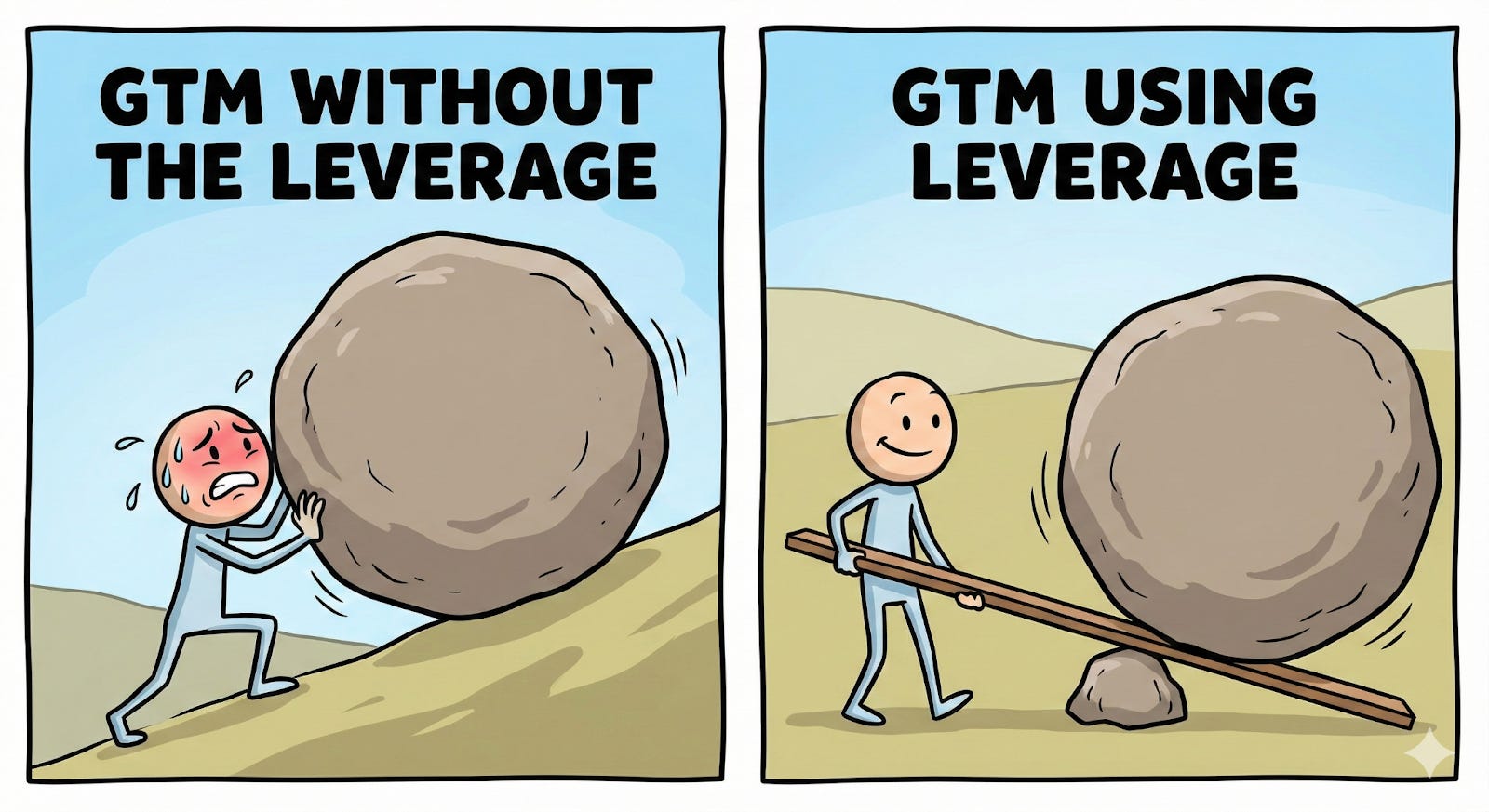
While makers of great products are working hard to produce more social media posts, send out more emails and pour more budget into ads, GTM strategists who understand one simple but incredibly powerful principle - “go where your ICP already is” - consistently achieve much better results.
As products are getting easier than ever to build (and copy), speed to market and exclusive access to high-quality distribution channels (paid, owned, or earned) have become the new gold.
But it does not stop there. Creating distribution leverage across marketing and sales explains only a small fraction of growth equations of some of the fast-growing companies in 2025, such as Lovable ($200M ARR in 8 months), Clay ($100M revenue ARR and $3.2B valuation), and Cursor (from $300M to $500M ARR in 2 months).
Not only did they build sticky products with great UX that supported habit creation and instant wow factors and clear ROI for their users. They have also built strong GTM ecosystems that add leverage across the customer journey, unlock new value propositions, open new revenue streams - and ultimately create new jobs and business opportunities.
When Kyle Poyar and I did the State of B2B GTM survey report, ecosystem marketing emerged as one of the next big things. I first heard about ecosystem marketing from Emily Kramer, and I cannot forget it since.

But after analysing the mega success of AI-native fast growers, one thing became crystal clear: we should not treat it as a “marketing tactic”. The principle of the ecosystem is deeply embedded in the business model design of these organizations and covers all stages of the customer journey.
GTM ecosystems are a function of business model design - and when done right, they become an almost unbeatable strategic moat for the company.
So how do best-in-class companies build their GTM ecosystem and, more importantly, how can you start building yours?
In this post, we’ll dive into:
Definition of the GTM ecosystem, its stakeholders, and modes of value creation
I have developed a GTM Ecosystem model that will help you build yours
We’ll analyze a hands-on example of the GTM ecosystem by Clay to map the relationships between different components of the ecosystem
Let’s start mapping 🗺️
GTM Ecosystems: Growth by Design
A GTM ecosystem is a repeatable go-to-market system where multiple independent actors are economically and operationally aligned to collectively create, distribute, and capture value across the customer journey; in ways a company could not replicate alone.
It is not a channel.
It is not a campaign.
It is not a list of partners.
It is a growth system closely connected with value multiplication and creation of new business models that can impact organizational design.
Tactically, we can envision it as a map system where independent actors (products, partners, creators, platforms, communities) are economically and operationally aligned to co-create demand, accelerate adoption, and expand revenue.
Here are 4 characteristics of a GTM ecosystem:
Growth driven by external actors, not internal headcount
Distribution embedded into product usage
Monetisation expands beyond the core product
Ecosystems function as a strategic moat, not marketing tactics
I visualised it as a radial map, with the product at the centre of value creation and rings representing different stages of the customer journey.
The Product Core = core of value creation
Activation Ring = usage & stickiness
Distribution Ring = demand generation and capture
Expansion Ring = monetisation & expansion
Growth Loops = compounding motion between the rings
Within these rings are ecosystem actors (platforms, partners, communities, programs, and technologies) that leverage the value creation of the ecosystem and expand TAM (total available market) beyond the product core.
If your GTM only grows when your team works harder, ships more campaigns, adds more channels, or increases spend, it’s not a GTM ecosystem. It’s a treadmill with diminishing returns.
GTM ecosystems flip the equation: growth stops being something you push and starts being something the system pulls by multiple stakeholders in the ecosystem.
The table below shows the difference between a GTM that scales by more of your input and a GTM ecosystem that scales by design when value is created for the customers and incentives are aligned.
Let’s make this discussion more practical now.
AI native companies are giving us a masterclass on how to scale beyond all traditional GTM motions using a powerful GTM ecosystem approach. What can we learn from them?
How Clay scales beyond traditional GTM motions
The fastest-scaling AI-native companies are not winning because they merely executed GTM better. They win because they design GTM ecosystems that compound leverage.
To illustrate the usefulness of the GTM Ecosystem model, I will analyze Clay’s ecosystem. Clay builds “a new economy” in the outer ring with Claygencies and GTM engineering. The goal of the analysis is to spark some ideas on how your product can start forming a GTM ecosystem or how your company can integrate into existing GTM ecosystems that are relevant for your target market and create new opportunities or revenue streams.
THE PRODUCT CORE
Aha Moment: “I can orchestrate my entire GTM motion from a table.”
Value Metric: GTM workflows automated per team/accounts activated.
ACTIVATION RING: WORKFLOW & USAGE
Strategic role: Clay becomes the control plane for GTM execution.
Integrations (Tools): 150 integrations with data providers, CRMs, dev tools automation tools, marketing, social media and outreach tools that enhance product experience beyond core capabilities enabling new opportunities and revenue streams for partners
Templates & Components: Pre-built Clay tables for prospecting, scoring, enrichment, and outbound are available in their Clay University section + integration partners share their playbooks
AI Agents: Claygent is Clay’s AI research agent that automatically gathers and structures rich business and people data for GTM and TAM sourcing. In Q4 2025, Clay launched its natural-language AI co-pilot Sculptor that helps GTM teams build workflows, analyze data, and tailor campaign logic to their unique strategy - enabling faster, insight-driven go-to-market execution without manual work.
Community Assets: Shared tables, playbooks, and GTM recipes from operators - one program that I’d really like to highlight are Clay cohorts - they are FREE and available to everyone to join - you don’t need a paid account.
DISTRIBUTION RING: DEMAND SOURCES
Strategic role: Operators teach operators - Clay rides trusted peer distribution.
Creators (Demos): Clay works with multiple influencers and content creators with the aim of producing highly valuable content that inspires product adoption and usage. What is interesting is that a lot of solution partners (Claygencies) and system integrators fiercely share their workflows too, becoming product ambassadors themselves, turning them into “ecosystem superstars”. In addition to content creation, Clay organizes online and physical events.

Employee Generated Content (UGC): Several Clay employees have developed very reputable personal brands on social media and newsletters. My fauvorite is Alex Lindahl, who shares his GTM engineering playbooks on LinkedIn and his newsletter Claymation.
Communities (Social / Dev): In addition to their 30K community, Clay organizes events, and supports multiple RevOps, GTM engineering, and growth operator external communities.
Platforms (Discovery): Recently, Clay had a big announcement that they launched an app in ChatGPT’s app store. Many think that this is the next big platform.
Peer-to-Peer Sharing: Teams sharing Clay tables internally and across portfolio companies as a natural usage growth loop.
EXPANSION RING: MONETISATION & NEW REVENUE
Strategic role: Clay owns the platform. Solution partners can help to handle the implementation.
Agencies & Freelancers: Clay Solution Partners implement GTM systems for clients - you can apply here if you are interested in partnering up with them
Educators (Courses): Paid GTM engineering courses built on Clay
Partner Services: Data providers and SaaS tools monetised through Clay credit usage (accessible directly in Clay, without the user needing to connect their tools)
Affiliate and referral: closed ATM - details here. A sweet “problem” to have :) “The Clay Creators Program is currently under construction. Our goal is to expand capacity to meet the needs of this program, which has nearly doubled in 2025. We will re-open for applications in Q1, 2026.”
Wow - that was a lot to comprehend.
Like Rome, Clay’s GTM ecosystem was not built in a day either :) and my best advice to you is literally - start with where the customer journey is broken ATM.
If you struggle to get people into the product, prioritize the distribution ring.
If you feel that “other people, aka service providers” could fuel your growth, explore the agency programs in the monetization ring.
How about if we flip the script and ask ourselves not only “How do we acquire more customers?”
but: “How do we design a system where others grow because we exist?”
(or piggyback on an existing one that already has the attention and trust of your ICP if you are just starting out)
Most of us are knee deep into optimizing campaigns, fighting the law of diminishing returns in traditional GTM motions and under constant FOMO what is the new “hot channel” out there. But once we envision our businesses as an ecosystem, it opens new intellectual capacities for how to build more leverage for our GTM endeavors.
Thanks for reading. If you like what I do, you can get many more useful GTM assets in the solutions I’ve created:
✅ Need ready-to-use GTM assets and AI prompts? Get the 100-Step GTM Checklist with proven website templates, sales decks, landing pages, outbound sequences, LinkedIn post frameworks, email sequences, and 20+ workshops you can immediately run with your team.
📘 New to GTM? Learn fundamentals. Get my best-selling GTM Strategist book that helped 9,500+ companies to go to market with confidence - frameworks and online course included.
📈 My latest course: AI-Powered LinkedIn Growth System teaches the exact system I use to generate 7M+ impressions a year and 70% of my B2B pipeline.
🏅 Are you in charge of GTM and responsible for leading others? Grab the GTM Masterclass (6 hours of training, end-to-end GTM explained on examples, guided workshops) to get your team up and running in no time.
🤝 Want to work together? ⏩ Check out the options and let me know how we can join forces.


