


👋 Welcome to another weekly edition of the GTM Strategist newsletter - stay until the end for the latest GTM news and new job posts!
Presenting partner: Viktor
Viktor is an AI employee that lives in Slack or Teams. Its Skills Marketplace has ready-made skills with specialized workflows like revops, running ads, and AEO. Viktor’s team used these playbooks to grow to $50M in annualized revenue in 8 months. Try Viktor free with $100 in credits.

GTM partners:

Ahrefs Brand Radar - Make AI recommend your brand.
Clay - Build systems to grow revenue.
FullEnrich - 80+% find rate for emails and phone numbers.
HubSpot for Startups - The GTM engine that grows with you. See if you qualify for 90% off.
Miro - The collaborative workspace where GTM teams and agents converge to build together.
Ploy - The marketing platform that turns your website into a growth engine.
Primer - Target your ICP across LinkedIn, Meta, Google, Reddit, and more.
Dear GTM Strategist,
Guillermo Rauch, the CEO of Vercel, says more software will be developed next year than in all of history combined. It took Vercel 10 years to reach its first billion deployments. Then only 10 months to add another 1.4 billion.
Building is no longer the hard part. Getting people to care is.
In 2025, I’d stop scrolling for every AI launch.
A new agent? I’d sign up.
A new AI tool? I tested it the same evening.
A new demo video? Bookmarked and shared on Slack.
Now I see five of those during my morning scroll, and a good chunk of last year’s sign-ups never delivered what the launch video promised.
Only 19% of consumers say they feel excited about AI in 2026 - down from 50% two years ago. Buyers are fatigued.
It’s harder than ever to build momentum for your product.
Yet this season, a handful of AI launches took social media by storm: Instinct, Jev, Clay’s “Summer of Launches”, Grok Bot, and Meta’s Muse.
What you’ll learn in this post:
A great product is the entry ticket. Distribution amplifies whatever you launch, good or bad.
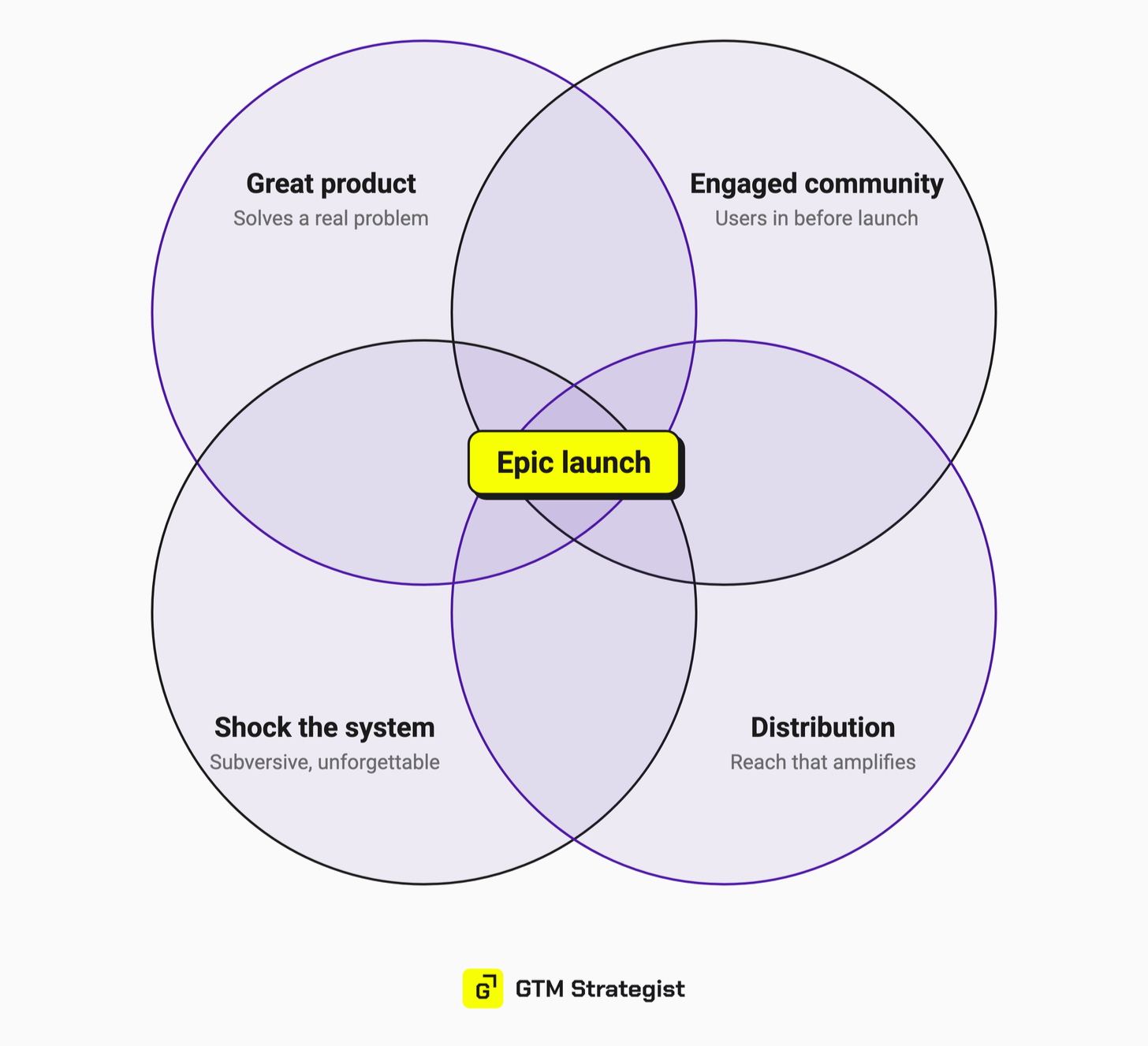
Epic launches sit where four things overlap: a great product, an engaged community, distribution and a way to shock the system.
Private beta is the new launch event. Instinct reached a $10 billion valuation without launching publicly.
Your amplifiers need to be ready on day one. Jev hit 13% of Vercel’s paid AI Gateway teams in 24 hours.
Plan a launch season. Start building the base about six months out.
The old launch playbook vs. the new one
The old way to launch was “simple”: build for a year or two, pick a date, and bring up your launch marketing big guns: huge event, advertising budgets, paid creators on socials, and an artsy launch video - better yet, a Times Square billboard.
Things have changed. Now pre-launch momentum is where you make it or break it; launch is carried on genuine customer love. And you need to shock the system - do something radically different.
Great product still comes first
I smirk every time somebody says, “Distribution is the only moat left.”
If that were true, OpenAI’s Dots would have been the launch of the year.
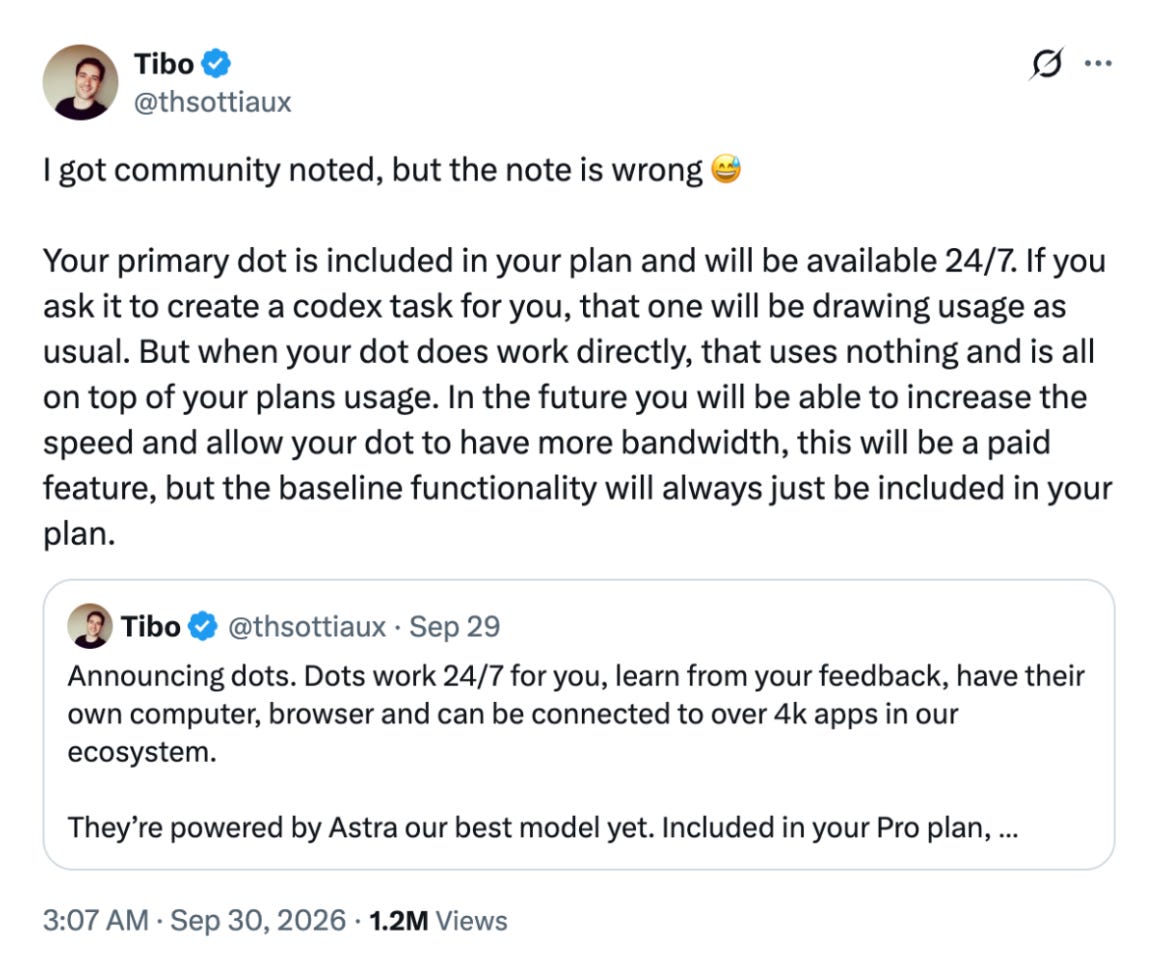
OpenAI introduced Dots, always-on AI agents that keep working on your goals after you log off, at DevDay on Sept. 29. Few companies have a bigger stage or a bigger audience.
The reception was mixed. The Hacker News launch thread passed 640 comments, and many developers couldn’t work out what Dots was for. The launch post from OpenAI’s Tibo Sottiaux picked up a Community Note about usage limits, which he disputed the next day. And users in Europe couldn’t get Dots at all.
Great products are the key ingredient in impactful launches, no matter how much buzz you create. If the product is trash, you will just amplify negative word of mouth and damage the brand.
Now that we agree on that, let’s discuss how to take over social media by storm.
3 launches that built the base before launch day
1. Instinct: The invite everyone wanted
Instinct, a personal AI agent you text or call like a human assistant, has no launch day. And the reason was not a genius marketing plan.
Running a personal agent for every user burns a lot of compute. So the team rationed access to save on compute: a private beta from February, then an invite-only beta where every user got five invites to pass on. Its 23-year-old founder, Noah Shinn, only introduced himself publicly in August.
What started as a cost decision became the growth engine. Instinct has spent $0 on marketing while the product grew roughly 10% a day. Invites got so scarce that people resold them on eBay, and newsletters started giving them away to paid subscribers. Within seven months, Instinct had a reported 100,000+ users and a $10 billion valuation. Still in early access.
The lesson is not “add a waitlist.” Instinct had three things working together:
A real constraint: limited compute, so access had to be limited.
A product that delivers: people who got in wanted to tell others.
A built-in way to share: five invites per person is a growth loop.
Scarcity on top of a mediocre product is just friction.
2. Jev: Two years in stealth, one launch day that looked effortless
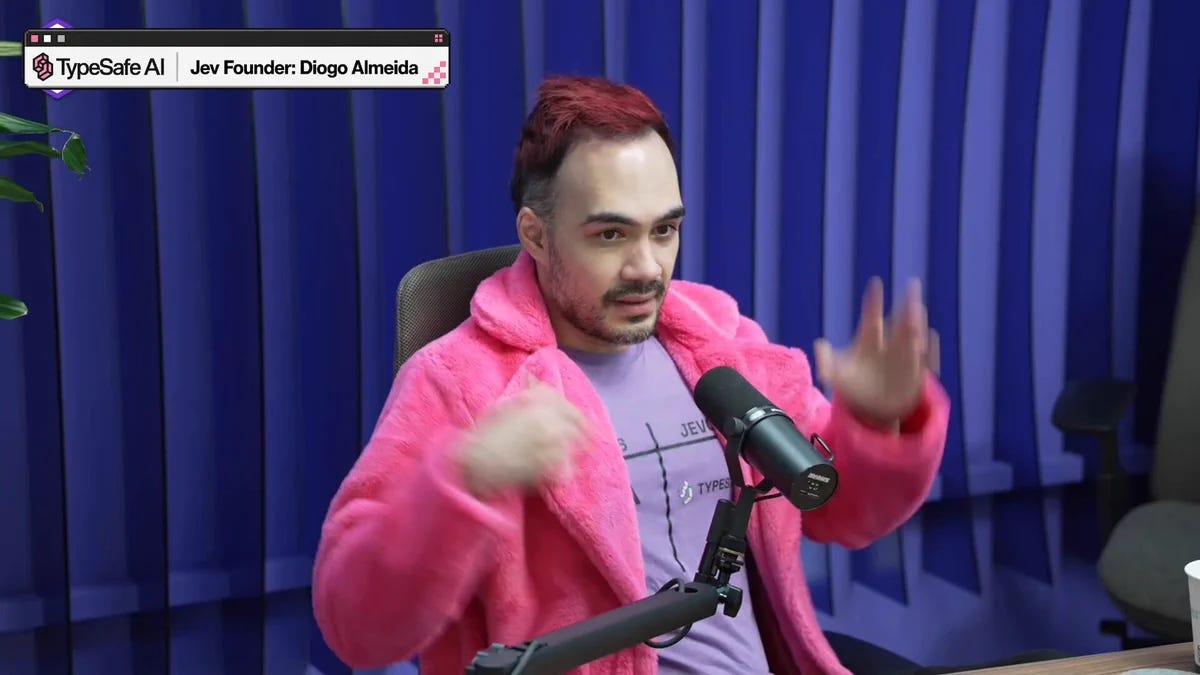
Every team building with LLMs knows that models are slow and expensive. Jev, from TypeSafe AI, returns typed decisions instead of text, which makes it fast and cheap for routing and guardrails inside software. Its founder, Diogo Almeida, helped build ChatGPT.
Jev’s launch stacked everything on one day: opening the developer waitlist, announcing a $40 million seed round, a demo of Jev playing Doom, and a Hacker News thread where Diogo answered questions himself.
Then the real move: Jev borrowed distribution. A day later, it was live and free on Vercel’s AI Gateway, where its beachhead (developers already paying for AI infrastructure) works every day. Within 24 hours, it ran on 13% of paid teams, the gateway’s fastest adoption ever.
Jev passed 1 million users within days, including teams at one-third of Fortune 500 companies. Weeks later, TypeSafe raised an $870 million Series A.
3. Clay: Turn your community into the launch stage
Clay spent years building its GTM ecosystem: a community, Claygencies and 50,000+ trained people. For Sculpt, its annual conference, Clay used that ecosystem to turn one launch into many.
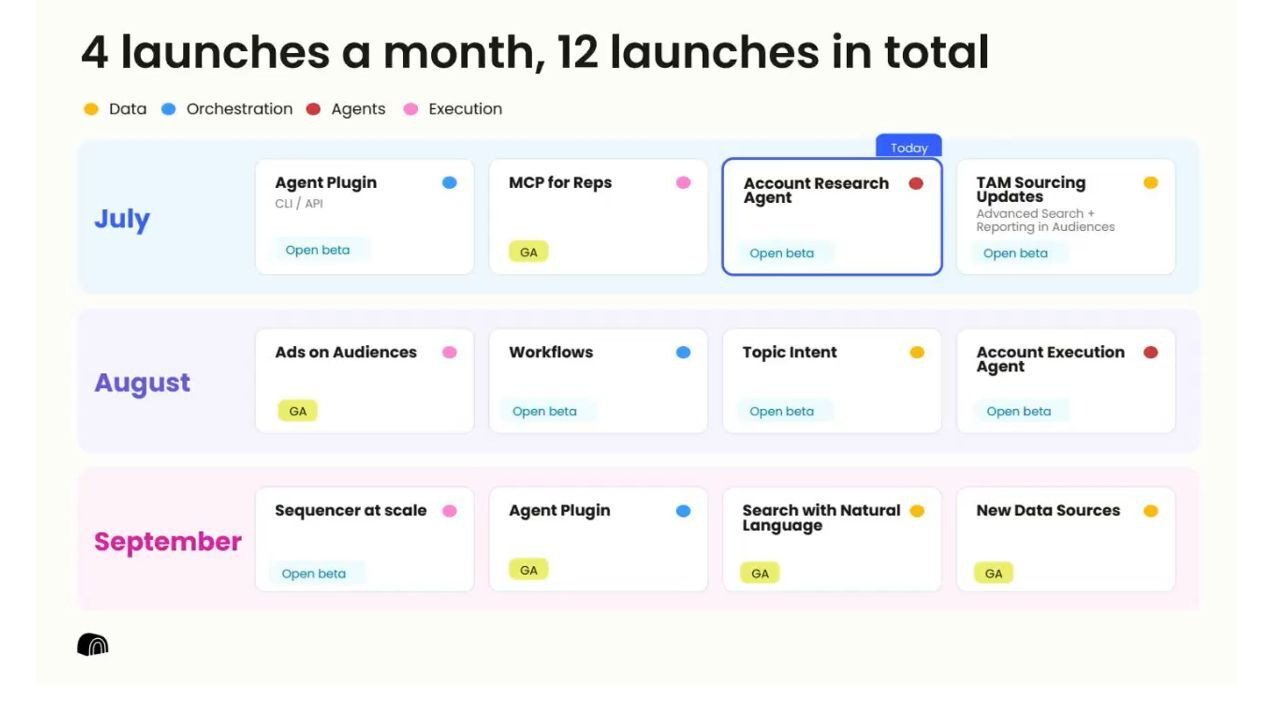
From early July, Clay shipped a major release every week, including Workflows and Sequencer 2.0, and doubled down on video. They called it the “Summer of Launches.” Every mini launch gave creators, partners and users something new to try and post about. By the time 2,000 attendees arrived in San Francisco on Oct. 8, they were already hyped.
A partner day before the event briefed agencies to amplify. Then Clay saved the biggest reveals for the stage:
Agent-first way to build: an agent that plans and runs GTM plays. Available to Sculpt attendees on paid plans first, with early access rolling out after.
Inbound SDR Agent: Clay’s first agentic seller, which qualifies inbound leads and demos the product. Previewed on stage, with a waitlist for pre-beta partners.
Build anticipation in waves, but keep something worth showing up for. Every mini launch feeds the next one.
By now, you have a couple of really clever ideas for FOMO tactics to bake into your next launch plan. Let’s move one layer up into strategy.
The four components of an epic launch
Every successful launch that broke through recently had at least three of these four elements in place before launch day:
1. Great product that solves a real problem. Grok Bot spread across xAI’s own teams, who built bots for sales outbound and bug fixes, before anyone outside saw it. The team also personally onboarded almost 300 external users and observed their “wow” moments. (I was also in this private alpha program, and it was amazing to see how fast the product improved, and how curious the team was about my best practices.)
2. Engaged community: users are your best ambassadors. At Momentum.io, an AI platform that turns sales calls into CRM data, two customers talked about the product on two well-known podcasts in the same week without being asked. It became Momentum’s best pipeline week ever. Jonathan Kvarfordt, who led marketing there, turned it into a rule: notice what works that you had nothing to do with, “and weaponize it.”
3. Distribution: reach that amplifies. Rule number one: go where the audience is. Successful distribution has two critical components:
UGC social proof. Users who used the product and shared it. It’s the most powerful fuel for viral loops. The fastest way to get attention is to launch to people who already know and trust you, like your users, your newsletter subscribers, or your partners’ audiences. Meta launched Muse to an audience it already owned: over 95% of Muse users already use Facebook.
Amplifiers. Once you have organic social proof (case studies, shares, UGC videos), get (or buy) more of it. Use influencers, key opinion leaders, paid ads, PR, or additional channels to amplify it. That is a secret ingredient of Wispr Flow’s advertising strategy that recently went viral.

4. Shock the system: subversive and unforgettable. In a crowded market, safe is invisible. When Datarails, an FP&A software company, shipped a Google Sheets integration (targeting CFOs), it announced it with a telenovela in which Excel catches the company’s panda mascot in bed with Google Sheets.
Launch day is the tip of the iceberg: the announcement post and the funding headline. What makes it float is the 90% underneath: beta users, design partners, a waitlist, creators who used the product for weeks.
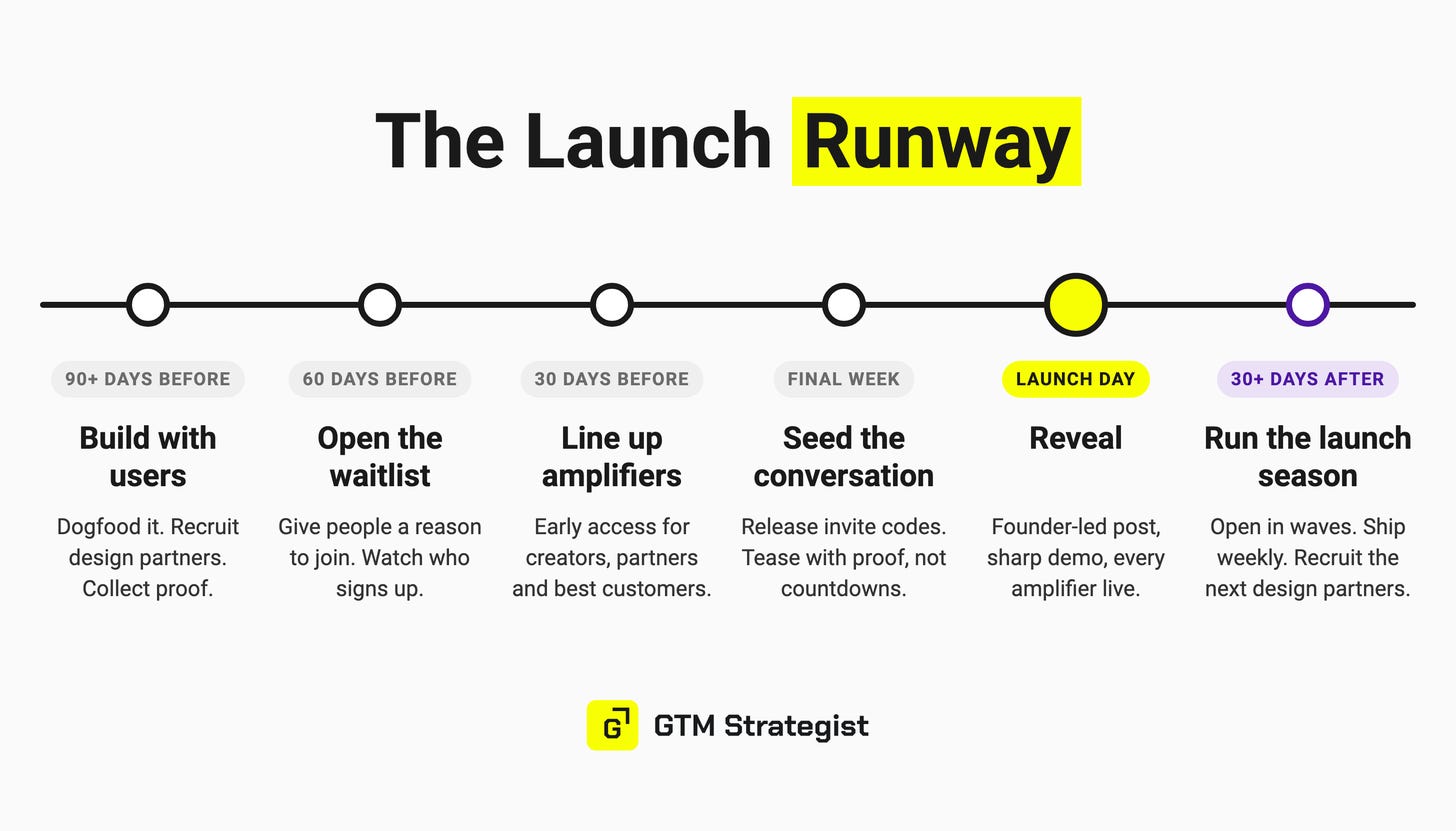
The launch runway
So, to make the most out of your launch, swap the launch day plan for a runway:
Build with users (6 to 3 months before). Use the product internally, recruit design partners from your beachhead segment, collect proof and start charging once it solves a problem. It’s also OK to go wide within one vertical, then narrow down to the users who keep coming back.
Open the waitlist (about 60 days before). Give people a reason to join beyond “be first,” and check how many sign-ups match your ICP.
Line up your amplifiers (about 30 days before). Give creators, partners and your best customers access early enough to form an opinion. Plan the one idea that shocks the system.
Seed and reveal (final week + launch day). Release invite codes, then make a founder-led announcement with every amplifier posting the same day.
Run the launch season (60+ days after). Open access in waves, ship visibly every week and recruit design partners for your next launch.
Before you set a date, ask yourself:
Do customers in your ICP already get real results?
Could you name 10 people who will post on day one because they used it?
Does every user have a built-in way to bring someone in?
Is there a plan for weeks 2 through 4?
If you’re planning a launch for Q1, my GTM Checklist walks you through every step, from beachhead segment to launch. It’s included in the annual subscription to my Substack - and it’s the best way to support my work.
Go build your iceberg!
Maja

My hand-picked selection of the latest news, data you shouldn’t miss, and job posts.
Salesforce agreed to acquire Braze in a $5.66B deal. Braze turns live customer behavior into personalized messages in real time, and Salesforce plans to plug it into Marketing Cloud and Data 360. Salesforce is on a buying spree this year, and the rumor mill already has Klaviyo as the next martech company to get snapped up.
HubSpot made AI credits easier to budget: spend caps are now on by default, at up to 50% above your monthly credits, and seats can turn into credits mid-contract. With a predictable bill, expect agents to show up in more real-world workflows.
Different came out of stealth with a $48M seed led by General Catalyst. ThoughtSpot co-founder Ajeet Singh built a system that plans and launches ads, emails, landing pages, and AEO work, and a marketer approves everything before it goes live. VCs now fund the “marketing-team-as-software,” but picking the ICP and the positioning is still a human call.
GTM roles worth a look
Director, Product Marketing at Rillet, San Francisco, hybrid, $230K to $260K plus equity. Rillet is an ERP company valued at $1B, with more than 600 companies running on it.
Integrated Marketing Lead at Sierra, San Francisco, in person, $220K to $240K plus equity. You run campaigns for the AI agent company Bret Taylor and Clay Bavor co-founded.
GTM Team Lead - Iberia at Legora, Madrid. The legal AI company has passed $200M in ARR, with 2,100+ customers across 80+ countries.
GTM Enablement - Sales Execution & North America Lead at ElevenLabs, remote. ElevenLabs was last valued at $22B.
Lead Product Marketing Manager - Verticals at Ramp, New York, hybrid, $190K to $260K plus equity. You build the story for construction companies, nonprofits, and public-sector teams.
Before trusting the list of 10 people who will post on day one, check who follows them. Ten developers posting about an FP&A tool can bring lots of likes and no CFOs. Put those 10 names next to the ICP you checked at the waitlist step, and count how many reach people who buy.